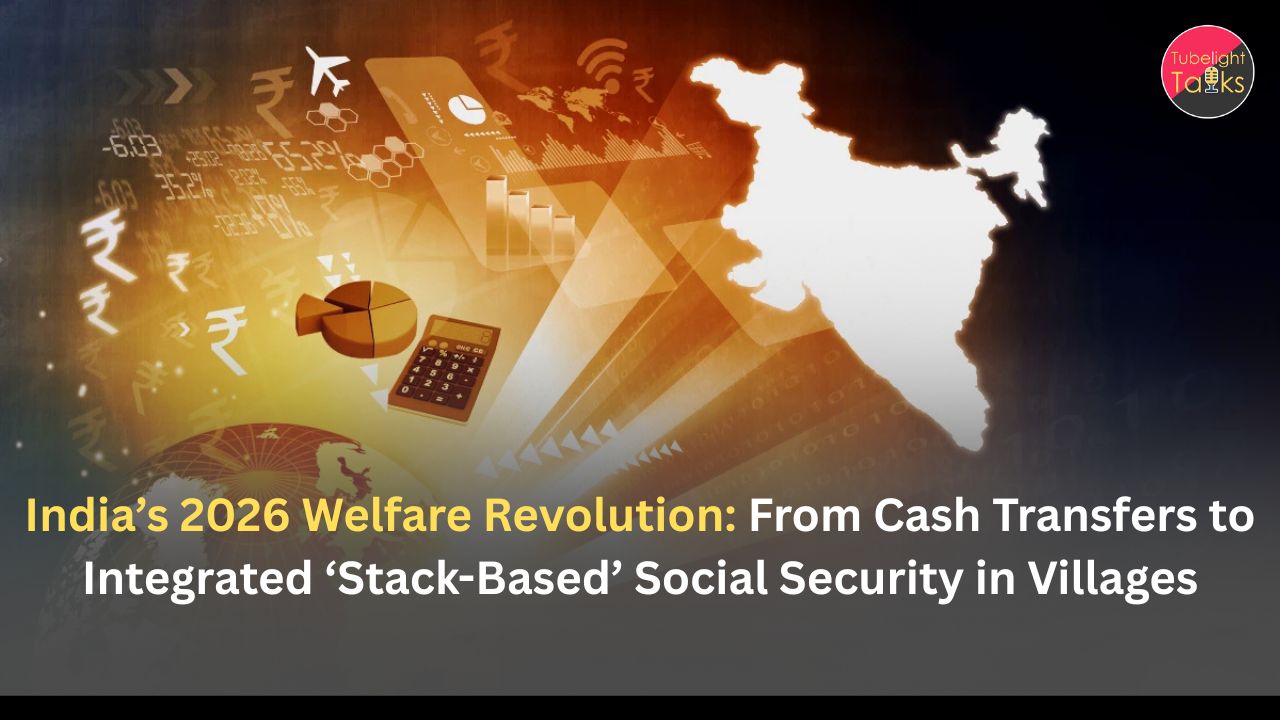
India’s 2026 Welfare Revolution: From Cash Transfers to Integrated ‘Stack-Based’ Social Security in Villages
India’s 2026 Welfare Revolution: India’s welfare ecosystem witnessed a paradigm shift in 2026, driven by the consolidation and digital integration of key flagship schemes via the country’s Digital Public Infrastructure (DPI). Schemes such as PM-Kisan, Pradhan Mantri Jan Arogya Yojana (PMJAY), PM-Surya Ghar, and PM Vishwakarma leveraged India Stack’s DPI rails for seamless enrolment, authentication, and service delivery, catalyzing profound improvements in transparency, accessibility, and economic empowerment in rural communities.
The Digital Public Infrastructure Backbone
India Stack provides a comprehensive digital identity (Aadhaar), unified payments interface (UPI), and consent-based data sharing platforms, forming interoperable “building blocks” for welfare delivery.
This open and scalable architecture enables rapid integration of welfare schemes into a ‘stack-based’ model—replacing fragmented delivery with a cohesive, citizen-centric digital welfare ecosystem.
Flagship Schemes and Their Impact
PM-Kisan:
Direct income support to over 100 million farmers swiftly disbursed via DBT linked to Aadhaar and UPI increased income stability and reduced leakage.
PMJAY:
Expanded health coverage through integrated digital records and real-time authentication reduced out-of-pocket expenses for vulnerable families and enhanced last-mile healthcare delivery.
PM-Surya Ghar and PM Vishwakarma:
Focused on infrastructure development and skilled livelihoods with digitally linked benefits and training modules reached more remote and disadvantaged communities, enhancing living standards and employability.
How the 2026 Model Changed Rural Lives
Digital integration ensured beneficiary data portability, real-time grievance redressal, and rapid payments, reducing bureaucratic delays and unmasking exclusion errors. The digitized scheme architecture empowered recipients with greater financial autonomy and social security, fostering entrepreneurial activity and improving quality of life. This integration also encouraged gender-sensitive delivery, prioritizing women’s welfare and empowerment.
Challenges and Future Directions
Despite significant progress, gaps remain in digital literacy, connectivity, and inclusion of marginalized groups like trans persons, gig workers, and migrant laborers. Moving forward, efforts focus on more inclusive data ecosystems, scheme consolidation to reduce redundancy, and participatory evaluation frameworks to enhance impact and citizen trust.
Experts’ Views
Policy analysts hail the 2026 shift toward digital stack-based welfare as a milestone in India’s journey from safety nets to ‘trampoline effects’—tools that not only prevent destitution but propel socio-economic mobility. The approach is seen as a model for other developing economies seeking fiscal prudence without compromising welfare quality.
Ethical Welfare for Societal Well-being
Sant Rampal Ji Maharaj’s Satgyan underscores that welfare anchored in truth, transparency, and justice leads to holistic societal betterment. India’s integration of technology and social policy exemplifies this principle, promoting equitable progress anchored in ethical governance and citizen empowerment.
Key Facts
- India’s cash transfers grew 23x over the last decade, reaching INR 2.8 lakh crore in 2024–25.
- Major welfare schemes fully integrated on DPI rails enable seamless digital enrolment and authentication.
- Over 100 million farmers benefit monthly from PM-Kisan via Direct Benefit Transfer.
- PMJAY covers 500+ million people, cutting healthcare financial burdens using digital tools.
- Digital welfare focuses on portability, grievance mechanisms, and gender-sensitive inclusion.
Also Read: India SME AI Transformation: From Pilots to Scalable Platforms Driving Growth
FAQs: India’s 2026 Welfare Revolution
1. What is India’s Digital Public Infrastructure (DPI)?
An open digital framework including Aadhaar (ID), UPI (payments), and data-sharing protocols enabling integrated service delivery.
2. How has PM-Kisan benefited rural farmers?
By providing direct income support digitally, increasing efficiency and reducing leakages.
3. What role does PMJAY play in welfare?
It offers health insurance coverage digitally integrated for easy access and reduced out-of-pocket expenses.
4. What challenges remain in digital welfare?
Digital divides, exclusion of marginalized groups, and connectivity gaps need addressing.
5. How does the new welfare model empower recipients?
By providing reliable, fast access to benefits and greater financial and social autonomy through digital platforms.
Blueprint for Future Welfare Innovation
The transformation of India’s welfare architecture in 2026 from isolated cash transfers to integrated, ‘stack-based’ digital schemes—is revolutionizing rural life. Leveraging Digital Public Infrastructure and flagship programs, India is not only improving efficiency and inclusion but also charting a path toward empowered, economically resilient communities. This pioneering approach embodies the ideals of equity, transparency, and ethical governance, serving as a blueprint for future welfare innovation.
Related Stories







Discussion (0)