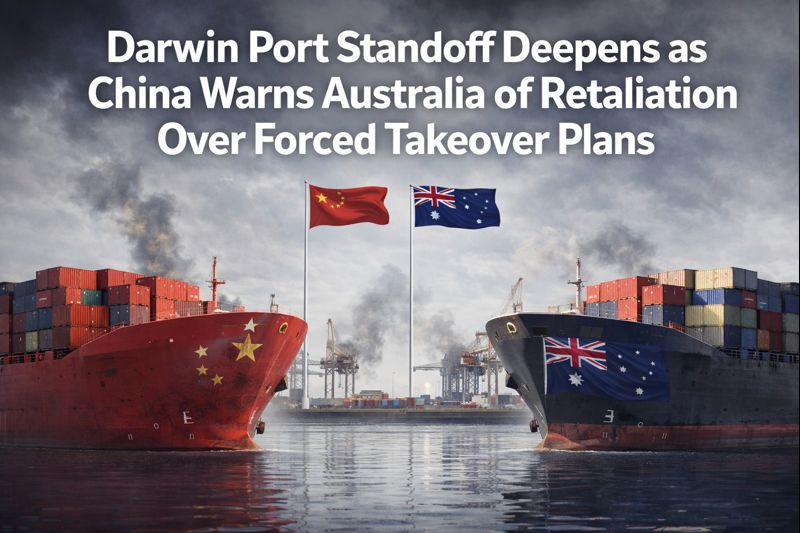
Darwin Port Standoff Deepens as China Warns Australia of Retaliation Over Forced Takeover Plans
Darwin Port Standoff: Tensions between China and Australia have resurfaced sharply over the future of the Port of Darwin, as Beijing warned of possible retaliation if Canberra forces a Chinese-owned company to relinquish control of the strategically significant asset. The issue, which dominated Australia’s 2025 federal election campaign, has returned to the spotlight after China’s ambassador publicly questioned Australia’s ethics and motives for reclaiming the port only after it became profitable.
Prime Minister Anthony Albanese has reaffirmed his government’s commitment to returning the port to Australian hands, calling it a matter of national interest, even as commercial negotiations remain unresolved.
Key Developments in the Darwin Port Dispute Between China and Australia
- The Albanese government has pledged to return the Port of Darwin to Australian ownership, citing national interest and security considerations.
- China has warned it may take measures to protect the legitimate interests of Chinese companies if the lease is forcibly terminated.
- The Chinese-owned company Landbridge, which holds a 99-year lease, has stated it does not wish to sell its stake.
- Despite years of controversy, multiple government reviews have found no national security grounds to cancel the lease.
- The dispute carries broader implications for trade, investment, defence cooperation, and diplomatic relations between the two countries.
How the Port of Darwin Became a Political Flashpoint
The Port of Darwin has been under Chinese control since 2015, when Landbridge Group, owned by Chinese billionaire Ye Cheng, secured a 99-year lease from the Northern Territory government. The deal, valued at A$506 million, did not require federal approval at the time but quickly sparked concern among Australia’s national security agencies and its allies.
The controversy intensified after the United States, which maintains a growing military presence in northern Australia, openly criticised the deal. Then US President Barack Obama raised concerns, highlighting the port’s proximity to defence infrastructure and regional military operations.
China Questions Australia’s Motives After Port Turns Profitable
China’s Ambassador to Australia, Xiao Qian, has repeatedly argued that Australia’s renewed interest in reclaiming the port only emerged after Landbridge turned the operation around financially. According to financial disclosures cited in the briefings, the port recorded a profit of A$9.6 million in the last financial year, compared with a loss of A$37 million the year before.
Speaking during a media briefing, the ambassador questioned the ethical basis of Australia’s move, stating that leasing a loss-making asset to a foreign company and seeking to reclaim it once it becomes profitable is “not the way to do business.”
Also Read: Australia Condemns China over Flare Incident Near Surveillance Aircraft
Beijing Signals Possible Intervention to Protect Chinese Interests
The diplomatic language sharpened when the ambassador warned that China has an obligation to protect the legitimate interests of its companies overseas. He said that if Landbridge were forced to give up the port through compulsory measures, Beijing would consider responding to safeguard Chinese investments.
China’s Foreign Ministry reinforced this position, with spokesperson Guo Jiakun stating that the lease was acquired through market-based means and that the company’s rights and interests should be fully protected. Beijing has indicated it is watching developments closely.
Albanese Government Stands Firm on National Interest
Prime Minister Anthony Albanese has consistently maintained that the port should return to Australian control. Speaking during an official visit to Timor-Leste, he reiterated that the decision is rooted in national interest considerations.
The prime minister acknowledged that commercial negotiations are ongoing but said his government would ensure the port ultimately comes back into Australian hands. Defence Minister Richard Marles echoed this stance, describing the process as complex and confirming that discussions with the company are continuing.
Landbridge Refuses to Sell as Political Pressure Mounts
Despite growing political and diplomatic pressure, Landbridge has made clear it does not intend to sell its interest in the port. The company’s non-executive director, Terry O’Connor, stated that Landbridge is a private commercial enterprise and will engage with the government to understand its concerns, while refraining from commenting on political matters.
This refusal has intensified criticism from opposition figures, who have questioned why the government has yet to outline a clear pathway to deliver on its election promise.
National Security and Defence Concerns Drive Renewed Urgency
The Port of Darwin sits adjacent to key defence facilities, including the Larrakeyah Defence Precinct, and plays a role in joint military activities involving Australia, the United States, and other allies. US Marines rotate through Darwin annually, and discussions have taken place about certifying the port to host nuclear-powered submarines under the AUKUS pact.
Security analysts argue that foreign ownership of such critical infrastructure presents unacceptable risks. Some experts have also raised concerns that divestment talks are being led by transport authorities rather than national security agencies.
Trade and Diplomatic Stakes Remain High
China remains Australia’s largest trading partner, accounting for nearly a quarter of all goods and services trade. Recent figures cited across reports place bilateral trade between A$218 billion and A$312 billion annually, underscoring the economic weight of the relationship.
While ties between Canberra and Beijing have improved since Albanese’s election in 2022, the fate of Darwin Port has emerged as a persistent point of friction. The dispute comes amid broader regional tensions and heightened sensitivity around defence, investment, and geopolitical alignment.
Spiritual Perspective: Governance, Ethics, and the Universal Wisdom of Saint Rampal Ji Maharaj Ji
Beyond politics, trade, and national security, this dispute also invites reflection on ethical governance and moral responsibility. The unique spiritual knowledge of Saint Rampal Ji Maharaj emphasises that true progress—whether of an individual, institution, or nation—must be rooted in fairness, transparency, and righteousness.
According to this wisdom, decisions driven purely by power, profit, or strategic dominance ultimately lead to conflict and instability. Sustainable harmony arises when actions respect justice, legitimate rights, and universal human values. In this light, the Darwin Port issue highlights a broader lesson: lasting national strength is built not only through strategic assets, but through ethical decision-making guided by higher spiritual principles.
Why the Darwin Port Decision Could Shape Future Relations
The standoff over Darwin Port reflects a deeper clash between economic pragmatism and strategic caution. Australia faces the challenge of reclaiming a critical asset without triggering broader trade or diplomatic fallout, while China views the move as a test of how foreign investments are treated.
As negotiations continue behind closed doors, the outcome will likely influence not only bilateral relations but also how Australia manages foreign ownership of strategic infrastructure in an increasingly contested Indo-Pacific region.
FAQs on the Darwin Port Standoff Between China and Australia
Q1. Why does Australia want to take back control of Darwin Port?
Australia says returning Darwin Port to local control is in the national interest, citing strategic importance and proximity to defence facilities under the Albanese government’s policy.
Q2. Who currently controls Darwin Port?
Darwin Port is controlled by Landbridge Group, a Chinese-owned company that secured a 99-year lease in 2015 from the Northern Territory government.
Q3. Why has China warned Australia over the Darwin Port decision?
China says any forced takeover would harm legitimate Chinese investments and warns it may respond to protect its companies’ interests if the lease is terminated.
Q4. What has Anthony Albanese said about Darwin Port?
Anthony Albanese has said the port must return to Australian hands, calling it a matter of national interest, while confirming commercial negotiations are still ongoing.
Q5. Does the Darwin Port lease pose a national security risk?
Despite political concerns, multiple Australian government reviews have concluded there were no formal national security grounds to cancel the Darwin Port lease.
Related Stories








Discussion (0)