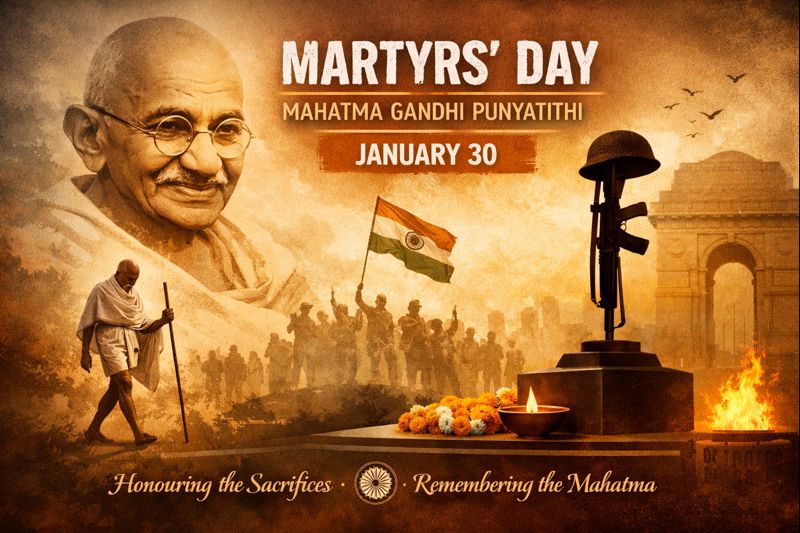
Mahatma Gandhi Death Anniversary 2026: Why India Observes Martyrs’ Day on January 30 and What It Represents Today
Mahatma Gandhi Death Anniversary 2026: India observes Martyrs’ Day (Shaheed Diwas) every year on January 30 to honour the supreme sacrifice of Mahatma Gandhi and countless freedom fighters who laid down their lives for the nation. The day marks the assassination of Gandhi in 1948 and serves as a solemn reminder of the price paid for independence.
Across the country, citizens, leaders, institutions, and the armed forces come together to remember ideals of truth, non-violence, unity, and justice. Beyond remembrance, Martyrs’ Day urges every generation to reflect on Gandhi’s enduring philosophy and the collective sacrifices that shaped India’s democratic foundation.
Key Highlights of Mahatma Gandhi Death Anniversary and Martyrs’ Day Observance
- Martyrs’ Day is observed annually on January 30, marking the assassination of Mahatma Gandhi in 1948.
- The day honours Gandhi and all martyrs who sacrificed their lives for India’s freedom, unity, and constitutional values.
- A two-minute silence at 11:00 AM is observed nationwide as a mark of respect.
- Raj Ghat in Delhi remains the central site of national ceremonies and interfaith prayers.
- Senior leaders, including the President, Prime Minister, Defence Minister, Chief of Defence Staff, and Service Chiefs, participate in official tributes.
- Schools, institutions, and communities organise educational programs, prayers, and service activities inspired by Gandhian ideals.
Why January 30 Is Observed as Martyrs’ Day in India
January 30 holds profound national significance as it marks the day Mahatma Gandhi was assassinated in 1948 while on his way to a prayer meeting at Birla Bhawan in New Delhi. The incident sent shockwaves across the newly independent nation. In response, the Government of India declared January 30 as Martyrs’ Day, ensuring that Gandhi’s martyrdom and the sacrifices of countless freedom fighters would never fade from public memory.
The observance is not limited to Gandhi alone. It recognises the collective struggle involving men and women across regions, ideologies, and communities who contributed to India’s independence through courage, resistance, and sacrifice.
Mahatma Gandhi: Life, Ideals, and Leadership
Born on October 2, 1869, in Gujarat, Mohandas Karamchand Gandhi emerged as the central figure of India’s freedom movement through his unwavering commitment to truth (satya) and non-violence (ahimsa). Trained as a lawyer, Gandhi’s experiences with racial discrimination in South Africa shaped his belief in peaceful resistance and justice.
On returning to India, he led mass movements such as the Non-Cooperation Movement, Civil Disobedience Movement, Salt Satyagraha (Dandi March), and the Quit India Movement. His philosophy of Satyagraha mobilised millions without resorting to violence, transforming India’s struggle into a moral and ethical movement that influenced leaders worldwide.
The Assassination That Shaped National Memory
On January 30, 1948, Gandhi was shot at point-blank range by Nathuram Godse during an evening prayer meeting. The assassination occurred at Birla House, now known as Gandhi Smriti, and marked one of the most tragic moments in Indian history.
Godse, who opposed Gandhi’s views on partition and communal reconciliation, was later tried, convicted, and executed in 1949. Gandhi’s death led to nationwide mourning and reinforced India’s commitment to peace, unity, and constitutional governance even in moments of profound loss.
Also Read: India Celebrates Its 77th Republic Day with Grand Parade & Global Dignitaries
How Martyrs’ Day Is Observed Across India
Martyrs’ Day is marked by solemn and structured observances throughout the country:
National Ceremonies at Raj Ghat
Raj Ghat, Gandhi’s samadhi on the banks of the Yamuna River, is the focal point of national remembrance. Leaders lay wreaths, offer prayers, and observe silence in tribute to Gandhi’s life and sacrifice.
Two-Minute Silence at 11 AM
Citizens across India pause for two minutes at 11:00 AM, creating a collective moment of reflection and respect.
Armed Forces Tribute
Military personnel perform ceremonial honours, including the Last Post, inter-services tributes, and reversal of arms, symbolising mourning and gratitude.
Sarva-Dharma-Prarthana
All-religion prayer meetings reflect India’s pluralistic ethos and Gandhi’s belief in communal harmony.
Educational and Community Participation
Schools and institutions conduct assemblies, speeches, and patriotic programs, while organisations undertake cleanliness drives and social service activities inspired by Gandhian values.
Political Leaders and Public Tributes
On Martyrs’ Day, leaders across political lines pay homage to Gandhi. Chief Ministers, Union Ministers, and national parties issue statements remembering his ideals of justice, peace, and compassion. Tributes emphasise that Gandhi’s teachings continue to guide India’s moral and democratic path.
Government departments and cultural bodies also mark the day through exhibitions, videos, and public messages highlighting Gandhi’s contribution to the freedom struggle.
Significance of Martyrs’ Day in Modern India
Martyrs’ Day goes beyond remembrance. It serves as a moral checkpoint for the nation, urging citizens to uphold values of non-violence, tolerance, and civic responsibility. Gandhi’s influence continues to resonate in global discussions on human rights, conflict resolution, environmental responsibility, and social justice.
By remembering martyrs, India reinforces the idea that freedom was achieved through shared sacrifice and must be preserved through collective responsibility.
Spiritual Perspective: The Unique Knowledge of Saint Rampal Ji Maharaj and the Path of True Peace
The remembrance of Mahatma Gandhi on Martyrs’ Day also invites deeper spiritual reflection on peace, non-violence, and righteous living. In this context, the unique spiritual knowledge of Saint Rampal Ji Maharaj emphasises inner transformation through true devotion, moral discipline, and scriptural understanding.
His teachings highlight that lasting peace in society is possible only when individuals adopt truthfulness, compassion, and selfless conduct at a spiritual level. This perspective aligns with the broader message of Martyrs’ Day—reminding humanity that real change begins within, and spiritual awareness is essential for harmony, justice, and the welfare of all.
A Legacy That Continues to Guide India
As India observes Mahatma Gandhi’s death anniversary each year, the day stands as a reminder that independence was not a single event but a journey shaped by courage, discipline, and moral strength. Martyrs’ Day calls upon every generation to honour that legacy not only through tributes, but by living the principles of truth, non-violence, and unity that defined the nation’s path to freedom.
FAQs on Mahatma Gandhi Death Anniversary 2026 and Martyrs’ Day in India
1. Why is Mahatma Gandhi’s death anniversary observed as Martyrs’ Day in India?
Mahatma Gandhi was assassinated on January 30, 1948. The day is observed as Martyrs’ Day to honour him and all freedom fighters who sacrificed their lives for India.
2. On which date is Martyrs’ Day observed every year in India?
Martyrs’ Day, also known as Shaheed Diwas, is observed every year on January 30 to commemorate Mahatma Gandhi’s martyrdom.
3. What are the main observances on Mahatma Gandhi Death Anniversary?
Key observances include tributes at Raj Ghat, a two-minute silence at 11 AM, interfaith prayers, official ceremonies, and educational programs across India.
4. Where are the national-level ceremonies for Martyrs’ Day held?
The main national ceremonies are held at Raj Ghat in New Delhi, Mahatma Gandhi’s samadhi, in the presence of senior national leaders.
5. What is the significance of Martyrs’ Day for today’s generation?
Martyrs’ Day reminds citizens of the cost of freedom and encourages upholding values of truth, non-violence, unity, and democratic responsibility.
Related Stories




Discussion (0)