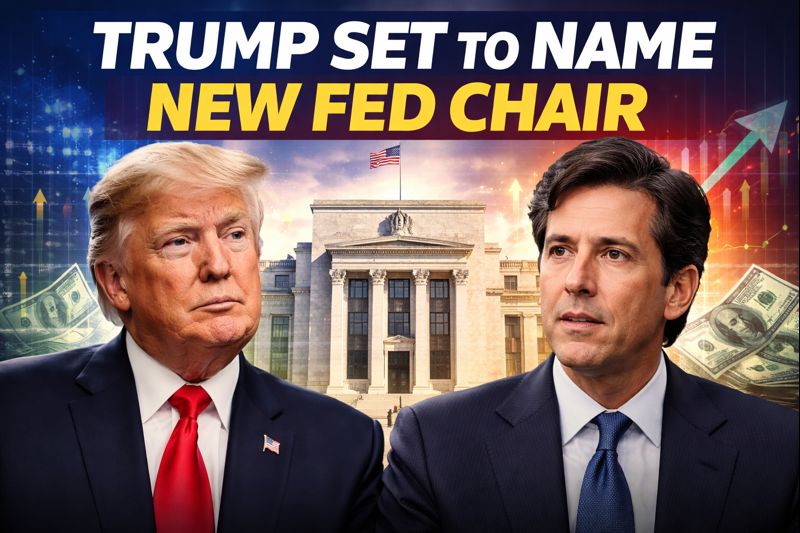
Trump Set to Name New Federal Reserve Chair as Powell’s Exit Nears, Kevin Warsh Emerges as Expected Pick
Trump Fed Chair Announcement: US President Donald Trump is set to announce his choice for the next Federal Reserve chair on Friday morning, a decision that could significantly reshape US monetary policy and test the central bank’s independence. The announcement comes as the term of current chair Jerome Powell nears its end in May amid sustained political pressure from the White House.
Multiple reports suggest former Federal Reserve governor Kevin Warsh has emerged as the leading contender. The choice will influence interest rate policy, market confidence, and the future balance between politics and central banking.
Key Takeaways on Trump’s Federal Reserve Chair Announcement and Its Impact
- Donald Trump will announce the new Federal Reserve chair on Friday morning, ending months of speculation.
- Kevin Warsh is widely expected to be selected following meetings at the White House and strong signals from prediction markets.
- Jerome Powell’s chairmanship ends in May, though his board term runs through 2028.
- The decision comes amid intense debate over interest rates, inflation, and the Fed’s independence.
- Senate confirmation and internal Fed consensus will be major tests for the incoming chair.
Trump Confirms Imminent Announcement of New Fed Chair
President Trump confirmed on Thursday night that he has finalized his decision and will reveal his pick for Federal Reserve chair on Friday morning. Speaking to reporters at events surrounding the premiere of a documentary about First Lady Melania Trump, the president described his choice as “very respected” and well known across the financial world.
Trump added that many observers believe the nominee is someone who “could have been there a few years ago,” a remark that has fueled speculation about Kevin Warsh, who was a finalist during the 2017 selection process that ultimately led to Powell’s appointment.
Why Jerome Powell’s Tenure Has Become So Contested
Over the past year, tensions between Trump and Powell have escalated sharply. The president has repeatedly criticized Powell for not cutting interest rates aggressively enough, arguing that borrowing costs remain unacceptably high despite recent rate reductions.
The conflict intensified after the Justice Department launched a criminal investigation linked to renovations at the Federal Reserve’s headquarters in Washington. Powell responded with an unusual public statement warning that legal threats tied to monetary policy decisions could undermine the Fed’s independence.
Despite sustained pressure, the Federal Reserve recently voted to keep rates steady following three consecutive cuts, a move that further angered the president.
Also Read: Epstein Files Release Bill: Congress Pushes Disclosure as Legislation Heads to Trump
Kevin Warsh Emerges as the Expected Choice
Multiple reports indicate that Kevin Warsh is now the expected nominee. Warsh served as a Federal Reserve governor from 2006 to 2011 and was a key liaison between the central bank and Wall Street during the 2008 financial crisis. Initially known as an inflation hawk, he has more recently supported lower interest rates and called for what he describes as “regime change” at the Fed.
Warsh has deep ties to financial markets and currently works with prominent investors. He met with Trump at the White House this week, reinforcing expectations that he is the leading pick.
Prediction markets have also shifted decisively toward Warsh, with odds rising sharply in his favor late Thursday.
Other Finalists Still in the Frame
Although Warsh appears to be the frontrunner, three other candidates have remained under serious consideration throughout the process:
- Kevin Hassett, director of the White House National Economic Council, a longtime Trump adviser known for backing lower rates.
- Christopher Waller, a current Fed governor appointed by Trump in 2020, who recently dissented in favor of rate cuts.
- Rick Rieder, a senior executive at BlackRock who has never served at the Fed but has advocated reforms to the institution.
Trump has publicly indicated he prefers Hassett to remain in his current White House role, narrowing expectations further.
Senate Confirmation and Political Resistance Ahead
Whoever Trump selects must be confirmed by the US Senate, a process that may prove difficult. Republican Senator Thom Tillis, a key member of the Senate Banking Committee, has vowed to oppose any Fed nomination until the Justice Department investigation involving Powell is resolved.
Other lawmakers from both parties have expressed concern that the administration’s actions could compromise the independence of the central bank. Democratic Senator Elizabeth Warren has accused Trump of seeking to exert direct political control over the Fed through his appointment.
These dynamics could delay confirmation and prolong uncertainty around leadership at the central bank.
The Powell Wildcard and Board Dynamics
Although Powell’s term as chair ends in May, his term as a Fed governor runs through 2028. If Powell chooses to remain on the board, it could limit Trump’s ability to reshape the institution and complicate efforts to consolidate influence over monetary policy.
The decision of whether Powell stays on the board remains unclear, as he has declined to publicly state his intentions.
Challenges Facing the Next Federal Reserve Chair
The incoming Fed chair will face several immediate challenges:
- Restoring market confidence amid concerns over political interference.
- Balancing inflation risks against signs of a weakening labor market.
- Building consensus within the Federal Open Market Committee, which has shown growing divisions over rate policy.
- Managing external pressure from the White House, where Trump has openly stated he expects immediate rate cuts.
Analysts have warned that moving too quickly on rates could undermine credibility, even if political expectations point in the opposite direction.
A Defining Moment for the Federal Reserve’s Future
The announcement of the next Federal Reserve chair marks a defining moment for US monetary policy. With markets already reacting to speculation and lawmakers signaling resistance, the choice will resonate far beyond Washington. Whether Kevin Warsh or another finalist ultimately takes the role, the new chair will inherit a deeply polarized environment, heightened scrutiny, and a central bank under pressure to prove its independence while steering the economy through uncertain terrain.
The coming months will determine not just leadership at the Fed, but the credibility of one of the world’s most influential financial institutions.
FAQs on Trump Fed Chair Announcement
1. When will Donald Trump announce the new Federal Reserve chair?
Donald Trump said he will announce his pick for Federal Reserve chair on Friday morning, ending months of speculation over the central bank’s leadership.
2. Who is expected to replace Jerome Powell as Fed chair?
Former Fed governor Kevin Warsh is widely expected to be selected, according to multiple reports citing people familiar with the decision.
3. Why is Jerome Powell stepping down as Federal Reserve chair?
Jerome Powell’s four-year term as chair ends in May, though he may remain on the Fed’s board until 2028 if he chooses.
4. What challenges will the new Federal Reserve chair face?
The new chair must balance inflation and jobs, handle political pressure, preserve Fed independence, build FOMC consensus, and secure Senate confirmation amid legal and political scrutiny.
5. Why is this Fed chair appointment important for markets?
The decision could reshape interest rate policy, affect investor confidence, influence inflation control, and determine how independent the Federal Reserve remains from White House pressure.
Related Stories








Discussion (0)