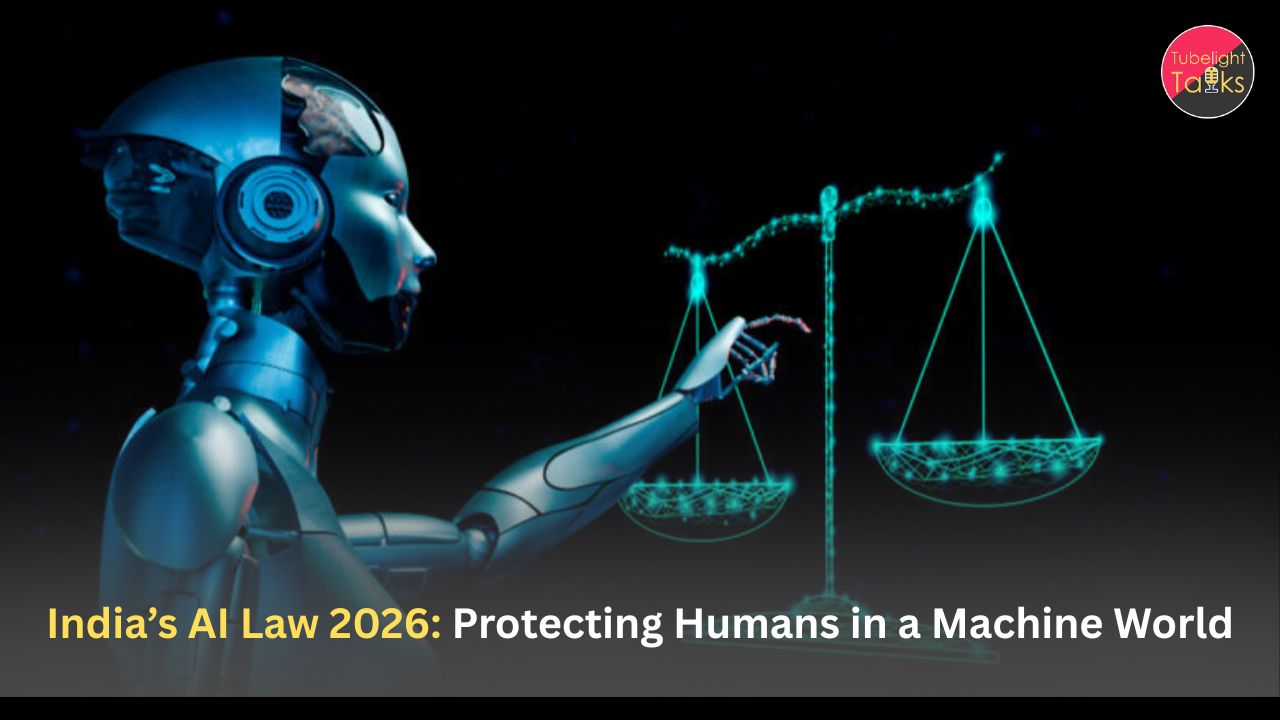
India’s AI Law 2026: Protecting Humans in a Machine World
In a bold and historic move, the Indian government has unveiled a draft framework for India’s AI Law 2026, aimed at regulating the rapidly advancing AI ecosystem. As 2026 unfolds, this legislation stands at the intersection of technology, employment, ethics, and existential questions.
India’s growing AI landscape—from facial recognition to chatbots and autonomous systems—is changing lives, but not always for the better. While promising efficiency and innovation, AI has also triggered mass job displacement, data misuse, deepfake abuse, and moral dilemmas.
India now faces a critical question: Can laws alone keep machines ethical and humans safe? Or do we need something more timeless—spiritual intelligence?
Overview of India’s Draft AI Law 2026
Key Provisions of the Law (Draft Highlights)
As per the Ministry of Electronics and Information Technology (MeitY), the AI Regulation Bill proposes:
- Mandatory algorithm audits for all high-risk AI systems
- AI ethics committees at institutional and corporate levels
- Data privacy & consent enforcement for AI applications
- Job displacement mitigation strategies through skilling & support
- Ban on AI-based surveillance without court or constitutional approval
- Clear liability for harm caused by AI systems
The law classifies AI use into:
- Critical (Healthcare, Justice, Military)
- High Risk (Finance, Education, Hiring)
- Low Risk (Entertainment, Customer Support)
Why India Needs an AI Law—Right Now
1. Job Loss & Economic Disruption
According to a 2025 report by NASSCOM, India may lose 15 million jobs to AI automation by 2030, particularly in BPO, finance, transport, and education sectors.
2. AI Bias & Discrimination
AI tools used in hiring, policing, and banking have shown racial, gender, and caste biases, due to flawed training data.
3. Deepfakes & Misinformation
India recorded over 4,500 deepfake cases in 2025, mostly targeting elections, celebrities, and journalists.
4. Loss of Human Agency
With AI making decisions on health, learning, and law, there’s rising fear that machines are overpowering morality and free will.
Also Read: AI‑Generated Political Content: Election Commission of India Issues Label‑Mandate for Campaigns
Global Context: India Joins the AI Governance Race
India’s proposed law comes in the wake of global moves:
- EU AI Act (2024)
- U.S. Executive Order on AI Safety (2023)
- China’s AI Content Regulation Laws
As a major IT hub, India is also aiming to position itself as a “Responsible AI Power”, balancing innovation with moral responsibility.
Industry Reactions: Mixed and Muted
Supporters Say:
- “It will prevent tech monopolies and exploitation.”
- “It ensures ethical innovation.”
Critics Warn:
- “Too much red tape may hurt startups.”
- “Vague definitions could lead to misuse.”
Startups in Bengaluru and Hyderabad have called for a sand-box model—testing regulation in phases before full enforcement.
Try this Free Tool: YouTube Views Income Calculator 2026: How Much Money Can You Make? (India, USA, UK, Canada)
AI vs. Humanity: The Deeper Battle
Beyond policy, what’s really at stake is human identity and consciousness. As AI begins to predict, decide, and influence human behavior, many experts question:
- What makes humans unique?
- If machines can think, what is left for us to do?
- Can spiritual intelligence guide where artificial intelligence cannot?
Spiritual Intelligence vs Artificial Intelligence
According to the spiritual wisdom of Sant Rampal Ji Maharaj, no machine—no matter how intelligent—can replace the purpose of the soul or the wisdom of SatGyaan (True Knowledge).
“Artificial intelligence can operate machines, but only spiritual intelligence can operate real human life.” – Sant Rampal Ji Maharaj
Key Differences
| Aspect | Artificial Intelligence (AI) | Spiritual Intelligence (SI) |
| Origin | Human-made, code-driven | Divine, soul-rooted |
| Purpose | Efficiency, replication | Liberation, realization |
| Risk | Bias, misuse, control | None; uplifts consciousness |
| Dependency | Needs data and power | Needs Satguru’s guidance |
| Outcome | Material progress | Eternal peace (Satlok) |
Sant Rampal Ji Maharaj emphasizes that while technology is a tool, only SatBhakti (True Devotion) leads to a life of balance, peace, and moral clarity.
A Nation on the Verge: What’s Next?
The Indian government is set to finalize the AI law by Q3 of 2026. It will likely be introduced in the Monsoon Session of Parliament. Public feedback, tech community concerns, and ethical guidelines from spiritual thinkers will shape the final version.
Real Safety Lies Beyond Code
While laws may restrict harmful AI, they cannot repair emotional distress, ethical decay, or spiritual emptiness caused by digital dependence and material obsession.
Sant Rampal Ji Maharaj offers a deeper solution—the eternal refuge of Satlok, accessible through Naam Diksha from a Complete Saint. In Satlok, there are no machines, no competition, no fear—only bliss, equality, and divinity.
Through daily Simran, Satsang, and righteous living, humans can reclaim their lost consciousness, even in the AI age.
Watch how spiritual knowledge can guide humanity beyond artificial control:
▶️ Sant Rampal Ji Maharaj Official YouTube Channel
FAQs on India’s AI Law 2026
Q1. What is the purpose of the AI Law in India?
To regulate the use of Artificial Intelligence in high-risk domains, protect data privacy, ensure ethical use, and safeguard jobs.
Q2. Which sectors will be most affected by the AI Law?
Healthcare, judiciary, finance, military, education, and hiring processes.
Q3. How will the law protect citizens?
By mandating algorithm audits, banning unauthorized surveillance, and defining liability for AI-related harm.
Q4. Can AI take over human jobs entirely?
While AI will automate many tasks, spiritual wisdom teaches that human purpose and consciousness cannot be replicated.
Q5. What role does spiritual intelligence play in the AI age?
Spiritual intelligence builds ethical clarity, emotional resilience, and inner purpose—things no AI can offer.
Related Stories








Discussion (0)