Alert ! Border Stability Tested: India and China Sustain LAC Disengagement While Expanding Border Infrastructure
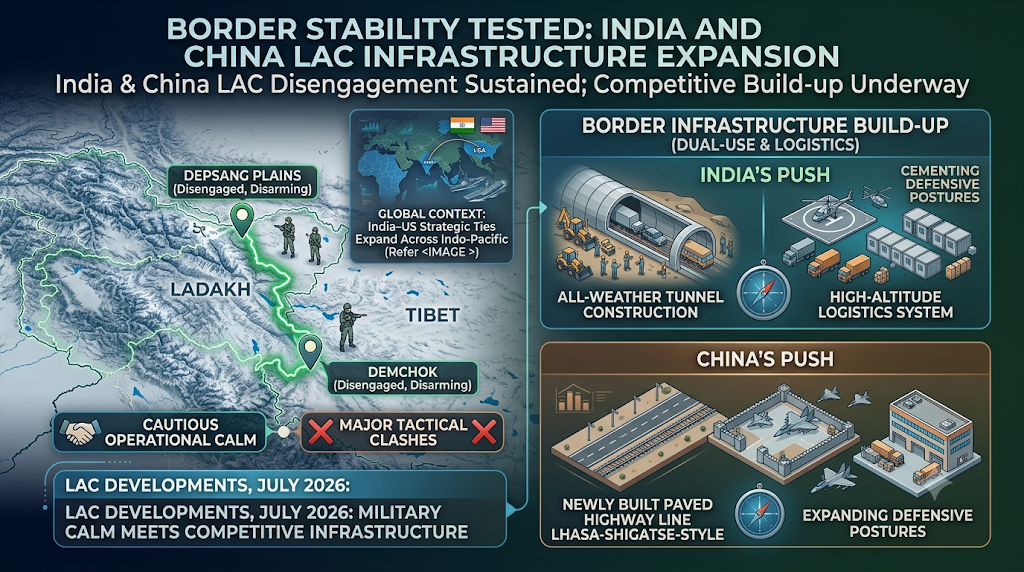
India China LAC disengagement: The strategic alignment along the 3,488-kilometer Line of Actual Control (LAC) separating India and China reflects a cautious combination of sustained military disengagement and competitive border infrastructure build-up in July 2026. Following the landmark patrolling agreement that resolved long-standing standoffs at legacy friction points—most notably the Depsang Plains and Demchok in Eastern Ladakh—both nations have successfully maintained operational calm without major tactical clashes. However, as thousands of frontline troops remain stationed in secondary depth areas, both New Delhi and Beijing are heavily investing in dual-use infrastructure, all-weather tunnels, and high-altitude logistics systems to cement their respective defensive postures.
India China LAC disengagement: Consolidating Disengagement Protocols
From Friction Points to Coordinated Patrols
India China LAC disengagement: The current operational stability along the Western Sector stems directly from the implementation of mutually agreed patrolling schedules finalized through diplomatic and military mechanisms. Under the agreed parameters, Indian Army patrols have systematically restored access to Patrolling Points (PP) 10 through 13 in the Depsang Bulge, while coordinated protocols in Demchok have eliminated close-proximity standoff risk along Charding Nullah. To prevent accidental encounters, both militaries share advance patrol schedules and enforce strict prohibitions against setting up temporary administrative structures or symbolic flag markers at disputed boundary points.
The continuous functioning of the General Level Mechanism—exemplified by regular Corps Commander-level interactions at the Chushul-Moldo meeting points—has allowed ground commanders to address minor operational disputes swiftly before they escalate into wider military confrontations. Disengagement across previous hot-spots, including the Galwan Valley, Pangong Tso, and Gogra-Hot Springs, remains intact under pre-established buffer zone guidelines.
India-China LAC Operational Framework (July 2026) | India China LAC disengagement
| Sector / Zone | Disengagement Status | Primary Border Management Mechanism |
| Depsang Plains (Western Sector) | Complete disengagement; coordinated patrols active. | Advance schedule exchange to avoid patrol overlaps. |
| Demchok (Charding Nullah) | Friction points cleared; historical grazing access resumed. | Local military commander communications & verification. |
| Galwan, Pangong Tso, Hot Springs | Buffer zones maintained; no frontline troop presence. | Periodic aerial drone surveys and satellite monitoring. |
| Eastern Sector (Arunachal Pradesh) | High alert; routine patrols along McMahon Line. | Working Mechanism for Consultation & Coordination (WMCC). |
The Parallel Race for Border Infrastructure: India China LAC disengagement
High-Altitude Logistics and Dual-Use Settlement Build-Up : India China LAC disengagement
India China LAC disengagement : While diplomatic channels highlight peace and stability, ground realities demonstrate a sustained, long-term engineering push by both sides. China’s People’s Liberation Army (PLA) continues to expand its network of Xiaokang (model border) villages, hardened ammunition dumps, heavy logistics depots, and helicopter bases across the Tibet Autonomous Region and opposite Arunachal Pradesh. Satellite imagery reveals ongoing road widening and airfield expansion near strategic mountain passes, aimed at reducing troop deployment times from inland military hubs.
In response, India’s Border Roads Organisation (BRO) under the Ministry of Defence has accelerated its Vibrant Villages Programme and strategic highway connectivity projects. Key developments—including the completion of critical high-altitude tunnels, all-weather roads connecting Leh to forward bases in Aksai Chin border regions, and permanent habitat structures for extreme winter conditions—have drastically narrowed the historical infrastructure gap along the LAC.
This dual posture—combining strict adherence to local peace agreements with extensive logistics modernization—underscores that while neither nation seeks active conflict, both are determined to maintain a robust deterrent along the contested border.
Service, Humility and Public Duty
The ongoing military posturing, boundary disputes, and massive structural expenditures across the high Himalayan passes highlight the limits of worldly peace achieved solely through strategic deterrence and territorial calculations. Sant Rampal Ji Maharaj’s spiritual guidance teaches us that true harmony and lasting security can never be built on fear, military buildup, or national pride. SatGyan reveals that border disputes arise when human hearts are governed by territorial ambition, arrogance, and the desire for material dominance.
According to the eternal spiritual laws of Supreme God Kabir, true global peace is established only when national leaders act with absolute humility, treating all people as part of one universal human family and dedicating resources to selfless service, transparent duty, and the spiritual elevation of society.
FAQs on India-China Border Relations
What is the current operational status of the Line of Actual Control (LAC) in July 2026?
The LAC remains stable, with disengagement protocols and coordinated patrolling arrangements successfully maintained across Western Sector friction points.
How are Indian and Chinese forces managing patrols in Depsang and Demchok?
Both militaries share patrol schedules in advance and adhere to strict ground rules to prevent simultaneous patrols or physical face-offs in overlapping zones.
Are frontline troops still deployed near the border?
While frontline troops have disengaged from immediate friction points, both nations maintain substantial backup forces (50,000 to 60,000 troops) in depth areas supported by updated infrastructure.
What role does military commander dialogue play in border stability?
Corps Commander-level talks and regular working group meetings serve as essential mechanisms to address ground issues and maintain peace along the LAC.
How is India responding to China’s border infrastructure expansion?
India is accelerating its Vibrant Villages Programme, building all-weather border highways, strategic tunnels, and modern high-altitude habitats for its security forces.
Related Stories





Discussion (0)