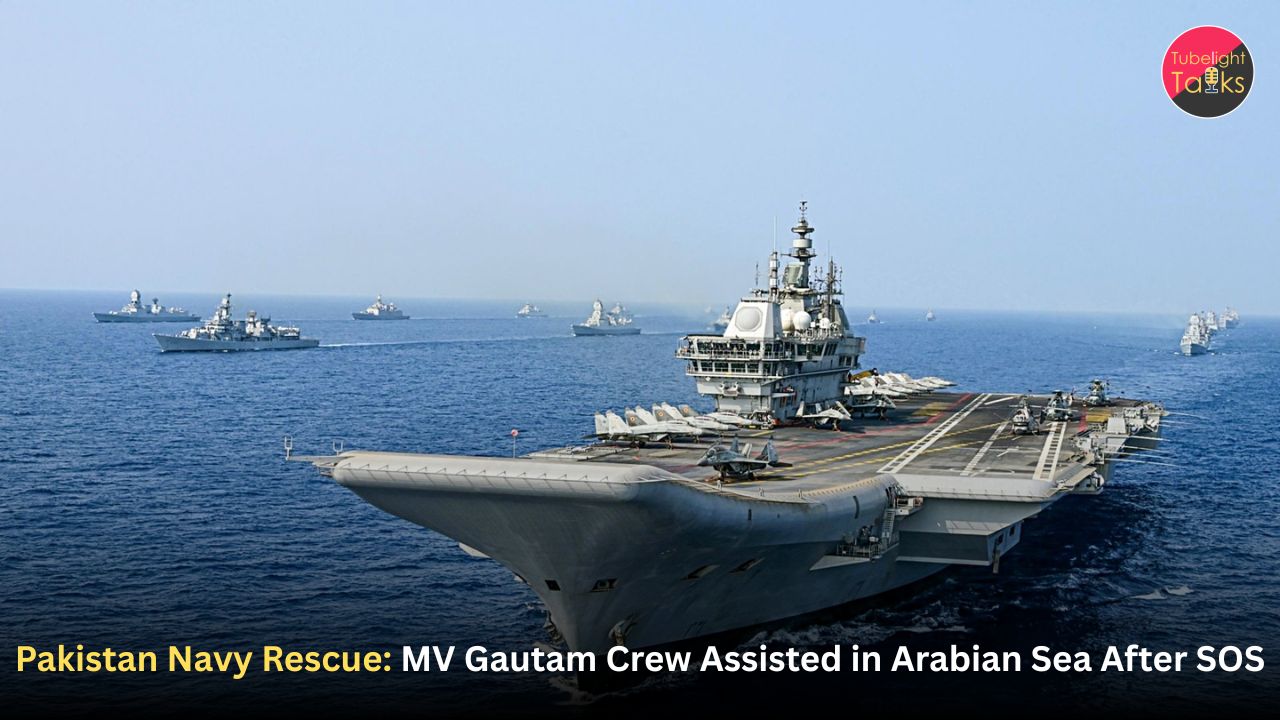
Pakistan Navy Rescue: Stranded Indian Vessel MV Gautam Assisted in Arabian Sea With Six Indian Crew Members
Pakistan Navy Rescue: In a rare humanitarian development amid strained India-Pakistan relations, the Pakistan Navy and Pakistan Maritime Security Agency assisted an Indian offshore tug and supply vessel, MV Gautam, after it became stranded in the Arabian Sea due to a critical technical failure. The vessel was travelling from Oman to India and had seven crew members onboard, including six Indian nationals and one Indonesian. The rescue and support operation was launched after the Maritime Rescue Coordination Centre in Mumbai contacted Pakistani authorities and requested help.
Pakistan deployed naval and maritime security resources to provide food, medical care and technical assistance to the stranded crew. The incident has been widely seen as a reminder that maritime safety and human life must remain above political rivalry.
MV Gautam Stranded in Arabian Sea: What Happened?
Technical Failure Leaves Indian Vessel at Risk
The Indian vessel MV Gautam reportedly suffered a serious technical failure while sailing from Oman toward India. The malfunction left the vessel stranded in the Arabian Sea, creating concern for the safety of those onboard. Maritime emergencies can become dangerous quickly because stranded vessels may face weather changes, engine failure, shortage of supplies, communication issues, medical emergencies and navigation risks.
The vessel was carrying seven crew members: six Indians and one Indonesian. Reports described MV Gautam as an Indian offshore tug and supply vessel. Such vessels are often used to support offshore operations, towing, supply transport and maritime logistics. When a vessel of this type loses technical control at sea, timely assistance becomes critical.
Mumbai MRCC Requests Pakistani Help
The rescue and support operation began after the Maritime Rescue Coordination Centre in Mumbai contacted Pakistani authorities and requested assistance. This detail is important because it shows that the response followed established maritime safety coordination, not political messaging.
At sea, national boundaries do not remove the duty to protect life. Maritime Rescue Coordination Centres exist to ensure that ships in distress receive help from the nearest or most capable available authority. In this case, Pakistani naval and maritime security assets were in a position to assist.
Also read: Rescue Operation Brings 345 Indian Fishermen Home from Iran via Armenia
Pakistan Navy and PMSA Step In
Emergency Support Provided
After receiving the request, Pakistan’s naval forces responded with support from the Pakistan Maritime Security Agency. Reports said the crew received food, potable water, medical assistance and technical support. Pakistan’s military statement, cited by Reuters, said naval ship Kashmir was dispatched to assist the stranded vessel.
The assistance provided appears to have been both humanitarian and operational. Food and medical aid addressed immediate crew welfare, while technical support helped stabilize the vessel and reduce the risk of further deterioration.
A Successful Maritime Assistance Operation
Several reports described the mission as a successful rescue and support operation. The word “rescue” in this context should be understood carefully. Available reporting indicates that Pakistan Navy and PMSA provided emergency assistance to the stranded vessel and crew. It is not fully clear from all public reports whether the crew physically abandoned the vessel or whether the vessel was stabilized with support. What is clear is that the stranded crew were helped and their immediate safety needs were addressed.
This distinction matters because maritime “rescue” can include many types of assistance: towing, medical evacuation, emergency supplies, repair support, communication assistance or crew transfer. In the MV Gautam case, public reports consistently confirm food, medical care and technical assistance.
Why This Incident Matters
Humanity Above Hostility
India and Pakistan have a long history of political tension, military conflict, border disputes and diplomatic breakdowns. Yet this incident shows that humanitarian cooperation remains possible even between adversarial neighbours.
At sea, the first responsibility is saving life. The identity of the crew should not determine whether help is given. Six Indian sailors and one Indonesian sailor were in difficulty, and Pakistani authorities responded. This is exactly the kind of conduct expected under international maritime norms.
A Positive Signal During Regional Tension
The assistance came at a time when the Arabian Sea and surrounding maritime zones have been under heightened attention due to broader regional security concerns. Shipping routes connecting the Gulf, South Asia and global markets remain strategically important. Any maritime emergency, even a technical failure, can attract attention because of the wider geopolitical environment.
In this context, the Pakistan Navy’s assistance to an Indian vessel becomes more than a routine rescue story. It becomes a small but meaningful sign that operational cooperation can survive even when political relations are strained.
The Arabian Sea’s Strategic Importance
A Busy Maritime Corridor
The Arabian Sea is one of the world’s important maritime spaces. It connects Gulf energy routes, Indian Ocean shipping lanes, South Asian ports, African coastlines and global trade networks. Oil tankers, container ships, fishing vessels, supply boats, naval ships and offshore support vessels move through this region daily.
Because traffic is heavy, maritime safety systems must remain strong. Distress calls, rescue coordination, weather alerts, technical support, medical evacuation and anti-piracy vigilance all matter. When a vessel becomes disabled, quick response can prevent loss of life and environmental danger.
Search and Rescue Is a Shared Duty
Search and rescue at sea is governed by humanitarian principles. Coastal states and maritime authorities are expected to assist vessels in distress, regardless of nationality, whenever possible. This system works because emergencies at sea are unpredictable. A country’s own sailors may need help from another country tomorrow.
The MV Gautam incident reflects that principle. The Indian rescue coordination centre sought help, Pakistani authorities responded, and the crew received aid.
Lessons for Maritime Safety
Technical Maintenance Is Critical
The incident highlights the importance of vessel maintenance. Ships travelling long routes must undergo proper technical checks, engine inspection, communication testing, safety equipment verification and emergency planning before departure. A technical failure at sea can leave crew dependent on external help.
Offshore tug and supply vessels often operate under demanding conditions. Their engines, power systems, navigation tools, pumps and communication equipment must be reliable. The MV Gautam case should encourage shipping operators to review maintenance standards and emergency readiness.
Crew Welfare Must Remain Central
When ships become stranded, the crew faces physical and mental stress. They may worry about food, water, medical needs, weather, communication with family and uncertainty over rescue. Providing immediate supplies and medical support is therefore essential.
The Pakistani response reportedly included food and medical care, which directly addressed crew welfare. Such support can prevent panic and stabilize the situation until technical or towing arrangements are made.
Regional Communication Works
The role of MRCC Mumbai is also important. The incident shows that maritime communication channels can function even when political relations are difficult. Emergency coordination should always remain insulated from diplomatic hostility.
India and Pakistan may disagree on many issues, but they share maritime spaces where fishermen, merchant sailors and offshore workers face real risks. Communication during distress situations saves lives.
Also Read: Community Resilience: Authorities Confirm Safety of 460 Indian Seafarers in the Western Gulf Region
India-Pakistan Relations and Humanitarian Openings
Small Gestures Can Build Trust
One rescue operation cannot solve decades of tension. It will not change the entire political relationship. But such events can create small openings of goodwill. They remind citizens on both sides that ordinary people—sailors, fishermen, workers and families—are often more important than political rhetoric.
Humanitarian cooperation has historically played a role in reducing tension, whether through prisoner exchanges, medical visas, disaster assistance or rescue operations. The MV Gautam assistance fits into that category.
Maritime Cooperation Should Continue
India and Pakistan should ensure that emergency maritime communication remains open. Fishermen frequently cross disputed or sensitive waters by mistake. Merchant vessels face technical problems. Storms and accidents do not wait for diplomatic comfort.
Even when political talks are frozen, rescue coordination, weather alerts, medical evacuation channels and maritime safety protocols should remain active. Human life must not become hostage to political tension.
Media Coverage and Responsible Framing
Avoiding Propaganda and Suspicion
The incident has been covered positively by several outlets, but such stories can easily become propaganda or suspicion-driven narratives. Some may try to overstate it as a political breakthrough. Others may try to dismiss it due to mistrust. The most responsible framing is simple: a stranded Indian vessel needed help, and Pakistani naval authorities provided humanitarian assistance.
That is enough to matter. Good actions do not need exaggeration.
Recognizing Professionalism
The professional conduct of rescue coordination centres, naval personnel and maritime security teams deserves recognition. At sea, speed, discipline and coordination matter more than speeches. This operation appears to have followed maritime safety norms and helped protect the crew.
Also Read: US-Iran Peace Talks in Pakistan: A Critical Step Toward Stability
Humanity, Duty and the Higher Lesson
The Pakistan Navy’s assistance to MV Gautam reminds us that human life is precious and should be protected beyond political, national or religious divisions. The teachings of Sant Rampal Ji Maharaj and Sat Gyaan emphasize truth, compassion, humility, righteous conduct and true worship according to holy scriptures. His teachings guide people away from intoxication, corruption, dishonesty, violence, hatred, greed and harmful actions.
In the context of this maritime rescue, the spiritual message is deeply relevant. When people are in danger, compassion must come before rivalry. Sat Gyaan teaches that real humanity lies in helping others with pure intention and living according to truth. Nations may have disputes, but human beings must not forget mercy, duty and the value of life.
FAQs on Pakistan Navy Rescue of MV Gautam
1. Which Indian vessel was stranded in the Arabian Sea?
The stranded vessel was MV Gautam, described in reports as an Indian offshore tug and supply vessel travelling from Oman to India.
2. How many crew members were onboard?
There were seven crew members onboard: six Indian nationals and one Indonesian.
3. Why did the vessel need help?
MV Gautam reportedly suffered a critical technical failure while sailing in the Arabian Sea, leaving it stranded and in need of emergency assistance.
4. Who requested the rescue assistance?
The Maritime Rescue Coordination Centre in Mumbai contacted Pakistani authorities and requested assistance for the stranded vessel.
5. What support did Pakistan provide?
The Pakistan Navy and the Pakistan Maritime Security Agency provided food, medical care, potable water and technical assistance to the crew.
6. Why is the incident significant?
The incident is significant because it shows humanitarian maritime cooperation between India and Pakistan despite political tensions, reinforcing that saving human life at sea must come above rivalry.
Related Stories





Discussion (0)