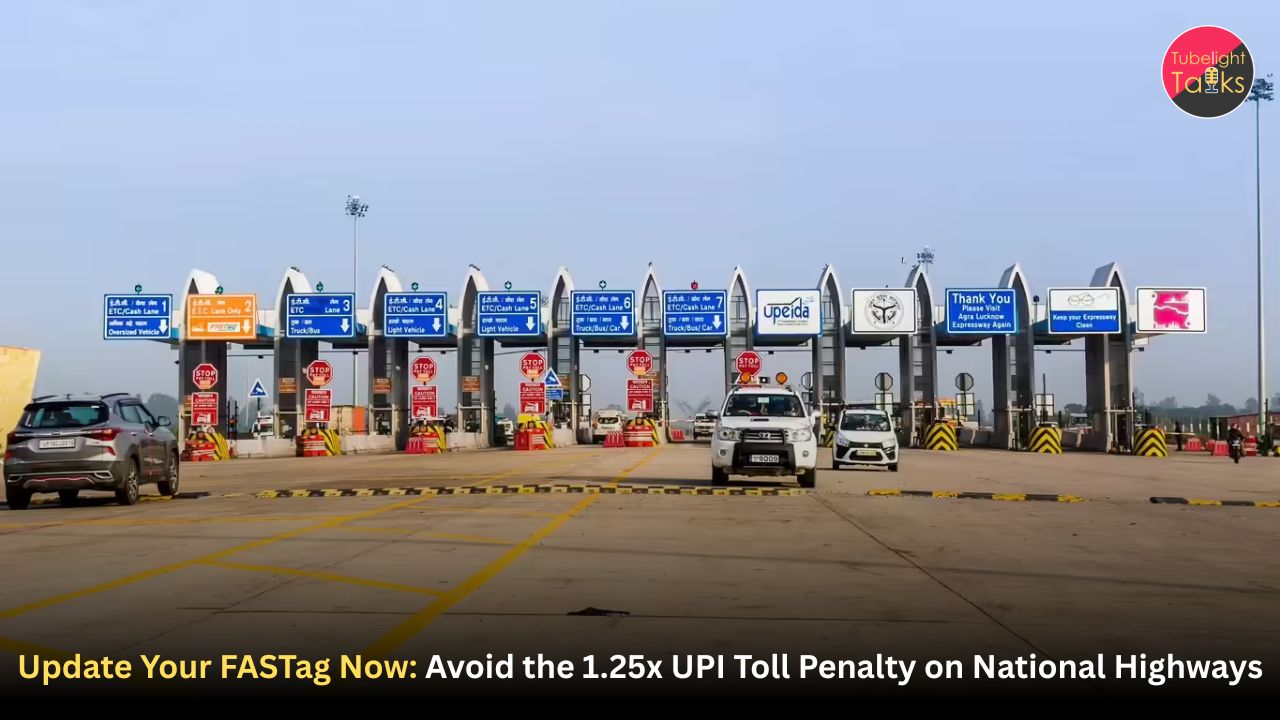
Update Your FASTag: Avoiding the 1.25x UPI Penalty on National Highways
Update Your FASTag Now: India’s toll system has entered a stricter digital phase, and that means a FASTag sticker by itself is no longer enough. What matters at a National Highway fee plaza is whether your FASTag is valid, functional, correctly linked to your vehicle, properly affixed on the windshield, and backed by sufficient balance.
The government’s amended toll framework, introduced in October 2025 and still reflected in Parliament replies in early 2026, allows users without a valid FASTag to pay through UPI at 1.25 times the normal fee, while cash can still trigger a double charge. For regular commuters, this turns FASTag maintenance into a direct money-saving habit, not just a digital convenience.
Why this FASTag update matters more in 2026
The most important point for motorists is that the 1.25x UPI rule is not a rumor. Official reporting on the Ministry of Road Transport and Highways amendment states that vehicles entering a toll plaza without a functional FASTag face higher fees. Recent parliamentary answers in 2026 refer to G.S.R. 734(E), confirming that the applicable user fee for vehicles without an active FASTag was reduced from 2 times to 1.25 times specifically for UPI users.
This means if a standard toll is ₹100, a valid FASTag user pays ₹100, a UPI user without a tag pays ₹125, and a cash user pays ₹200.
Also Read: India to Roll Out Barrier-Free Tolling on National Highways
What an “updated” FASTag actually means
A working FASTag is not just a sticker. Official guidance shows that a blacklisted tag is one that has been blocked by the issuer bank. Tags can be blacklisted due to insufficient balance, vehicle-tag class mismatch, or carrying the tag by hand instead of fixing it to the windshield. Maintenance is key; a tag with zero balance or one issued for a different vehicle class will result in the plaza rejecting the transaction, forcing the driver to pay the higher penalty rates.
KYC matters and the “One Vehicle, One FASTag” initiative
Many users ignore the importance of KYC. NHAI’s “One Vehicle, One FASTag” initiative mandates that users complete the KYC process as per RBI guidelines. FASTags with valid balances but incomplete KYC are now being deactivated or blacklisted by banks. Users are directed to discard old tags and keep only the latest active one. Multiple tags on a single vehicle or incomplete documentation are primary causes of avoidable toll disputes and delays at plazas.
How to avoid the 1.25x UPI toll charge
The easiest way to avoid penalties is to use auto-recharge. The government encourages linking FASTag wallets to UPI or savings accounts. Since National Highway toll plazas now operate on the ICD 2.5 protocol with real-time tag status, customers can recharge even minutes before crossing a plaza. Auto-recharge is particularly beneficial for logistics operators and daily commuters who otherwise lose money due to small, repetitive lapses in memory.
Check your status before leaving home
The My FASTag App offers a simple color-coded tool: green for active, orange for low balance, and red for blacklisted. Checking this status before a trip should be as routine as checking fuel or tires. A five-minute check at home is significantly cheaper than paying a 1.25x UPI charge at every plaza along a long journey. If the app shows orange or red, the user should resolve the issue before reaching the highway.
Use official grievance channels instead of arguing
If a dispute arises, motorists should use the National Highways 24×7 Toll-Free Helpline (1033) or the RajmargYatra App. The government is working to make the system more transparent, allowing users to submit complaints with photos or videos for false deductions. Using these digital tools is more effective than arguing in the lane, as the smartphone has become the primary device for both payment and dispute resolution in the modern highway network.
Know your rights if the toll equipment fails
Motorists have protections under the law. Official FASTag FAQs state that if the electronic toll collection equipment at a plaza is not working, but the vehicle has a valid FASTag with sufficient balance, the user must be permitted to cross free of cost. Being an informed commuter means knowing both your obligations and your rights regarding equipment failure and wrong deductions.
The future of tolling: Multi-Lane Free Flow
The tightening of digital rules is preparation for the next phase: Multi-Lane Free Flow. The government plans to use AI-enabled Automatic Number Plate Recognition and RFID-based FASTag to charge fees without making vehicles stop or slow down. In this barrier-less future, system readiness will be the only metric of compliance. Keeping your FASTag updated today is essential practice for a future where manual negotiations at a toll booth will no longer exist.
Road Discipline and Inner Discipline
This FASTag update carries a deeper life lesson about the cost of negligence. Just as a small lapse in road compliance leads to financial loss and frustration, spiritual life also requires discipline. Sant Rampal Ji Maharaj teaches that life should be guided by Satgyan and scriptures-based worship rather than carelessness.
His teachings emphasize that following the correct path of worship, like following the correct rules of the road, saves the soul from the penalties of suffering and leads to ultimate salvation. To understand this path of order and truth, one should read the sacred book Gyan Ganga and visit the official website at jagatgururampalji.org. Just as an updated FASTag ensures a smooth journey, Satgyan ensures a smooth path for the soul.
Related Stories








Discussion (0)