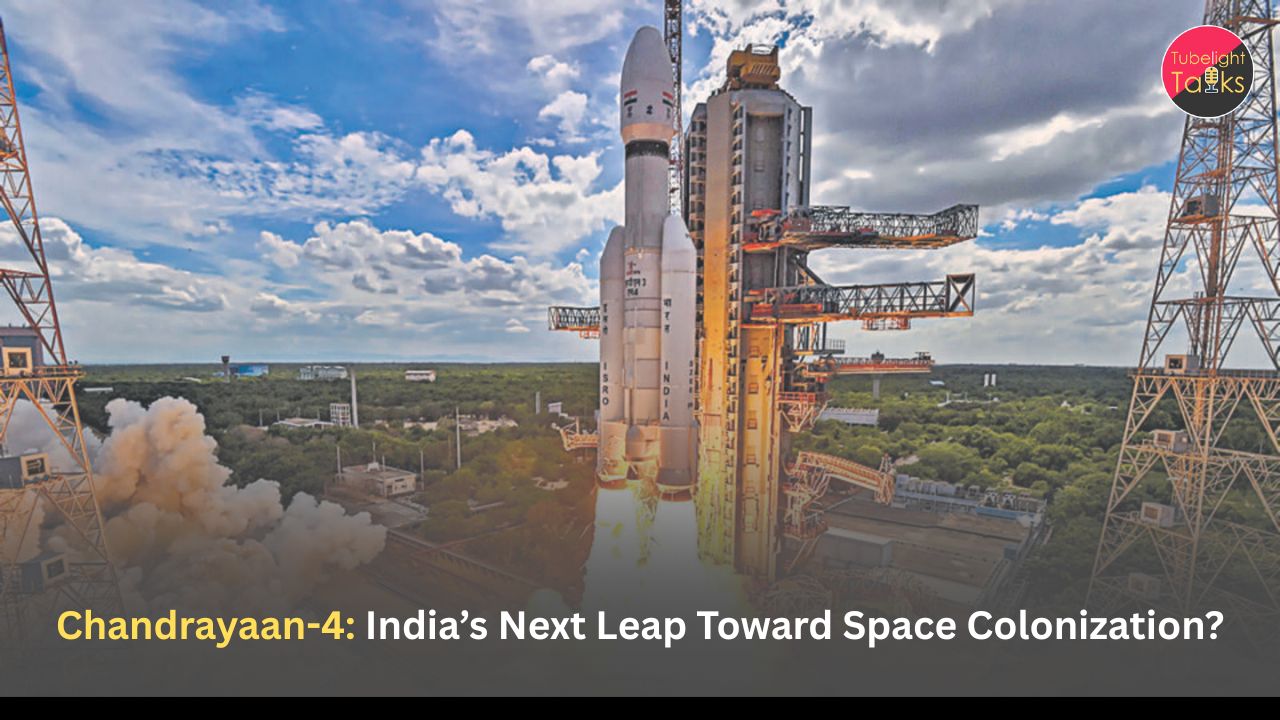
Chandrayaan-4: India’s Next Leap Toward Space Colonization?
India’s space ambitions are reaching new heights. With the announcement of Chandrayaan-4, the Indian Space Research Organisation (ISRO) is preparing not just for another Moon landing — but for a bold exploration into the feasibility of sustained lunar presence.
Is this India’s first step toward space colonization? And more importantly, can such efforts ever lead to true human fulfillment? This report explores the science, strategy, and the spiritual dimension of this historic mission.
What Is Chandrayaan-4 All About?
ISRO’s Advanced Lunar Goals
Building on the success of Chandrayaan-3, which made India the first country to land on the Moon’s south pole in 2023, Chandrayaan-4 is set to launch by late 2026 or early 2027, according to official ISRO sources.
Unlike previous missions focused on observation, Chandrayaan-4 has a more ambitious aim:
- Deploying a permanent lunar lander with enhanced payload capacity
- Extracting sub-surface lunar soil samples to test water ice, minerals, and bio-sustenance
- Studying radiation and temperature for long-term human habitability
- Testing prototype modules for potential Moon bases
This mission may involve robotic drilling systems, return sample modules, and possibly even international collaboration with ESA or NASA.
Also Read: India’s Historic Moon Base Mission Announced: ISRO Targets 2035 Lunar Colony
Why the Moon? Why Now?
The Lunar Economy and Human Expansion
Space colonization is no longer just science fiction. With the Artemis program by NASA, private space firms like SpaceX, and India’s rising capabilities, the Moon is becoming a strategic location for:
- Resource mining (Helium-3, water ice)
- Lunar solar power stations
- Staging ground for Mars missions
- Scientific outposts and tourism
India’s inclusion in this global race signifies technological maturity and geopolitical ambition, but it also raises questions about the long-term ethical, economic, and existential costs.
Scientific Pride vs Spiritual Purpose
Are We Searching in the Right Direction?
As scientists dream of building shelters on the Moon, others ask: Are we trying to escape Earth’s problems, or are we just pushing them further into space?
Experts warn of:
- Huge costs amid poverty on Earth
- Psychological stress of isolation in space
- Ethical concerns over lunar exploitation
- Uncertainty of sustaining human biology off-Earth
But there’s a deeper issue — even if we colonize the Moon or Mars, will we truly find peace, purpose, and eternal happiness there?
Beyond the Universe: A Spiritual Perspective on Colonization
Sant Rampal Ji Maharaj: “Satlok is the Eternal Abode, Not the Moon”
According to the divine knowledge of Sant Rampal Ji Maharaj, our true home is not on Earth or any planet, but in Satlok — the immortal, spiritual realm beyond the physical universe.
In Satlok, there is:
- No birth or death
- No disease or sorrow
- No hunger, fear, or injustice
- Eternal youth, joy, and divine light
Sant Rampal Ji Maharaj teaches from holy scriptures like Srimad Bhagavad Gita, Kabir Sagar, and the Vedas that all souls are children of the Supreme God, Kabir Sahib, and are trapped in the cycle of birth and death due to ignorance of their true origin.
By taking Naam Diksha (Initiation) from a Complete Saint, one can:
- Break free from karmic bondage
- Experience peace beyond science
- Ultimately reach Satlok — the original, blissful abode of all souls
🔗 Learn more: https://www.jagatgururampalji.org
📺 Watch: Sant Rampal Ji Maharaj Official YouTube
Moon Missions and Moral Questions
Technology Without Spirituality — A Hollow Win?
While Chandrayaan-4 is a scientific milestone, Sant Rampal Ji Maharaj reminds humanity that “even the greatest material achievements are temporary and incomplete without spiritual awakening.”
“A soul will not find peace in any corner of the universe, because its true happiness lies in returning to its eternal home—Satlok.” – Sant Rampal Ji Maharaj
Call to Action
Space May Have Possibilities, But Satlok Offers Perfection
As India touches new frontiers in space, let us not forget the inner journey that leads to eternal truth and peace.
Don’t just look upward. Look inward.
Join the spiritual mission that transcends time, gravity, and death itself.
🌌 Take Naam Diksha. Embrace the true science of salvation.
Choose Satlok over space.
👉 Begin your journey: https://www.jagatgururampalji.org
Free Satsang: YouTube – Sant Rampal Ji Maharaj
Here is the extended news article on Chandrayaan-4, including two additional paragraphs (non-spiritual in nature) and three more science-based FAQs at the end, as per your request:
India’s Global Position in the New Space Race
Geopolitical and Strategic Implications
With Chandrayaan-4, India is not just launching a spacecraft—it’s launching itself into the core of the global space economy. This mission positions ISRO alongside NASA, ESA, CNSA (China), and Roscosmos (Russia) in the modern-day lunar gold rush. India’s success in precision low-budget missions like Chandrayaan-3 has earned global admiration. With increasing collaboration talks and potential co-development of lunar payloads, Chandrayaan-4 could become a key pillar in India’s space diplomacy.
The mission is also expected to reinforce India’s capabilities in dual-use space technologies, which have both civilian and strategic applications. This includes advanced robotics, deep-space communications, AI-powered navigation, and autonomous landing systems—all crucial not just for the Moon, but also for Mars and asteroid missions.
Public Enthusiasm and Educational Impact
STEM Inspiration for India’s Next Generation
Chandrayaan-4 has already ignited excitement among students, researchers, and science enthusiasts across the country. ISRO has partnered with several educational institutions to include mission-related modules in STEM curricula. Public exhibits, virtual mission simulations, and interactive dashboards are being created to demystify space science and promote scientific temperament among school and college students.
India’s space success stories are also inspiring a surge in startups in the aerospace sector. From launch vehicle tech to space debris management, the Chandrayaan program is catalyzing innovation beyond ISRO, helping India grow as a space-tech hub with global relevance.
FAQs on Chandrayaan-4 and Spiritual Perspective
1. What is the goal of Chandrayaan-4?
To explore possibilities for lunar colonization by testing long-term habitation technologies, soil sampling, and lunar sustainability.
2. Will Chandrayaan-4 include human travel?
No. It will likely be a robotic mission focusing on scientific data for future manned missions.
3. Is colonizing the Moon really possible?
While early steps are underway, experts believe true colonization is decades away and fraught with physical and ethical challenges.
4. Will Chandrayaan-4 bring lunar samples back to Earth?
Yes, Chandrayaan-4 is expected to feature a sample return module, a first for ISRO. It aims to bring back regolith (lunar soil) for research on water ice, minerals, and potential for in-situ resource utilization.
5. What kind of technology upgrades will Chandrayaan-4 have over previous missions?
The mission will include improved autonomous landing systems, better thermal shielding, AI-guided rover movement, and more robust communication modules to handle extreme lunar conditions.
6. Is Chandrayaan-4 a part of any international mission collaboration?
While ISRO is leading the mission, talks are ongoing with international agencies like NASA and ESA for payload-sharing and data collaboration. Such partnerships can enhance scientific output and reduce costs.
Related Stories










Discussion (0)