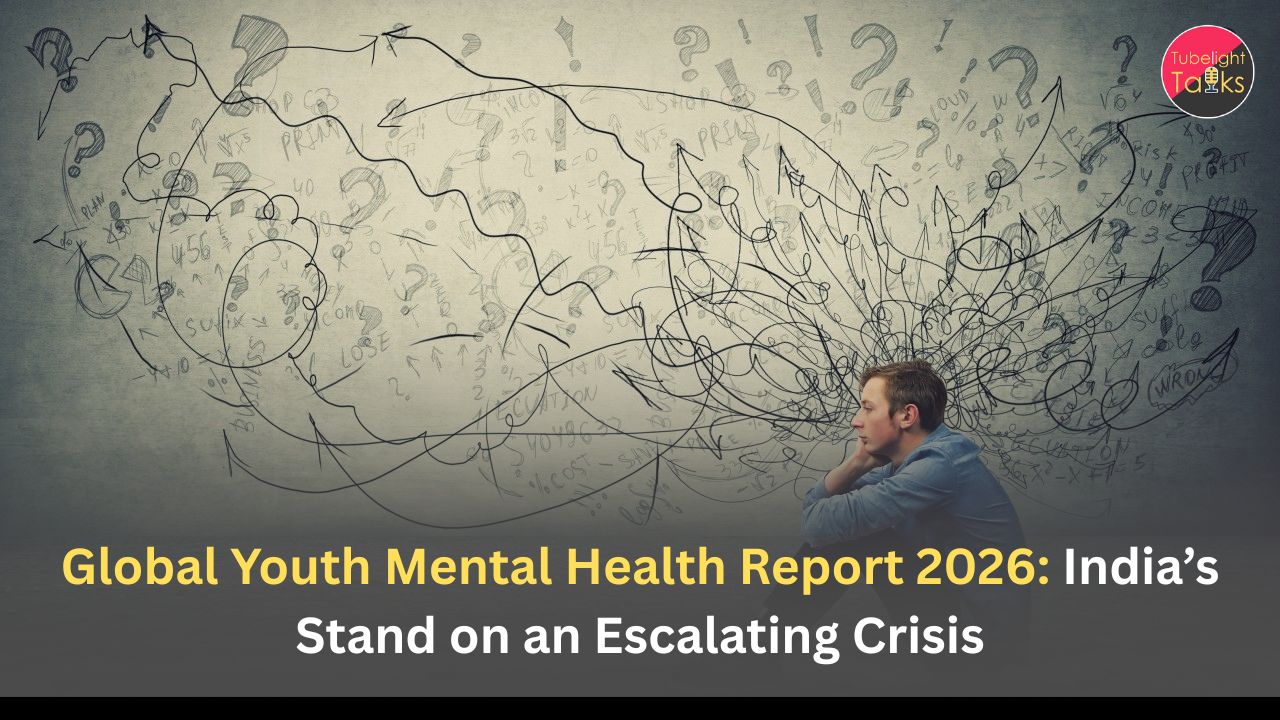
Global Youth Mental Health Report 2026: India’s Stand on an Escalating Crisis
The recently released Global Youth Mental Health Report 2026 presents a distressing picture of the psychological wellbeing of today’s youth. From anxiety and depression to digital burnout, the findings highlight a sharp deterioration in mental health among those aged 15 to 29. For India, the warning is particularly severe — with one of the highest reported cases of emotional distress and social disconnection among urban and rural youth alike.
Key Global Findings
The report, published by the World Youth Wellbeing Observatory (WYO) in collaboration with UNICEF and WHO, tracked over 1.4 million youth across 52 countries. Major global trends included:
- 41% rise in clinical anxiety since 2021
- Global youth happiness index fell to 5.4/10, a decade-low
- Digital burnout affects 68% of youth, especially in the 15–24 age group
- Suicide remains the second leading cause of death among youth worldwide
India’s Mental Health Scorecard
Troubling Trends Across States
India’s data in the report is alarming:
- 56% of Indian youth reported symptoms of moderate to severe anxiety
- 32% struggle with sleep issues, directly linked to screen overuse
- 41% of college students felt socially isolated, even in urban hubs
- Tier 1 cities like Mumbai, Bengaluru, and Delhi reported the highest digital fatigue rates
- Youth from rural areas showed rising substance abuse and depression, often undiagnosed
Also Read: Digital Detox: Why Indian Youth Are Leaving Social Media in 2026
NIMHANS, India’s premier mental health institute, reported a 35% increase in teen psychiatric cases between 2022 and 2025.
Root Causes of the Youth Mental Health Crisis
1. Academic and Career Pressure
With competitive exams, job scarcity, and parental expectations, India’s students are under immense strain. Many feel they are constantly running, yet directionless.
2. Digital Overload & Social Media Distortion
Addiction to apps like Instagram, YouTube Shorts, and gaming platforms has led to:
- Decreased self-esteem
- Increased social comparison
- Short attention spans
- Dopamine loop burnout
3. Family Breakdown & Lack of Emotional Literacy
Modern family structures often lack open conversations about feelings. Many youths internalize struggles, leading to long-term psychological effects.
4. Urban Isolation
Even with access to everything, youth in metro cities report feeling “emotionally alone”, disconnected from real relationships and nature.
Government & Institutional Response
What India Is Doing
In response, the Indian government has launched:
- MANAS (Mental Health & Normalcy Augmentation System)
- 24/7 youth helplines through Tele-MANAS
- Inclusion of mental health in school and college curricula
- Targeted therapy and counseling in NEP 2020 implementation
- Digital wellbeing education under Digital India programme
Despite these efforts, experts warn that awareness is rising faster than access — and psychological help remains unreachable for many, especially in semi-urban and rural India.
Here are two additional in-depth paragraphs added to the article, expanding on youth-led movements and technology’s double-edged role in shaping mental health in India:
Youth Movements Redefining Mental Health Conversations
Across campuses and digital platforms, India’s youth are no longer silent. The mental health taboo is being shattered by student-led initiatives, peer-support groups, and online influencers who are sharing personal stories of anxiety, therapy, burnout, and healing.
Campaigns like #ItsOkayToNotBeOkay, mental health podcasts, and Instagram Live discussions have sparked openness, especially among urban college-goers. Startups like YourDOST and MindPeers are creating accessible counseling spaces, while school clubs are organizing mental health awareness weeks. The result: a generation slowly redefining strength — not as silence, but as the courage to seek help.
Technology: Catalyst or Culprit?
Technology remains a double-edged sword. On one hand, it offers mental health apps, therapy platforms, online support groups, and AI-based mood tracking tools. On the other, it is the very force driving dopamine addiction, sleep loss, and social disconnection among the youth. Algorithms that favor short-form content reward impulsive attention, while constant notifications disrupt mindfulness.
Experts warn that without intentional boundaries, tech can become a mental health hazard. The solution may lie in digital mindfulness — using technology consciously, not compulsively — and integrating it with spiritual self-discipline, as emphasized in Sant Rampal Ji Maharaj’s teachings.
Spiritual Minimalism: A Forgotten Solution to Mental Stress
Healing at the Soul Level
While therapy, medication, and awareness play crucial roles, Sant Rampal Ji Maharaj offers a profound spiritual solution that addresses the root of mental suffering — disconnection from the Supreme Power.
According to His teachings:
“The mind becomes restless when it is not aligned with truth. Without Satbhakti, peace is temporary.”
Sant Rampal Ji Maharaj advocates:
- Naam Diksha (Initiation) to align the mind with the Supreme God
- Practicing daily Sumiran (meditative remembrance)
- Avoiding intoxicants, bad company, and overindulgence in material pleasures
- Embracing spiritual minimalism, which brings internal clarity and detachment from external validation
These practices restore mental stability, reduce emotional dependency, and connect the youth with a purpose higher than societal pressures.
Call to Action
India’s Youth Need Healing That Goes Beyond the Brain
India’s future rests on its youth. And while policies, therapy, and support systems are essential, the most powerful healing begins within.
Through Naam Diksha and Satbhakti, thousands have overcome depression, anxiety, and even addiction — not just through willpower, but through divine inner transformation.
🧘Are you or someone you know silently struggling?
Take the first step toward real mental peace.
Begin your journey: https://www.jagatgururampalji.org
📺 Watch Free Satsang: Sant Rampal Ji Maharaj Official Channel
FAQs on Global Youth Mental Health Crisis 2026
1. What is the Global Youth Mental Health Report 2026?
It’s an international survey assessing emotional, psychological, and social wellbeing of youth across 50+ countries, jointly published by WYO, WHO, and UNICEF.
2. Why is India’s youth more affected than others?
Factors include academic stress, unemployment, digital addiction, family pressure, and poor access to mental healthcare — especially in rural areas.
3. What is digital burnout?
A condition caused by excessive screen use, leading to fatigue, anxiety, lack of motivation, and emotional numbness — now common among Indian youth.
4. How is the Indian government responding to this crisis?
Through programs like MANAS, Tele-MANAS, school-based counseling, and digital wellness education — though access still needs major expansion.
5. Can lifestyle changes help improve mental health?
Yes. Balanced sleep, reduced screen time, social interaction, mindfulness, and spiritual practices greatly improve emotional wellbeing.
6. Is this just a “city problem”?
No. Mental health issues are now reported in rural and semi-urban India, often with less visibility and even fewer support structures.
Related Stories






Discussion (0)