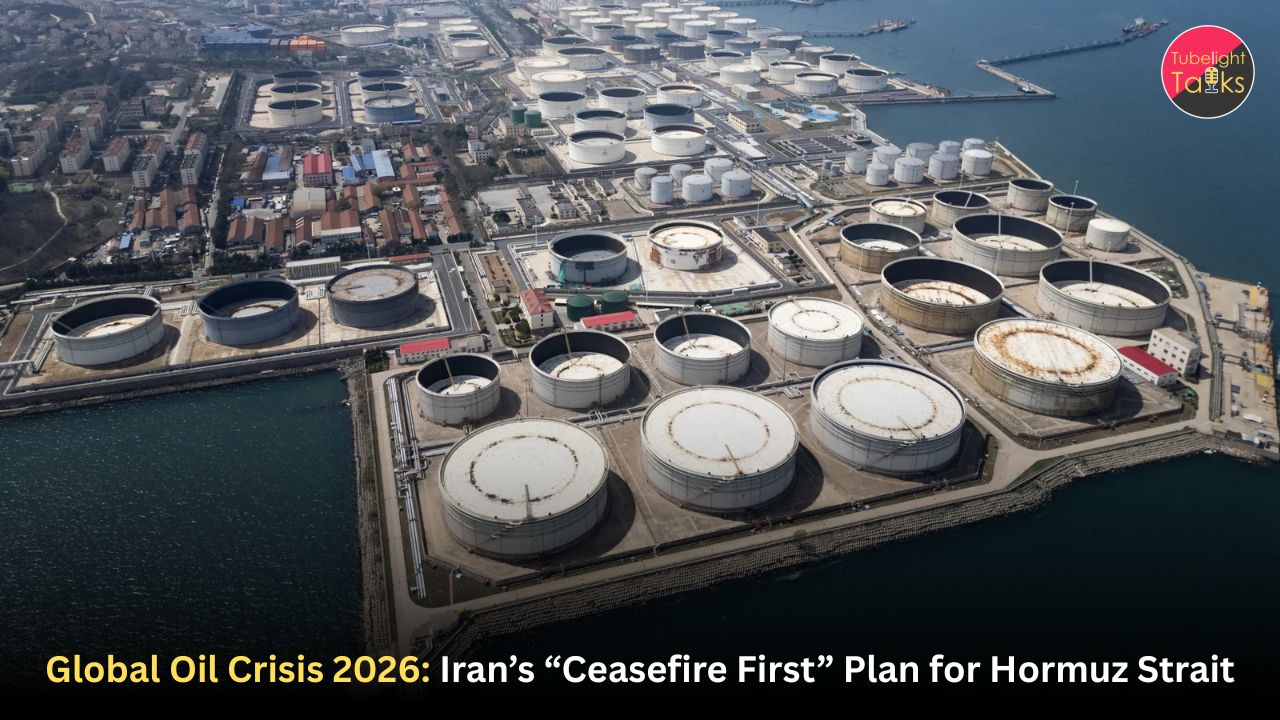
Crisis in the Strait of Hormuz: Can Iran’s “Ceasefire First” Plan Save the Global Oil Market?
The global economy is currently facing its sternest test of 2026 as the Strait of Hormuz, the world’s most critical oil transit chokepoint, becomes the center of intense geopolitical maneuvering. Over the last 24 hours, Iran has put forward a strategic proposal dubbed “Ceasefire First,” suggesting a total halt to regional maritime hostilities in exchange for the unhindered passage of oil tankers. With global crude prices teetering at record highs and supply chains beginning to fracture, the world is watching with bated breath to see if diplomacy can triumph over the drumbeats of war.
The Strategic Importance of the Hormuz Chokepoint
The Strait of Hormuz is a narrow waterway between Oman and Iran that connects the Persian Gulf with the Gulf of Oman and the Arabian Sea. It is mathematically the most significant chokepoint in the global energy infrastructure, with approximately 21 million barrels of oil, roughly 20 percent of the world’s total daily consumption, passing through its lanes.
Any disruption here causes an immediate and violent reaction in stock markets from Tokyo to New York. The current closure, or “soft blockade,” has already led to a 15 percent spike in Brent Crude prices within a single trading session.
Deconstructing the “Ceasefire First” Proposal
Iran’s proposal suggests that all regional maritime skirmishes, drone interventions, and tanker seizures should cease immediately to allow for a “cooling-off” period. Tehran argues that the escalating presence of foreign naval vessels in the Persian Gulf has created a “pressure cooker” environment. The proposal demands that regional security be managed by littoral states rather than international task forces. While the plan offers a path to reopening the shipping lanes, critics argue it is a tactical move by Iran to ease economic sanctions and reduce the US military footprint in the region.
The Trump Administration’s Security Response
In Washington, President Trump has convened an emergency session of the National Security Council. The administration’s stance has remained firm: “freedom of navigation” is a non-negotiable right under international law. While the White House has acknowledged receipt of the Iranian proposal, there is deep skepticism regarding the verification mechanisms of such a ceasefire. Military analysts suggest that the US is considering “protected convoy” operations, where commercial tankers are escorted by destroyers, a move that Iran warns would be viewed as an act of escalation.
Also Read: Strait of Hormuz Tensions Push Oil Prices Above $106
Impact on Global Energy Markets and Consumers
The uncertainty in the Middle East has translated into immediate pain at the pump for consumers worldwide. In India, Europe, and the US, fuel prices have reached levels not seen in a decade. This volatility is not just affecting transport; it is driving up the cost of manufacturing and food distribution. Shipping companies have seen insurance premiums for “War Risk” skyrocket by 400 percent, forcing many to reroute vessels around the Cape of Good Hope. This detour adds 15 days to the journey and thousands of tons in extra fuel costs, further fueling global inflation.
The Vulnerability of Liquefied Natural Gas (LNG)
Beyond petroleum, the Strait of Hormuz is the primary exit point for nearly all Liquefied Natural Gas from Qatar, one of the world’s top exporters. Countries like Japan, South Korea, and India, which have transitioned heavily toward gas for power generation and industrial use, are particularly vulnerable. A prolonged disruption could lead to industrial slowdowns and energy rationing in Asia. Energy ministers across the G20 are currently discussing the release of strategic reserves to prevent a total collapse of the energy market.
The Shift Toward Energy Independence
This crisis has reignited a fierce global debate over energy independence. Governments are being urged to accelerate their transition to renewable energy and domestic nuclear power to decouple their economies from Middle Eastern volatility. The “Green Shift” is no longer just an environmental goal; it has become a matter of national security. Analysts predict that if the Hormuz crisis persists for more than 30 days, it could permanently alter the global energy mix, as nations scramble to build massive battery storage and hydrogen infrastructure.
Naval Maneuvers and the Risk of Miscalculation
As the diplomatic back-and-forth continues, the waters of the Gulf are crowded with naval assets from a dozen nations. The risk of a “miscalculation,” a stray drone, a misunderstood signal, or a minor collision, leading to a full-scale conflict is at its highest point in years. The International Maritime Organization has issued an emergency advisory for all merchant vessels to maintain maximum security posture. Meanwhile, Operation Sentinel continues to monitor the waters using advanced AI-driven satellite surveillance to detect mine-laying activities.
Seeking a Permanent Diplomatic Resolution
The United Nations Security Council is scheduled to meet in an emergency session to debate a resolution based on Iran’s proposal. The goal is to establish a “Maritime Neutral Zone” overseen by a neutral third party, potentially a coalition of non-aligned nations. However, reaching a consensus is difficult, as major powers have conflicting interests in the region. The next 48 hours will be decisive: either the “Ceasefire First” plan provides a ladder for de-escalation, or the world prepares for a prolonged energy winter.
True Security in the Refuge of the Almighty
While nations struggle for control over oil and water, Sant Rampal Ji Maharaj reminds us that the only true “security” in this world comes from the protection of the Supreme God, Kabir Sahib. He explains that man-made conflicts arise from greed, ego, and a lack of spiritual understanding. By following the path of “Sat-Bhakti” True Devotion as prescribed in our holy scriptures, an individual can find an inner peace that no global crisis can disturb.
Sant Rampal Ji Maharaj teaches that we are all travelers in this temporary world, and our real goal should be to reach “Satlok,” the eternal home where there is no war, no scarcity, and no suffering. To understand the purpose of human life and find the path to ultimate salvation, one should read the sacred book Gyan Ganga and visit the official website at jagatgururampalji.org.
FAQs: Global Oil Crisis 2026
What is the “Ceasefire First” proposal?
It is an Iranian initiative suggesting a halt to all regional maritime hostilities to allow for the safe passage of oil tankers through the Strait of Hormuz.
Why are oil prices rising so fast?
Because 20 percent of the world’s oil passes through the Strait; any threat to this route creates a risk premium, driving prices up due to fear of supply shortages.
Is the US going to accept the deal?
The Trump administration is currently evaluating the plan but remains skeptical about how the ceasefire will be monitored and verified.
How does this affect India?
India imports a large portion of its oil and LNG through this route. A disruption leads to higher petrol prices and potential energy shortages.
What is the alternative if the Strait stays closed?
Ships must go around Africa, the Cape of Good Hope, which adds 15 days to the trip and significantly increases shipping costs and inflation.
Related Stories






Discussion (0)