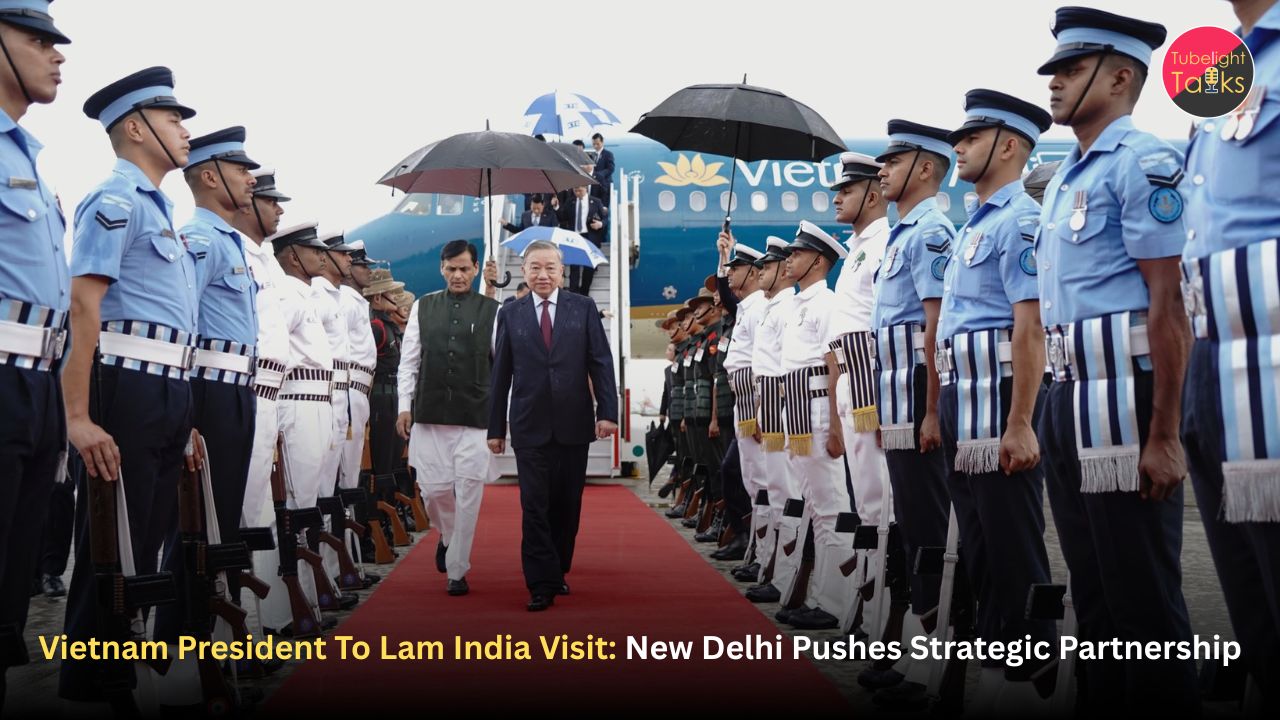
Vietnam President To Lam India Visit: Why It Matters Now
Vietnam President To Lam’s India visit comes at a time when regional partnerships in Asia are becoming increasingly important. The Ministry of External Affairs confirmed that President To Lam, who is also the General Secretary of the Central Committee of the Communist Party of Vietnam, is on a state visit to India from May 5 to 7 at the invitation of Prime Minister Narendra Modi. He is accompanied by a high-level delegation including ministers, senior officials, and a strong business delegation, showing that the visit is designed to cover both strategic and economic priorities.
This is President To Lam’s first state visit to India after being elected President of Vietnam in April 2026, making the visit diplomatically significant for both capitals. The official programme includes a ceremonial welcome at Rashtrapati Bhawan on May 6, wide-ranging talks with Prime Minister Modi, a meeting with President Droupadi Murmu, and visits to Bodh Gaya and Mumbai.
A Visit Built Around Trust and Strategic Timing
India and Vietnam have long shared close civilizational, cultural, and political relations. The relationship was elevated to a Comprehensive Strategic Partnership in 2016 during Prime Minister Narendra Modi’s visit to Vietnam, and this year marks the 10th anniversary of that major upgrade. MEA said the engagement is expected to give “fresh momentum” to bilateral relations and open new areas of cooperation.
For India, Vietnam is a key partner in its Act East Policy and Indo-Pacific outreach. For Vietnam, India is a trusted partner in defense, development, pharmaceuticals, digital technology, education, heritage conservation, and people-to-people exchanges. The current state visit is therefore not an isolated diplomatic event; it is part of a long-term strategic relationship that has matured through regular high-level exchanges.
Key Focus Areas: Defense, Trade, and Regional Stability
Defense Cooperation Remains a Central Pillar
India-Vietnam defense cooperation is one of the strongest pillars of the bilateral relationship. According to MEA’s official India-Vietnam relations document, the two countries signed a Memorandum of Understanding on Defence Cooperation in 2009, followed by a Joint Vision on Defence Cooperation in 2015. During Defence Minister Rajnath Singh’s visit to Vietnam in June 2022, both sides concluded the “Joint Vision Statement on India-Viet Nam Defence Partnership towards 2030” and signed a Memorandum of Understanding on Mutual Logistics Support.
The defense partnership has already seen concrete outcomes. India announced the gifting of the indigenously built missile corvette INS Kirpan to Vietnam in 2023, and military-to-military exchanges, training, ship visits, exercises, and maritime cooperation continue to form active areas of engagement.
In the current visit, defense cooperation is expected to remain high on the agenda, especially because both countries share concerns about maintaining peace, freedom of navigation, and a rules-based order in the Indo-Pacific. The emphasis is likely to be on capacity building, defense industry cooperation, maritime domain awareness, training, and logistics support rather than only symbolic announcements.
Also Read: UN General Assembly President Annalena Baerbock Announces Visit to New Delhi and Beijing
Trade and Business Delegations Add Economic Weight
Trade is another major focus of Vietnam President To Lam’s India visit. MEA data shows that India-Vietnam trade stood at USD 14.82 billion during April 2023-March 2024, with India’s exports to Vietnam at USD 5.47 billion and Vietnam’s exports to India at USD 9.35 billion. India’s exports include engineering goods, agricultural products, chemicals, pharmaceuticals, electronic goods, minerals, cotton, textiles, and plastics, while imports from Vietnam include computer and electronic goods, mobile phones, machinery, steel, footwear, garments, rubber, and wooden products.
The presence of a strong Vietnamese business delegation during the state visit signals that both sides are looking beyond diplomatic statements. Mumbai, one of India’s most important financial and business hubs, is part of President To Lam’s itinerary. That makes economic outreach an important feature of the visit.
India and Vietnam can expand cooperation in pharmaceuticals, digital public infrastructure, renewable energy, electronics, logistics, agriculture technology, startups, tourism, education, and resilient supply chains. As global companies diversify production networks, Vietnam’s manufacturing strength and India’s large market can complement each other.
New Delhi’s Diplomatic Outreach: A Wider Indo-Pacific Message
Regional Stability and the Indo-Pacific
The India-Vietnam Comprehensive Strategic Partnership has a wider regional meaning. Both nations support stability, dialogue, and peaceful settlement of disputes. In 2024, Prime Minister Modi and President To Lam met on the sidelines of the Summit of the Future at the UN General Assembly in New York, where they discussed bilateral cooperation and exchanged views on regional and global issues including the Indo-Pacific. PIB noted that both leaders underlined the collective role of the Global South at international platforms.
This makes the 2026 state visit an extension of an already active leadership dialogue. India and Vietnam are not only discussing bilateral gains; they are also contributing to a larger regional balance where maritime cooperation, economic resilience, and diplomatic trust matter deeply.
A Shared Civilizational Foundation
Civilizational links between India and Vietnam are not recent. MEA notes that Mahatma Gandhi and President Ho Chi Minh exchanged messages during their struggles for independence, and India established full diplomatic relations with Vietnam on January 7, 1972. These historical bonds give the partnership an emotional depth that pure geopolitics cannot provide.
President To Lam’s visit to Bodh Gaya also carries cultural and spiritual significance. Bodh Gaya is one of the most important Buddhist pilgrimage sites in the world, and Vietnam has a deep Buddhist cultural tradition. Official media reported that President To Lam was welcomed in Gayaji and visited the Vietnam Temple at Bodh Gaya during his India visit.
Also Read: Lord Buddha’s Relics: Sacred Piprahwa Relics Arrive in Ladakh for Historic Exposition
India-Vietnam Partnership: From Policy to People
Development Cooperation and Capacity Building
India’s development partnership with Vietnam has grown through training, education, capacity building, heritage conservation, and grassroots projects. MEA states that about 150 Vietnamese nationals attend sponsored training and educational courses in India annually. India has also undertaken Quick Impact Projects in Vietnamese provinces under the Mekong-Ganga Cooperation framework, with about 45 projects completed across more than 35 provinces since 2017.
India has also supported the conservation and restoration of the UNESCO World Heritage site of My Son in Quang Nam Province, a cultural project that reflects the historical connections between the two countries. This kind of cooperation helps the partnership remain people-centric rather than limited to official meetings.
Education, Tourism, and Cultural Exchanges
India and Vietnam also maintain strong educational, cultural, and people-to-people links. MEA data mentions that 392,000 Indians travelled to Vietnam in 2023, while tens of thousands of Vietnamese citizens visited India. The Swami Vivekananda Indian Cultural Centre in Hanoi, established in 2016, promotes cultural programmes, seminars, exhibitions, workshops, and closer people-to-people understanding.
These softer dimensions of diplomacy matter because they build trust across generations. Students, scholars, entrepreneurs, tourists, pilgrims, and cultural institutions often carry relationships forward beyond political cycles.
What Can Be Expected from the Visit?
Stronger Defense Understanding
The visit may lead to deeper conversations on maritime security, logistics cooperation, defense training, naval exchanges, and defense industry collaboration. Since India and Vietnam already have a defense vision document up to 2030, the current engagement can help review progress and identify the next practical steps.
Expanded Trade and Investment Pathways
Both countries may look for new ways to diversify trade, reduce supply chain risks, and promote business-to-business partnerships. Sectors such as pharmaceuticals, electronics, agriculture, information technology, renewable energy, tourism, and digital services have strong potential.
More Cooperation in Regional Forums
India and Vietnam are active voices in Asian and Indo-Pacific diplomacy. Their cooperation in ASEAN-linked platforms, the Global South, maritime dialogues, and multilateral forums can support a more balanced and peaceful regional environment.
Cultural Diplomacy with Spiritual Resonance
President To Lam’s visit to Bodh Gaya adds a softer but meaningful dimension to the state visit. Cultural diplomacy often strengthens political trust because it reminds nations that their connection is older than modern diplomatic language.
A Deeper Lesson in Peace, Trust, and Righteous Cooperation
Diplomacy becomes truly meaningful when it is guided not only by national interest but also by righteous conduct, honesty, restraint, and the desire for peace. The teachings of Sant Rampal Ji Maharaj and Sat Gyaan emphasize that true progress is not limited to material development; it must be supported by moral living, good karma, and the correct spiritual path.
His teachings discourage corruption, dishonesty, intoxicants, violence, and harmful social practices, while encouraging humility, truthful work, and a peaceful way of life. In the context of India-Vietnam relations, this spiritual perspective naturally connects with the larger message of cooperation: nations, like individuals, flourish when trust replaces suspicion and when dialogue is preferred over conflict.
Sat Gyaan teaches that worldly achievements become more valuable when they are aligned with the aim of human life—true worship, inner peace, and liberation from suffering.
Call to Action: Support Peaceful Diplomacy and True Knowledge
Vietnam President To Lam’s India visit reminds us that constructive dialogue can shape the future of regions and generations. Citizens should follow authentic updates from official sources, understand the importance of India-Vietnam cooperation, and support peaceful diplomacy. At the same time, every individual should also seek true spiritual knowledge that builds inner stability, honesty, and compassion.
Listen to the spiritual discourses of Sant Rampal Ji Maharaj through his official platforms and understand how Sat Gyaan can guide human life toward peace, discipline, and salvation. The format and content flow follow the uploaded Team 5 style reference.
FAQs on Vietnam President To Lam India Visit
1. Why is Vietnam President To Lam’s India visit important?
Vietnam President To Lam’s India visit is important because it comes during the 10th anniversary year of the India-Vietnam Comprehensive Strategic Partnership. The visit focuses on defense, trade, regional stability, business cooperation, and cultural ties.
2. When is President To Lam visiting India?
President To Lam is on a state visit to India from May 5 to May 7, 2026. His programme includes New Delhi, Bodh Gaya, and Mumbai, along with meetings with India’s top leadership.
3. What will PM Modi and President To Lam discuss?
Prime Minister Narendra Modi and President To Lam are expected to discuss the full range of bilateral relations, including defense cooperation, trade, investment, technology, regional and global issues, and Indo-Pacific stability.
4. How strong is India-Vietnam defense cooperation?
India-Vietnam defense cooperation is strong and structured through agreements such as the 2009 defense MoU, the 2015 Joint Vision, the 2030 defense partnership vision, and the Mutual Logistics Support MoU. India also gifted INS Kirpan to Vietnam in 2023.
5. What is the trade relationship between India and Vietnam?
India-Vietnam trade stood at USD 14.82 billion during April 2023-March 2024. India exports engineering goods, agricultural products, pharmaceuticals, electronics, minerals, textiles, and plastics, while Vietnam exports electronics, mobile phones, machinery, garments, footwear, and other products to India.
6. Why is Bodh Gaya part of President To Lam’s visit?
Bodh Gaya has deep Buddhist significance, and Vietnam has strong Buddhist cultural connections. President To Lam’s visit to Bodh Gaya highlights the civilizational and cultural side of India-Vietnam relations.
Related Stories
Discussion (0)