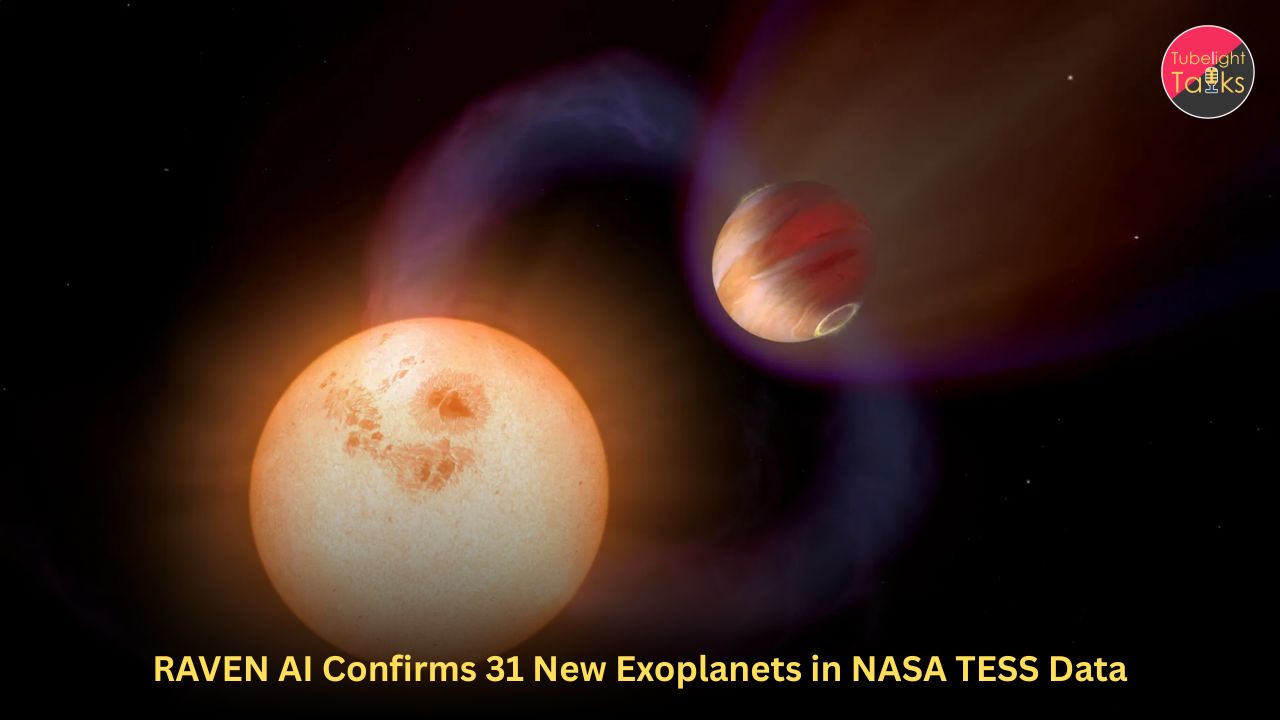
RAVEN AI Confirms 31 Brand-New Worlds Beyond Our Solar System
Astronomers using a new AI tool named RAVEN have confirmed 31 brand-new worlds outside our solar system, marking a major advance in modern planet hunting. Developed by researchers at the University of Warwick, RAVEN analyzed NASA TESS mission data from more than 2.2 million stars and validated 118 exoplanets in total. The breakthrough also identified more than 2,000 high-quality exoplanet candidates, including nearly 1,000 entirely new possibilities. While these are mostly close-orbiting planets rather than confirmed Earth-like homes, the discovery shows how machine learning in astronomy can speed up the search for hidden alien worlds.
RAVEN AI Tool: A New Era in Exoplanet Discovery
What Is RAVEN?
RAVEN stands for RAnking and Validation of ExoplaNets. It is an automated planet vetting and validation framework designed to solve one of the biggest challenges in modern astronomy: turning massive telescope datasets into reliable discoveries. NASA’s TESS mission produces huge amounts of brightness data from stars. Within that data are tiny dips in starlight, some of which may be caused by planets passing in front of their host stars. RAVEN uses artificial intelligence models trained on realistic simulations to separate true planetary signals from false positives such as eclipsing binary stars and instrumental noise.
This makes the RAVEN AI tool important because exoplanet discovery is not only about detecting a possible signal. Scientists must also determine whether that signal is really caused by a planet. Many events can imitate a planetary transit, and traditional vetting can take a long time. RAVEN brings detection, machine-learning vetting, and statistical validation into a single pipeline, giving astronomers a faster and more consistent way to analyze NASA TESS mission data.
Why the Discovery Is Making Headlines
The University of Warwick announced that astronomers validated over 100 exoplanets, including 31 newly detected planets, using RAVEN on data from NASA’s Transiting Exoplanet Survey Satellite. The team applied RAVEN to observations of more than 2.2 million stars collected during TESS’s first four years of operations. The study focused on planets orbiting close to their stars, completing one orbit in less than 16 days.
First author Dr Marina Lafarga Magro said the newly developed RAVEN pipeline validated 118 new planets and more than 2,000 high-quality planet candidates, with nearly 1,000 of those candidates entirely new. She called the result one of the best-characterized samples of close-in planets and said it will help identify promising systems for future study.
NASA TESS Mission: The Telescope Behind the Hidden Worlds
How TESS Finds Exoplanets
NASA’s TESS, or Transiting Exoplanet Survey Satellite, is an active space telescope launched on April 18, 2018. NASA describes TESS as a mission that discovers exoplanets, meaning worlds beyond our solar system. During its extended observations, TESS also monitors many objects that change in brightness, including asteroids, pulsating stars, and distant galaxies containing supernovae.
TESS primarily looks for transits. A transit happens when a planet passes in front of its star from our point of view, causing a small temporary dip in the star’s brightness. These dips can reveal a planet’s size, orbit, and sometimes help scientists choose targets for deeper follow-up studies. NASA notes that Kepler and TESS together have contributed to more than half of the over 6,000 known planets discovered outside our Sun.
Why AI Is Needed for TESS Data
TESS watches huge portions of the sky and produces an enormous amount of data. Human researchers cannot manually inspect every signal at the speed required by modern missions. That is where machine learning in astronomy becomes valuable. AI tools can quickly scan patterns, compare signals, and classify likely planet candidates.
NASA has also highlighted the growing role of AI in exoplanet research through tools such as ExoMiner++, an open-source model trained on Kepler and TESS data. NASA says such tools help distinguish real planet transits from similar-looking events, including eclipsing binary stars. RAVEN now adds another powerful example of how artificial intelligence can support planet validation.
Also Read: Artemis II and the ISS Complete a Historic Deep-Space Call
31 Brand-New Worlds: What Did Astronomers Find?
A Stronger Catalog of Close-In Planets
The 31 brand-new worlds confirmed by RAVEN are part of a larger group of 118 validated planets. Many of these are close-in planets, meaning they orbit very near their host stars. The Warwick team focused on planets with orbital periods shorter than 16 days, giving researchers a clearer picture of how common such short-period planets are around Sun-like stars.
These new exoplanet discoveries are not simply a list of strange objects. They form a scientifically useful sample. Because RAVEN also measures which planet types are easier or harder to detect, researchers can correct hidden biases in the data. This helps scientists estimate how common different kinds of planets really are, instead of only counting the planets that are easiest to spot.
Rare Planetary Populations
Among the newly validated planets are several valuable categories. These include ultra-short-period planets that orbit their stars in less than 24 hours, rare “Neptunian desert” planets found in a region where Neptune-sized planets are expected to be scarce, and close-orbiting multi-planet systems, including previously unknown planetary pairs around the same star.
Ultra-short-period planets are extreme worlds. They are so close to their stars that their surfaces may be intensely heated, making them unlikely to support life as we know it. But they are scientifically important because they help astronomers understand planet formation, orbital migration, atmospheric loss, and how stars shape nearby planets over time.
The Search for Habitable Planets: What This Discovery Means
Not Earth Twins, But Important Clues
The discovery of 31 brand-new worlds does not mean scientists have found 31 habitable planets. This is important to understand clearly. RAVEN’s current sample focused on close-orbiting planets with short orbital periods. Many such planets are likely too hot for Earth-like life. However, the breakthrough still helps the wider search for habitable planets because it improves the methods scientists use to find and confirm worlds in massive telescope datasets.
Habitable planets are expected to orbit in a region where conditions may allow liquid water on the surface, depending on atmosphere, star type, planet size, and other factors. Finding such planets requires careful detection and follow-up. RAVEN’s strength is that it can produce cleaner datasets, reduce false positives, and help researchers select the most promising targets for future observations.
Why Cleaner Data Matters
A false positive can waste telescope time. If astronomers believe a signal is a planet but it is actually caused by a binary star or instrument noise, follow-up observations may lead nowhere. RAVEN reduces this problem by using machine learning models trained on hundreds of thousands of realistic simulated planets and astrophysical events that can imitate planets.
Cleaner data is essential for future missions, including ground-based telescopes and space observatories that will study planetary atmospheres. The better the initial planet catalog, the better scientists can choose which worlds deserve deeper investigation.
RAVEN’s Scientific Edge
Full Workflow in One Pipeline
Many tools perform only one part of the exoplanet discovery process. Some detect signals, some vet candidates, and some help with validation. RAVEN is designed to handle the entire process: detecting the signal, vetting it with machine learning, and statistically validating the strongest cases. Warwick researchers said this all-in-one design gives RAVEN an edge over tools that focus only on specific parts of the workflow.
This matters because consistency is valuable in large-scale science. When millions of stars are analyzed through one carefully tested framework, the final catalog becomes more suitable for population-level studies.
Mapping Planetary Prevalence
The RAVEN project also helped researchers move beyond individual planet announcements. With a well-characterized set of validated planets, the team studied how frequently close-orbiting planets occur around Sun-like stars. A companion study found that around 9–10% of Sun-like stars host a close-in planet, consistent with NASA’s Kepler mission but with uncertainties up to ten times smaller.
The research also produced a direct measurement of “Neptunian desert” planets, finding that they occur around only 0.08% of Sun-like stars. This helps scientists understand why certain planet types are rare close to stars and how planetary atmospheres may be stripped away under intense radiation.
Also Read: Lunar Oxygen Prototype: Scientists Extract Oxygen From Simulated Moon Soil for Future Lunar Bases
Why the “Neptunian Desert” Is Important
A Cosmic Puzzle
The “Neptunian desert” refers to a region close to stars where Neptune-sized planets are unexpectedly rare. Scientists think this scarcity may be caused by intense stellar radiation, atmospheric escape, planet migration, and other formation processes. RAVEN’s ability to measure this population more precisely is valuable because it gives researchers stronger evidence to test theories of planetary evolution.
In simple words, the Neptunian desert tells us that planets do not survive equally in all orbits. Some are stripped down, some migrate, some become unstable, and some may never form in certain regions. By studying this desert, astronomers learn how planetary systems mature over millions or billions of years.
Learning From Extreme Worlds
Extreme planets are not necessarily habitable, but they are excellent laboratories. They help scientists study heat, gravity, radiation, atmosphere loss, and orbital dynamics. These lessons can indirectly improve the search for Earth-like planets by showing which planetary environments are stable and which are not.
AI and Astronomy: A Powerful Partnership
From Data Overload to Discovery
Modern astronomy has entered the age of data abundance. Telescopes can collect more information than traditional methods can process quickly. AI helps bridge this gap. RAVEN proves that machine learning in astronomy can do more than produce a list of possible planets; it can validate discoveries, measure detection biases, and improve population science.
NASA has also emphasized open science and open-source software as drivers of progress in exoplanet research. Its ExoMiner++ model is freely available for researchers to use on TESS’s growing public archive, reflecting the wider movement toward shared tools and reproducible science.
Human Expertise Still Matters
AI does not replace astronomers. It assists them. Scientists must design the models, create the simulations, interpret the results, check statistical validity, and plan follow-up observations. The RAVEN AI tool is powerful because it combines computational speed with scientific judgment.
This balance between technology and human wisdom is vital. Without human discipline, AI can amplify mistakes. With careful validation, it can become a remarkable instrument for discovery.
What Happens Next?
Follow-Up Observations
The 31 brand-new worlds and additional exoplanet candidates will require continued study. Astronomers may use ground-based telescopes, space observatories, radial velocity measurements, and atmospheric analysis to learn more about these systems. RAVEN has also released interactive tools and catalogs so other researchers can explore results and identify promising targets for future observations, including those that may be followed by upcoming missions such as ESA’s PLATO.
Building Better Planet Maps
The long-term goal is to build better maps of planetary systems in our galaxy. Scientists want to know how many stars have planets, how common small rocky worlds are, how often multi-planet systems form, and where potentially habitable planets may exist. Every validated exoplanet adds another piece to that cosmic puzzle.
The RAVEN breakthrough suggests that the future of astronomy will depend heavily on cooperation between telescopes, AI pipelines, open data, human researchers, and international missions.
A Bigger Question Beyond the Stars
Humanity’s search for new worlds is a sign of deep curiosity, but it also invites reflection on the purpose of life. Space research shows how vast the universe is, yet true peace is not found merely by counting planets. The teachings of Sant Rampal Ji Maharaj and Sat Gyaan explain that human life has a higher aim: to understand the Supreme God, follow true worship according to holy scriptures, and live with honesty, humility, and compassion.
Sant Rampal Ji Maharaj’s teachings emphasize righteous conduct, avoidance of dishonesty, intoxication, violence, and harmful actions, and the adoption of true devotion under the guidance of a complete spiritual teacher. Just as RAVEN helps scientists distinguish real planets from false signals, Sat Gyaan helps human beings distinguish true spiritual knowledge from incomplete traditions and confusion.
Scientific discovery expands our view of the universe, but true spiritual knowledge gives direction to the soul’s journey beyond this temporary world.
Call to Action: Explore Science, But Also Seek True Knowledge
The RAVEN AI tool has opened a new chapter in new exoplanet discoveries by confirming 31 brand-new worlds and validating 118 planets from NASA TESS mission data. Students, researchers, and science lovers should follow authentic space research, support open science, and understand how AI can help humanity explore the universe.
At the same time, every person should seek the deeper truth of human existence through Sat Gyaan and the spiritual discourses of Sant Rampal Ji Maharaj. Scientific knowledge tells us how vast creation is; true spiritual knowledge tells us why human life is precious. The writing style follows the uploaded Team 5 content reference.
FAQs on RAVEN AI Confirms 31 New Exoplanets in NASA TESS Data
1. What is RAVEN AI?
RAVEN is an automated planet vetting and validation framework called RAnking and Validation of ExoplaNets. It uses artificial intelligence to scan star brightness data, reject false positives, and statistically validate strong planet signals.
2. How many exoplanets did RAVEN confirm?
RAVEN validated 118 exoplanets in total, including 31 newly detected planets. It also identified more than 2,000 high-quality exoplanet candidates, with nearly 1,000 entirely new candidates.
3. Which space mission provided the data?
The data came from NASA’s TESS mission, the Transiting Exoplanet Survey Satellite. TESS searches for exoplanets by monitoring stars for small dips in brightness caused by planetary transits.
4. Are the 31 new exoplanets habitable?
The discovery does not confirm 31 habitable planets. RAVEN focused on close-orbiting planets with periods under 16 days, many of which are likely too hot for Earth-like life. However, the method improves the wider search for habitable planets by creating cleaner and more reliable catalogs.
5. Why is AI important in exoplanet discovery?
AI is important because telescope missions like TESS produce massive datasets. Machine learning tools can quickly detect patterns, separate real planetary signals from false positives, and help scientists prioritize follow-up observations.
6. What is the Neptunian desert?
The Neptunian desert is a region close to stars where Neptune-sized planets are unexpectedly rare. RAVEN helped measure this rare population, finding such planets around only 0.08% of Sun-like stars.
Related Stories









Discussion (0)