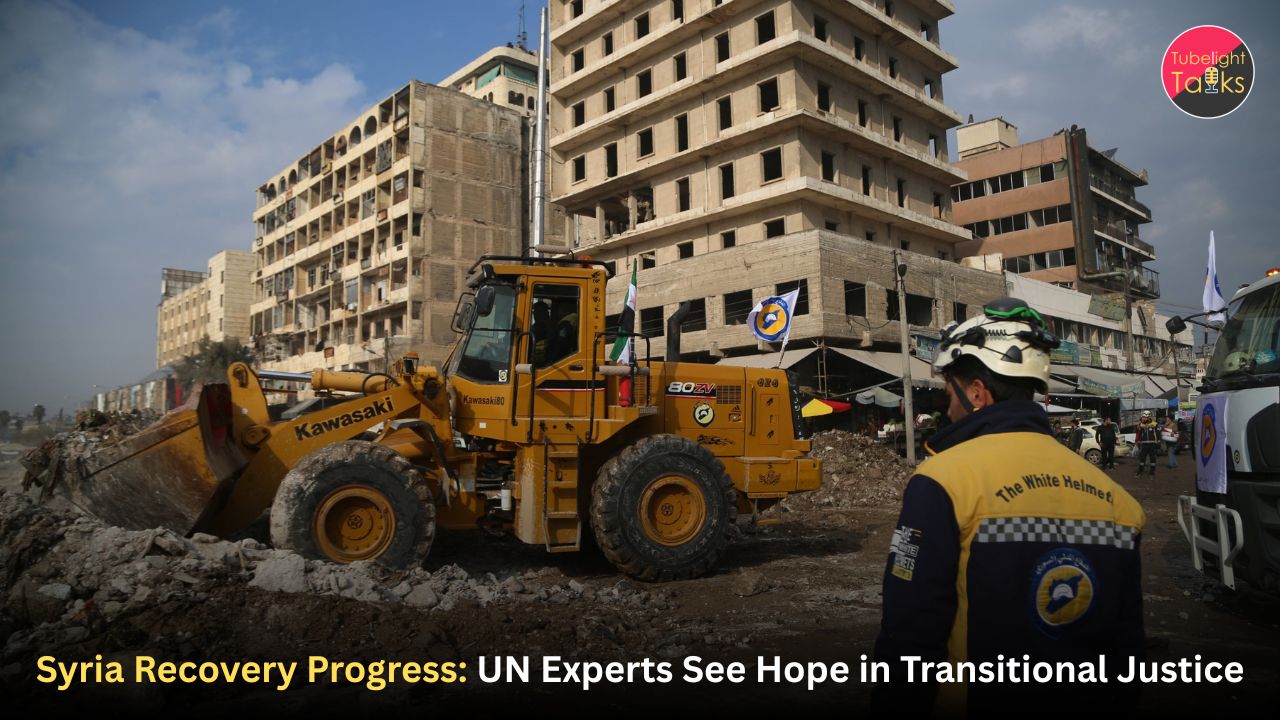
Syria Recovery Progress: UN Experts Report Remarkable Gains in Transitional Justice and Social Healing
UN experts have reported “remarkable progress” in Syria’s transitional justice efforts over the past year, raising cautious hope for accountability, social recovery, and long-term stability after more than a decade of conflict. The progress follows Syria’s dramatic political transition after the fall of the Assad regime in December 2024 and the emergence of new national institutions focused on justice, missing persons, survivor support, and recovery.
Yet the path remains fragile. The country still faces weakened courts, widespread trauma, displacement, funding shortages, damaged public services, and serious security concerns. Syria’s recovery is no longer only about rebuilding roads and buildings; it is about rebuilding trust, dignity, justice, and social cohesion.
Syria Recovery Progress: Why the UN Report Matters
“Remarkable Progress” in One Year
The United Nations Office at Geneva reported on April 14, 2026, that Syria has made “remarkable progress” on transitional justice within the past year. Sofia Candeias, a Judicial Affairs Officer with the UN Team of Experts on the Rule of Law and Sexual Violence in Conflict, said it was remarkable that Syrians were able to put so much in place in just one year.
This statement is significant because transitional justice is usually a long and difficult process. It involves investigating crimes, protecting victims and witnesses, preserving evidence, supporting survivors, searching for missing persons, rebuilding courts, reforming institutions, and creating public trust. In Syria, these tasks are especially complex because the country has endured years of civil war, mass displacement, detention, torture, sexual violence, enforced disappearances, destroyed infrastructure, and deep social fragmentation.
Progress Does Not Mean the Crisis Is Over
The same UN report also cautions that Syria’s progress rests on fragile ground. It notes weakened institutions, widespread trauma, limited forensic and judicial capacity, and declining international funding as serious obstacles. Ms. Candeias warned that if resources do not arrive, evidence may be lost, survivors may disengage, and early trust in emerging institutions could erode.
This makes Syria’s recovery progress both hopeful and urgent. The country has opened a window for accountability, but that window can close if national institutions and civil society are left without technical, financial, and political support.
What Is Transitional Justice?
Justice After Conflict
Transitional justice refers to the ways societies deal with past mass violations when moving from conflict or authoritarian rule toward peace and democracy. It can include criminal trials, truth commissions, reparations, institutional reform, missing persons work, memorialization, documentation, and community reconciliation.
In Syria’s case, transitional justice must address years of detention abuses, enforced disappearances, torture, sexual violence, killings, displacement, property loss, and other violations. It must also avoid turning justice into revenge. The goal is accountability with fairness, dignity for victims, and reconstruction of public trust.
Survivor-Centered Approach
The UN report highlights the importance of listening to survivors, especially survivors of conflict-related sexual violence. Ms. Candeias said civil society organizations are the backbone of transitional justice and the only way to truly listen to survivors. Syrian civil society groups have spent years documenting human rights violations, which may form the evidentiary foundation for future prosecutions.
This survivor-centered approach matters because justice cannot be built only in courtrooms. Survivors need safety, medical care, psychosocial support, legal assistance, protection from stigma, and confidence that institutions will not harm them again.
UN Support for Syria’s Rule of Law
UN Team of Experts Working With National Institutions
The UN Team of Experts on the Rule of Law and Sexual Violence in Conflict has been working in Syria since the fall of the Assad regime in December 2024. The team supports national institutions in investigating and prosecuting conflict-related sexual violence while strengthening broader rule-of-law systems. It has worked with Syrian bodies including the National Commission for Transitional Justice, the Commission for Missing Persons, ministries, and civil society organizations.
The team is co-led by the UN Department of Peace Operations, OHCHR, UNDP, and the Office of the Special Representative of the Secretary-General on Sexual Violence in Conflict. This multi-agency support reflects the scale of Syria’s needs: justice is not only a legal issue, but also a development, human rights, gender, and peacebuilding issue.
Syrian-Owned and Syrian-Led Process
The UN continues to support a Syrian-led and Syrian-owned political process in line with Security Council resolutions 2254 and 2799.
This principle is important. International experts can provide technical support, training, and resources, but Syria’s justice and recovery process must be owned by Syrians. If justice appears imposed from outside, it may fail to gain public legitimacy. If it is controlled only by political elites, it may fail victims. The balance must include national institutions, civil society, survivors, local communities, women, youth, displaced people, and minority groups.
Social Recovery and Civil Peace
Social Cohesion Becomes a National Priority
Syria’s recovery is also about social cohesion. SANA reported on April 23, 2026, that Minister of Social Affairs and Labor Hind Kabawat met UN Deputy Special Envoy Claudio Cordone to discuss ways to advance transitional justice and mechanisms for civil peace and social cohesion. The meeting reviewed measures to curb hate speech and promote dialogue and acceptance among all components of Syrian society.
This is a crucial part of long-term stability. After years of war, communities may carry fear, anger, grief, and mistrust. Many Syrians have lost relatives, homes, livelihoods, documents, and social networks. Social recovery requires more than legal reform; it requires dialogue, local peacebuilding, community services, trauma support, education, employment, and fair political participation.
From Emergency Aid to Sustainable Recovery
The same SANA report said earlier meetings with UN Resident and Humanitarian Coordinator Nathalie Fustier focused on aligning UN support programmes with Syria’s national development policies to move from emergency aid toward sustainable socio-economic recovery. (sana.sy)
This shift is important because emergency aid keeps people alive, but sustainable recovery helps people rebuild lives. Syria needs both. Food, medicine, shelters, and humanitarian relief remain essential, but they must gradually connect with livelihoods, schools, health systems, justice institutions, local governance, housing, and community stability.
Syria’s 2026 Recovery Landscape
A Pivotal Crossroads
The UN’s 2026 Common Country Analysis for Syria says the country stands at a pivotal crossroads after 14 years of conflict, with progress achieved in 2025 opening pathways from emergency relief toward nationally led recovery, reconstruction, and sustainable development. It notes that the Government of Syria has taken steps including launching a national dialogue process, organizing indirect elections, advancing reintegration into the international community, liberalizing the economy, and helping facilitate easing of sanctions.
The analysis also states that in March 2026, the Government issued a “Statement of Recovery Priorities for International Cooperation,” setting out a nationally owned vision to restore stability, rebuild institutions, and expand opportunities for Syrians.
Fragility Remains Serious
Despite these openings, the UN assessment warns that Syria’s overall situation remains fragile. It highlights widespread lawlessness, incomplete integration of armed factions, localized violence, displacement, terrorism risks, Israeli military actions inside Syrian territory, and severe economic and social challenges.
This means Syria’s recovery progress should not be romanticized. The country is not suddenly stable. It is in a delicate transition where gains can strengthen if supported—or collapse if neglected.
Also Read: India Approves ₹30 Billion Support for Maldives Under SAARC Framework
The Missing Persons Challenge
Families Still Waiting
One of Syria’s most painful issues is the fate of missing persons. During years of conflict, thousands of people disappeared into detention facilities, armed group prisons, checkpoints, mass graves, or displacement chaos. Families often do not know whether loved ones are alive or dead.
The UN report notes that the Team of Experts has worked with the Commission for Missing Persons. This work is central to transitional justice. Families need truth, identification of remains where possible, legal clarity, inheritance rights, psychosocial support, and recognition of suffering.
Truth Is Part of Recovery
No society can fully recover when families are forced to live in permanent uncertainty. Truth-seeking is not only a legal process; it is a human need. For many Syrians, knowing what happened to a missing parent, spouse, child, or sibling is the first step toward emotional healing.
Conflict-Related Sexual Violence
A Hidden but Devastating Crime
The UN report identifies conflict-related sexual violence as one of the most serious and least visible challenges in Syria’s justice process. Ms. Candeias said the full scale of the problem is unknown and may never be fully known. She described sexual violence as widespread and systematically used during the conflict, including in detention centres, at checkpoints, and during displacement.
This is a deeply sensitive issue because stigma often silences survivors. Many women, girls, men, and boys may never report what happened because of fear, shame, rejection, or retaliation.
Safe Spaces and Survivor Support
The UN emphasizes the need for safe spaces where survivors can access medical care, psychosocial support, and legal assistance without stigma or fear. Ms. Candeias said acknowledging the gravity of sexual violence as a crime is the first step toward placing shame on perpetrators rather than survivors.
This principle is essential for Syria’s social recovery. Survivors should not carry society’s silence alone. Justice systems, religious leaders, local communities, families, and media must help create an environment where victims can seek help safely.
Economic and Social Recovery
Poverty and Basic Services
The UN Common Country Analysis states that Syria’s economy continues to operate below potential due to a devastated industrial base, constrained fiscal and monetary space, limited investment, and a weakened financial system. It also says poverty and food insecurity remain widespread, while health, education, water, sanitation, and housing require substantial rehabilitation.
This is where justice and development meet. A court system cannot rebuild trust if people have no food, schools, jobs, medicine, electricity, or housing. Social recovery requires both accountability and public service restoration.
“No Camps 2026” and Dignified Living
The UN analysis notes that Syria launched a “No Camps 2026” policy initiative aimed at transitioning displaced populations away from prolonged encampment toward more sustainable and dignified living arrangements. It says the campaign seeks to facilitate access to housing, basic services, and livelihood opportunities within host communities and return areas.
This policy reflects a shift from emergency displacement management toward long-term solutions. But implementation will require funding, housing, land and property protections, local services, safety guarantees, and community acceptance.
Why International Support Is Still Needed
Institutions Need Capacity
The UN report warns that Syria’s medical, forensic, and judicial systems have been hollowed out by years of conflict. Without forensic capacity, evidence cannot be properly collected or preserved. Without trained investigators and prosecutors, cases cannot move forward. Without psychosocial support, survivors may not come forward.
This makes international support practical, not symbolic. Syria needs training, equipment, secure evidence systems, court rehabilitation, witness protection, forensic laboratories, trauma services, and independent legal expertise.
Funding Cuts Could Reverse Progress
Ms. Candeias warned that support for civil society organizations and national institutions has declined. She said Syria has done groundwork in one year, but now needs services and technical response.
If international partners reduce funding too soon, early progress may be wasted. Survivors could lose trust. Evidence could disappear. Civil society documentation could stop. Courts could become symbolic rather than effective.
Recovery With Justice and Inner Healing
Syria’s recovery progress shows that societies can begin rebuilding even after deep suffering, but lasting recovery requires both external justice and inner transformation. The teachings of Sant Rampal Ji Maharaj and Sat Gyaan emphasize truth, compassion, humility, righteous conduct, and true worship according to holy scriptures. His teachings guide people away from violence, intoxication, corruption, hatred, dishonesty, and harmful actions.
In a country recovering from war, this message naturally connects with the need for peace and social trust. Transitional justice can hold perpetrators accountable, but spiritual knowledge helps human beings overcome revenge, ego, and hatred. Sat Gyaan teaches that real peace comes when individuals and societies follow righteousness and connect with the Supreme God through true devotion. Syria’s legal recovery is important, but the deeper healing of hearts is equally necessary for long-term stability.
FAQs on Syria Recovery Progress
1. What did UN experts say about Syria’s recovery?
UN experts said Syria has made “remarkable progress” on transitional justice within the past year, raising hope for accountability and recovery, but they warned that sustained international support remains essential.
2. What is transitional justice in Syria?
Transitional justice in Syria refers to efforts to address conflict-era violations through accountability, missing persons work, survivor support, evidence preservation, institutional reform, and rebuilding public trust.
3. Which institutions are involved in Syria’s justice process?
The UN Team of Experts has worked with Syrian bodies including the National Commission for Transitional Justice, the Commission for Missing Persons, ministries, and civil society organizations.
4. Why is social cohesion important for Syria?
Social cohesion is essential because Syria’s war created deep mistrust, trauma, displacement, and community divisions. Recent UN-linked discussions in Damascus focused on curbing hate speech and promoting dialogue and acceptance among all components of Syrian society.
5. What are the biggest challenges to Syria’s recovery?
Major challenges include weakened courts, limited forensic capacity, widespread trauma, displacement, poverty, food insecurity, damaged public services, funding shortages, and ongoing security risks.
6. Why does Syria still need international support?
Syria needs technical and financial support for justice institutions, civil society documentation, survivor services, forensic capacity, psychosocial care, safe spaces, and sustainable recovery programmes. UN experts warn that without support, early progress could be reversed.
Related Stories



Discussion (0)