Oxford’s Sacred Text Tour: Shikshapatri Begins Historic UK Journey to Mark Bicentenary
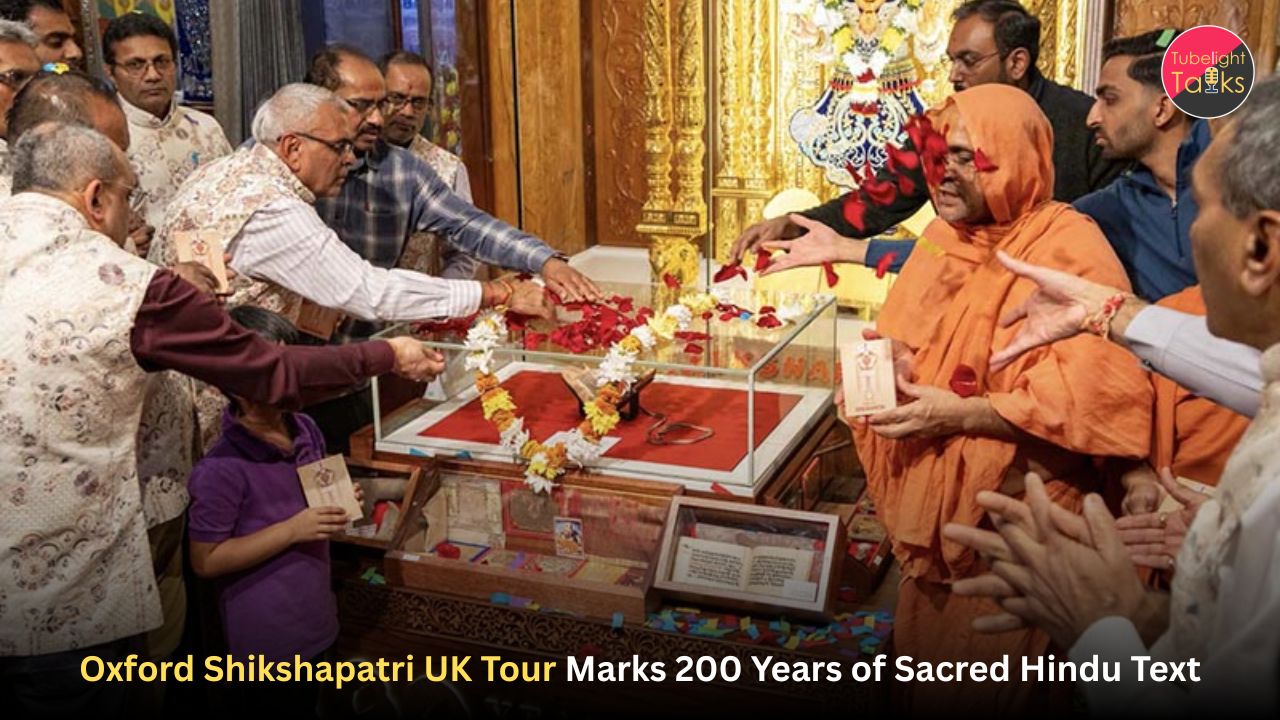
Oxford’s Bodleian Libraries have launched a historic UK tour of the Shikshapatri, one of the most revered Hindu manuscripts in the Swaminarayan tradition, to mark its 200th anniversary. Usually housed at the Weston Library in Oxford, the rare manuscript is being displayed at prominent Swaminarayan temples across the United Kingdom.
Composed in 1826 at Vadtal in Gujarat by Sahajanand Swami, also known as Lord Swaminarayan, the Shikshapatri contains 212 Sanskrit verses offering guidance for ethical, moral and spiritual living. The tour is not only a religious event; it is also a celebration of cultural diversity, community devotion and interfaith dialogue.
Shikshapatri UK Tour: Why This Moment Is Historic
A Rare Manuscript Leaves Oxford
The Shikshapatri manuscript normally remains protected within Oxford’s Bodleian Libraries, one of the world’s most respected library systems. For the manuscript to travel outside Oxford and be displayed in temples is a rare and meaningful moment. It brings a sacred heritage object closer to the communities for whom it holds deep religious and emotional value.
The tour has been organised in collaboration with leaders of the Swaminarayan faith. It is expected to attract tens of thousands of visitors, including devotees, scholars, community leaders, students, families and people interested in Hindu heritage.
For many devotees, seeing the manuscript is not only an academic experience. It is a moment of darshan, reverence and connection with a text that has guided generations.
Bicentenary of a Sacred Text
The tour marks 200 years since the Shikshapatri was composed in 1826. The word “Shikshapatri” means “letter of teachings.” Its 212 verses summarize principles of religious duty, personal discipline, ethical conduct, devotion, social responsibility and spiritual living.
The bicentenary is therefore not only about remembering a historical manuscript. It is about reflecting on how moral guidance written two centuries ago continues to shape the daily lives of devotees in the modern world.
What Is the Shikshapatri?
A Letter of Teachings
The Shikshapatri is a concise Sanskrit text composed by Sahajanand Swami, revered by followers as Lord Swaminarayan. It offers practical teachings for spiritual and social conduct. Its verses guide followers on devotion, compassion, non-violence, honesty, cleanliness, discipline, vegetarian living, respect for parents, responsible social conduct and avoidance of sinful behavior.
Its language is brief, but its influence is deep. The text is recited, studied and respected by millions within the Swaminarayan tradition. It has been printed in many editions and translated into different languages, helping the message reach communities across India and the global diaspora.
Ethical Living at the Center
The Shikshapatri is not merely a ritual text. It is a moral guide. It emphasizes that spiritual life must be reflected in daily conduct. A person’s devotion should appear in honesty, compassion, self-control, respect for others and avoidance of harmful actions.
This makes the text relevant beyond one community. In a world facing violence, addiction, family breakdown, dishonesty and social tension, teachings based on restraint and ethical conduct remain deeply significant.
Oxford, India and a Shared Historical Journey
From Gujarat to Oxford
The manuscript’s journey from Gujarat to Oxford is part of a wider history of India, colonial-era exchange, religious transmission and manuscript preservation. One of the historically important copies of the Shikshapatri was personally presented by Sahajanand Swami to Sir John Malcolm, then Governor of Bombay, in 1830.
This gives the manuscript a unique place in Indo-British historical memory. It is both a sacred Hindu text and a historical object that travelled through colonial-era networks before becoming part of the Bodleian collection.
Also Read: Konark Sun Temple Restoration: ASI Begins Historic Sand Removal After 123 Years
Returning to the Community
The UK tour carries symbolic power because the manuscript is being shared directly with temple communities. For years, it was accessible mainly through academic display or digital viewing. Now, devotees can see it in sacred spaces where its teachings are lived and practiced.
This represents a respectful model of heritage sharing. Instead of keeping a sacred manuscript only behind library glass, Oxford is allowing the community to engage with it spiritually and culturally.

UK Temple Tour and Community Participation
Major Temples Across the UK
The Shikshapatri tour includes prominent Swaminarayan temples across the United Kingdom, including temples in London, Wales and other community hubs. Earlier stops included Woolwich, Kenton, Cardiff, East London and Willesden, with further displays scheduled at Stanmore and Kingsbury.
Each stop is more than a display. Temples have organized prayer, educational sessions, cultural programmes, devotional gatherings and community engagement around the manuscript. Families are bringing children so the younger generation can understand the importance of scripture, discipline and cultural memory.
Diaspora Identity and Faith
For the Hindu diaspora in the UK, the Shikshapatri tour strengthens cultural identity. Many second- and third-generation British Hindus grow up balancing modern British life with Indian spiritual heritage. A tour like this helps connect them with language, scripture, history and values.
It also gives non-Hindu visitors an opportunity to learn about the Swaminarayan tradition and the broader diversity within Hinduism. In this way, the tour supports interfaith dialogue and cultural education.
Cultural Diversity and Interfaith Dialogue
A Text Beyond One Community
Although the Shikshapatri is central to the Swaminarayan tradition, its ethical themes can be appreciated by people from many backgrounds. Non-violence, truthfulness, respect, self-control and compassion are values shared across religious and philosophical traditions.
By displaying the manuscript publicly in UK temples and discussing its message, the tour creates an opportunity for interfaith understanding. It shows that sacred texts are not relics of the past; they can still guide conversations about morality, society and human behavior.
Britain’s Multicultural Landscape
The United Kingdom is home to a large and diverse Indian-origin population, including Hindus from many traditions. Public celebration of sacred texts like the Shikshapatri reflects the richness of Britain’s multicultural society.
At a time when many societies struggle with identity politics and social division, such cultural events can build respect. They remind people that diversity becomes a strength when communities share their heritage with dignity and openness.
Manuscript Preservation and Public Access
Why Libraries Matter
Libraries like the Bodleian preserve rare manuscripts for future generations. Without careful conservation, many historic texts would be damaged by light, humidity, handling, insects, ink decay or paper deterioration. Preservation allows scholars and communities to access texts long after their original creation.
The Shikshapatri tour shows that preservation and public access can work together. A manuscript can be protected scientifically while also being shared respectfully with living communities.
Digital and Physical Heritage
In the digital age, many manuscripts can be viewed online. This is useful for researchers and global audiences. But physical viewing remains powerful, especially for sacred texts. Standing before an original manuscript creates emotional and spiritual impact that digital images cannot fully replace.
The tour combines both worlds: modern conservation and living devotion.
Lessons From the Shikshapatri for Modern Society
Discipline in Daily Life
The Shikshapatri teaches that spirituality must influence daily behavior. It emphasizes self-discipline, good conduct and responsibility. These lessons are relevant today because modern life often promotes speed, consumption, distraction and selfishness.
A society guided by discipline becomes more stable. Families become stronger. Communities become safer. Individuals become more peaceful.
Non-Violence and Compassion
The text promotes non-violence and compassion. These values are essential in a world affected by war, crime, social hatred, domestic violence and online abuse. Spiritual texts remind humanity that strength is not cruelty. True strength lies in restraint and kindness.
Honesty and Moral Conduct
Honesty is a central pillar of any healthy society. Corruption, cheating, exploitation and falsehood damage both individuals and nations. The Shikshapatri’s emphasis on truthful conduct offers a timeless message: spiritual life cannot be separated from honesty.
Sacred Texts and the Search for True Knowledge
The Shikshapatri tour reminds us that sacred texts can shape communities for centuries when their teachings guide conduct, devotion and moral life. In the same spirit, the teachings of Sant Rampal Ji Maharaj and Sat Gyaan emphasize the importance of true worship according to holy scriptures, righteous conduct, humility and freedom from harmful practices.
Sant Rampal Ji Maharaj teaches that human beings should avoid intoxication, corruption, dishonesty, violence, greed and social evils, and should seek the true path of devotion for salvation. The Shikshapatri’s public journey across the UK highlights the value of scripture in social life, while Sat Gyaan further guides seekers to understand the complete spiritual path, the identity of the Supreme God and the purpose of human birth.
When society respects scripture and also seeks complete true knowledge, both personal conduct and spiritual direction become stronger.
FAQs on Oxford Shikshapatri UK Tour
1. What is the Shikshapatri?
The Shikshapatri is a sacred Hindu text of the Swaminarayan tradition, composed in 1826 by Sahajanand Swami. It contains 212 Sanskrit verses on ethical, moral and spiritual living.
2. Why is the Shikshapatri touring the UK?
The UK tour marks the 200th anniversary of the Shikshapatri and gives devotees and visitors a rare opportunity to view the historic manuscript outside Oxford.
3. Where is the manuscript usually kept?
The manuscript is usually displayed at the Weston Library, part of Oxford’s Bodleian Libraries.
4. Which communities are involved in the tour?
The tour is being conducted in collaboration with leaders and temples of the Swaminarayan faith across the United Kingdom.
5. Why is the tour important for interfaith dialogue?
The tour allows people from different backgrounds to learn about Hindu scripture, ethical values, Indian heritage and the Swaminarayan tradition, promoting cultural respect and dialogue.
6. What values does the Shikshapatri teach?
The Shikshapatri teaches devotion, non-violence, honesty, vegetarianism, moral discipline, respect, compassion and avoidance of sinful or harmful behavior.
Related Stories










Discussion (0)