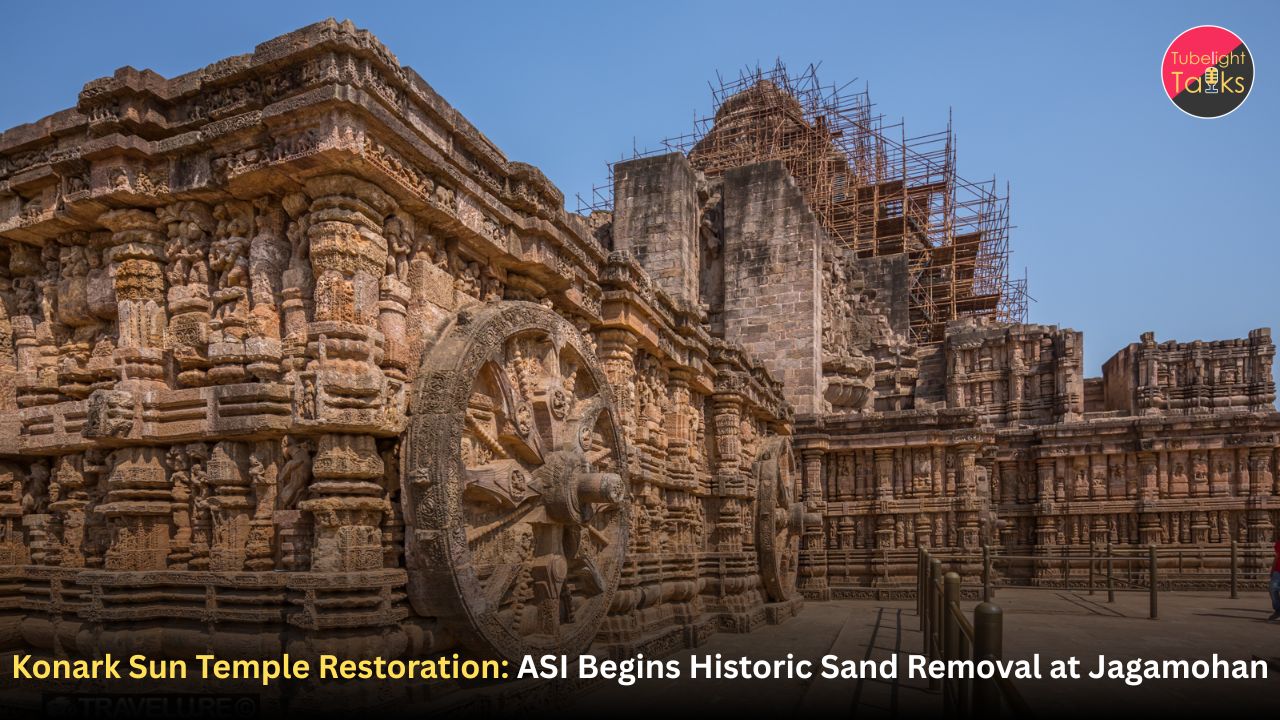
Konark Sun Temple Restoration: ASI Begins Historic Sand Removal After 123 Years
A historic temple Konark Sun Temple restoration effort has begun at Odisha’s Konark Sun Temple, where the Archaeological Survey of India is creating a carefully drilled passage into the Jagamohan, the grand assembly hall that was packed with sand during the British era more than a century ago. The operation is being treated as one of India’s most delicate conservation projects because the 13th-century monument is not only a UNESCO World Heritage Site but also a masterpiece of Kalinga architecture.
With IIT Madras technical assessment, diamond drilling, zero-vibration methods, and robotic systems, ASI aims to remove the sand without endangering the ancient stone structure.
Konark Sun Temple: Why This Restoration Is Historic
A Monument That Carries India’s Cultural Memory
The Konark Sun Temple is one of India’s most celebrated heritage monuments. UNESCO describes it as an outstanding example of temple architecture and art, known for its conception, scale, proportion, and sculptural narrative strength. The temple represents the chariot of the Sun God, with twelve pairs of wheels drawn by seven horses, and stands as an exceptional testimony to the 13th-century kingdom of Orissa under Narasimha Deva I.
The temple is not just a stone structure. It is a record of religious belief, artistic genius, political strength, social life, music, dance, astronomy, sculpture, and medieval engineering. UNESCO notes that the surviving structures and sculptures, along with dislodged remains preserved in situ, represent the monument’s essential qualities of architectural form, design, and sculptural relief.
Why the Jagamohan Matters
The Jagamohan, or audience hall, is the dominant surviving mass of the temple complex. UNESCO records that the principal sanctuary’s tower was razed in the 19th century, while the Jagamohan continues to dominate the ruins with its pyramidal mass. This makes the Jagamohan central to the visible identity of Konark today.
For visitors, the temple has long been admired from the outside because the Jagamohan remained inaccessible after being filled with sand by British engineers between 1901 and 1903. The purpose at that time was to prevent structural collapse and provide stability to the monument. Now, after about 123 years, ASI’s sand removal project has opened a new chapter in the temple’s conservation history.
What Exactly Has ASI Started?
A 6×5-Foot Passage Through the Western Wall
ASI has begun drilling a passage into the Jagamohan so that the sand packed inside more than a century ago can be removed. The Indian Express reported that ASI’s technical team started drilling a 6×5-foot passage through the western wall, and once the passage is completed, sand removal will begin manually.
Hindustan Times reported that the agency has begun creating a narrow passage between the first and second “pidha” on the western wall. ASI Puri Circle Superintending Archaeologist Dibishada Garnayak said the passage would measure 6 feet by 5 feet and be used to remove sand manually.
Approval, Technical Clearance, and Safety First
The restoration work began after approval from the ASI Director General and technical clearance from IIT Madras. Hindustan Times reported that IIT Madras assessed that sand removal would not endanger the structure.
This point is crucial because Konark is not a normal restoration site. It is a fragile medieval stone monument exposed for centuries to salt air, rain, cyclones, humidity, tourism pressure, and biological growth. UNESCO has already identified threats such as environmental pressure, saline breeze, sand blasting, monsoon-related erosion, tourism pressure, cyclones, and structural integrity concerns. Therefore, even one wrong conservation step could create irreversible damage.
Why Was the Temple Filled With Sand?
British-Era Conservation Intervention
The Jagamohan was filled with sand by British authorities between 1901 and 1903 to prevent the ageing structure from collapsing. The Indian Express notes that the hall remained inaccessible after the sand filling, with visitors seeing it only from outside.
Hindustan Times reported that, on the advice of engineer Bishan Swarup, Lieutenant Governor of Bengal J.A. Bourdillon ordered the Jagamohan to be filled with sand. Workers sealed the four entrance gates and poured sand into the 128-foot-tall structure from the top and sides over three years, turning the assembly hall into a massive stone container.
Why That Decision Worked Then
The intervention appeared successful for its time because the Jagamohan remained standing while the main temple tower had already been reduced to rubble. In the early 20th century, filling a vulnerable structure with sand was seen as a practical emergency solution.
But conservation science has changed. A method that helped protect the monument in 1903 can become risky after 123 years because moisture, settlement, pressure, biological growth, and hidden deterioration may slowly affect the stones from within.
Why Sand Removal Became Necessary
Moisture, Pressure, and Hidden Damage
The main concern is that the sand inside the Jagamohan may no longer be harmless. Hindustan Times reported that a previous drilling attempt in the mid-1950s by former ASI Director General Debala Mitra found that rainwater seepage was causing moss growth and damaging the khondalite stones.
A 2019 examination by the Central Building Research Institute found that the sand had settled approximately 12 feet, leaving a gap at the top while also exerting lateral pressure on the walls. Endoscopic surveys reportedly found large stones on the floor inside the structure, indicating ongoing interior deterioration hidden from public view.
Sand in Good Condition, But Still a Conservation Challenge
Before the latest work began, ASI conducted core drilling in December and collected stone and sand samples, which were sent to IIT Madras for analysis. The sand was found to be in good condition. However, “good condition” does not mean the sand should remain forever. The issue is not only the quality of the sand but also what its weight, moisture, settlement, and pressure may do to the temple’s inner walls over time.
This is why the current ASI Konark Sun Temple restoration project is both hopeful and sensitive. It is not a dramatic excavation for curiosity; it is a scientific conservation step meant to understand and protect the monument.
Technology Behind the Restoration
Diamond Drilling and Zero-Vibration Methods
ASI is using diamond drilling technology to avoid vibrations and damage during the passage creation. The Indian Express reported that the drilling is being carried out in a way that ensures zero vibrations and avoids damage to the structure.
This is important because Konark’s stones are old, weathered, and historically stressed. Traditional drilling methods could create vibration, microcracks, or stress transfer. Diamond drilling, when done under strict control, allows slow and precise cutting through hard material.
Robotic Trolleys and Controlled Extraction
Hindustan Times reported that a larger engineering operation is underway to access the inner chamber, with a tunnel approximately 9 feet wide being cut at a height of around 80 feet on the western side. Officials said no personnel will enter the tunnel directly because of safety concerns; instead, robotic trolleys will collect sand from inside the chamber.
The extracted material will reportedly be transported through pipelines and stored at a designated location in the north-western side of the temple complex. This shows that ASI is treating even the sand as part of the conservation record rather than waste. The sand itself has been part of the monument’s survival story for more than a century.
Also Read: ASI Begins Delicate Restoration Operation at Konark Sun Temple
Hidden Carvings and Interior Architecture: What May Be Revealed?
Hope of Studying Long-Sealed Interiors
The phrase “hidden carvings” has captured public imagination because the Jagamohan has remained sealed for about 123 years. While some reports and public discussions suggest that hidden carvings or architectural details may emerge as sand is removed, responsible reporting must distinguish between confirmed discovery and expected access. The most reliable confirmed fact is that ASI is creating access to remove sand and conserve the inner structure.
UNESCO’s description of Konark confirms that the monument is rich in sculptural embellishment, reliefs, wheels, lions, musicians, dancers, and iconographic depictions of contemporary life. It also states that the protected zone includes areas that may reveal unexplored archaeological remains that could enhance understanding of the property’s Outstanding Universal Value.
Why the Possibility Is Exciting
If the interior surfaces of the Jagamohan become visible for study, historians, archaeologists, conservation engineers, and art historians may gain new information about medieval Odisha’s stonework, construction sequence, wall condition, moisture damage, sculpture placement, and structural behavior. Even if no spectacular “new treasure” appears, the information hidden inside the sealed hall can be invaluable for conservation.
The true value of the project lies not only in revealing carvings but in understanding how the monument has survived, where it is vulnerable, and how it can be protected for the next century.
Konark’s Sculptural Brilliance
A Chariot in Stone
Konark Sun Temple is designed as the celestial chariot of Surya, the Sun God. UNESCO records that the temple’s chariot has twelve pairs of wheels drawn by seven horses, evoking movement across the heavens. The 24 carved wheels, each about 3 metres in diameter, include symbolic motifs linked to seasons and months.
This design is not only decorative. It reflects a deep understanding of time, cosmology, ritual symbolism, geometry, and visual storytelling. Every major stone surface seems to carry meaning.
Narratives of Life, Art, and Devotion
UNESCO states that Konark is embellished with sophisticated iconographical depictions of contemporary life and activities. It also notes reliefs of lions, musicians, dancers, and other sculptural groups on the plinth.
This is why conservation is so important. Every carved panel is a historical document. Every wheel, horse, dancer, musician, deity, animal, and decorative motif adds to India’s civilizational memory. Losing even a small section of carved stone means losing a portion of human artistic achievement.
A Victory for Cultural Heritage
Conservation After Long Planning
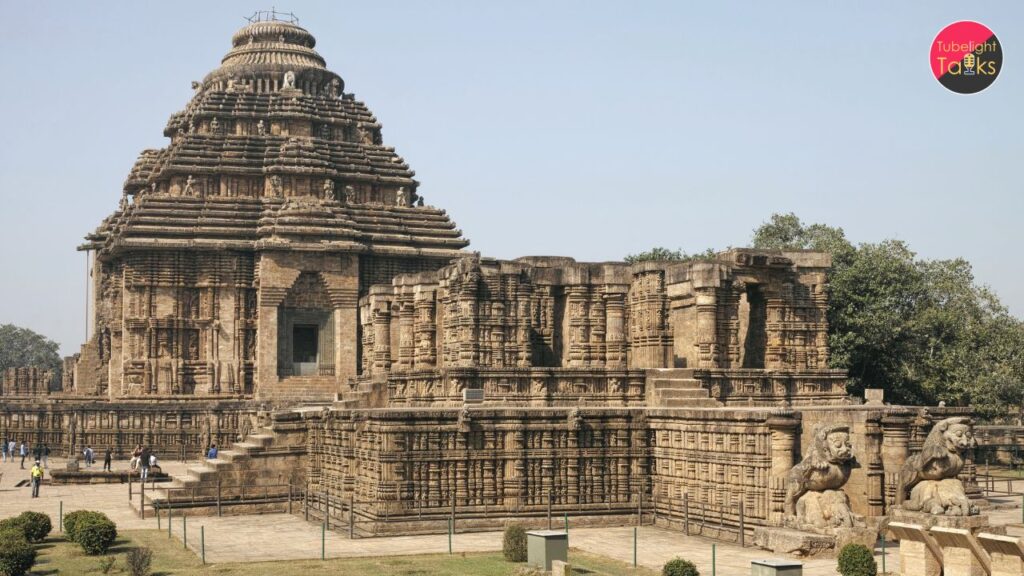
The current sand removal work did not begin suddenly. Hindustan Times reported that the project follows nearly 22 years of planning and technical studies, including laser measurements, endoscopic imaging, and sample testing. Around 30 teams of engineers, archaeologists, and conservation specialists are involved, using zero-vibration equipment to prevent damage to the temple’s thick stone walls.
This long preparation makes the project a heritage victory. It shows that modern India is not merely celebrating ancient monuments in speeches; it is using technology, scientific caution, institutional expertise, and conservation discipline to protect them.
ASI’s Continuing Role
The Ministry of Culture informed Parliament through PIB in 2021 that conservation work at Konark is a continuous process. ASI had taken steps to address saline action, waterlogging, erosion, vegetative intrusion, surface cleaning, stone strengthening, tree plantation against wind erosion, pumping to remove water, and periodic biocidal treatment. PIB also stated that the Sun Temple, Konark, was in a good state of preservation due to regular ASI care.
This background matters because the current sand removal is not an isolated event. It is part of a long conservation journey that includes routine maintenance, structural monitoring, and scientific intervention.
Challenges in the Restoration Process
No Room for Speed
ASI officials have made it clear that the work will take time because the monument’s stability must be ensured. The Indian Express reported that officials said it would be difficult to fix a timeframe for completing the drilling because no damage should occur during the process. One official indicated that the drilling stage itself could take up to a year.
This is exactly how heritage conservation should work. Public excitement must not push experts into rushing. A monument that has survived more than 700 years cannot be treated like a construction project with aggressive deadlines.
Balancing Access and Protection
The public may hope that one day the interior becomes visible or accessible. But heritage experts must first decide whether public access would be safe for the monument and visitors. Even after sand removal, the inner condition may require strengthening, ventilation, stone treatment, structural support, moisture control, and further monitoring.
A responsible restoration project must put preservation before tourism. The aim is not merely to open a chamber but to protect the temple.
Why Konark Matters to India and the World
UNESCO World Heritage Significance
Konark was inscribed as a UNESCO World Heritage Site because of its outstanding universal value. UNESCO calls it a unique artistic achievement and an exceptional testimony to the 13th-century kingdom of Orissa. This means Konark belongs not only to Odisha or India but also to the world’s shared cultural heritage.
When ASI restores Konark carefully, it protects a monument that speaks to all humanity about creativity, devotion, engineering, and artistic excellence.
A Lesson in Civilizational Confidence
Modern nations are judged not only by highways, satellites, and skyscrapers but also by how they treat their heritage. The Konark Sun Temple restoration shows that India can combine ancient wisdom with modern science. It shows respect for the past and responsibility toward future generations.
The project also reminds us that cultural heritage is not dead stone. It is living memory. It carries the knowledge, devotion, labor, and imagination of thousands of people who lived centuries before us.
Tourism and Local Impact
Growing Global Curiosity
Konark already attracts visitors from India and abroad. With news of the sand removal project, public curiosity is likely to grow. Heritage tourists, students, researchers, photographers, pilgrims, and culture enthusiasts may show renewed interest in the monument.
However, increased attention also brings responsibility. UNESCO has listed tourism pressure as one of the threats to the integrity of the site. Therefore, local authorities and visitors must ensure that tourism growth does not harm conservation work.
Responsible Visitor Behavior
Visitors should avoid touching carvings, climbing restricted areas, littering, ignoring barricades, or spreading unverified claims about the restoration. Responsible tourism means appreciating the monument while respecting ASI’s safety zones and expert instructions.
Odisha’s local economy can benefit from cultural tourism, but only if conservation remains the first priority. Heritage tourism must be sustainable, educational, and respectful.
Heritage Protection and Inner Purity
The restoration of Konark Sun Temple reminds us that external beauty can survive only when inner damage is identified and corrected. A monument may appear magnificent from outside, but hidden moisture, pressure, and neglect can weaken it from within. The same truth applies to human life. The teachings of Sant Rampal Ji Maharaj and Sat Gyaan explain that outward success is incomplete without inner purity, true worship, humility, and righteous conduct.
Sant Rampal Ji Maharaj teaches that human beings should avoid intoxication, dishonesty, violence, corruption, and harmful actions, and should follow true devotion according to holy scriptures. Just as ASI is carefully removing the sand that once protected Konark but may now create pressure, Sat Gyaan guides people to remove ignorance, ego, and wrong practices that silently damage the soul. Heritage restoration protects stone temples; true spiritual knowledge restores human life by connecting it with the Supreme God and the purpose of salvation.
Call to Action: Protect Heritage, Preserve Values, Seek True Knowledge
The Konark Sun Temple restoration is a proud moment for India’s cultural heritage. Citizens should support ASI’s scientific conservation work, follow official updates, respect visitor rules, and avoid misinformation about hidden chambers or unverified discoveries. Schools, colleges, historians, and media platforms should use this moment to educate people about Kalinga architecture, Odisha’s heritage, and the importance of protecting ancient monuments.
At the same time, every individual should also focus on inner restoration through true spiritual knowledge. Listen to the spiritual discourses of Sant Rampal Ji Maharaj, understand Sat Gyaan, and adopt a disciplined life based on truth, compassion, devotion, and moral conduct. The writing sequence and article style follow the uploaded Team 5 content reference.
FAQs on Konark Sun Temple Restoration
1. What has ASI started at Konark Sun Temple?
ASI has started drilling a 6×5-foot passage into the Jagamohan, the assembly hall of Konark Sun Temple, to remove sand that was packed inside during the British era more than a century ago.
2. Why was the Jagamohan filled with sand?
The Jagamohan was filled with sand by British authorities between 1901 and 1903 to prevent structural collapse and provide stability to the ageing monument.
3. Is the sand removal safe for the temple?
The project began after ASI approval and IIT Madras technical clearance. Hindustan Times reported that IIT Madras assessed that sand removal would not endanger the structure, and ASI is using controlled drilling, zero-vibration techniques, and robotic support.
4. Will hidden carvings be revealed inside Konark Sun Temple?
The operation may allow experts to study long-sealed interior architecture and possible hidden details. However, confirmed reporting so far mainly states that ASI is creating access to remove sand and conserve the inner structure, not that specific newly discovered carvings have been officially catalogued.
5. Why is Konark Sun Temple a UNESCO World Heritage Site?
UNESCO describes Konark as an outstanding example of temple architecture and art, a masterpiece of Kalinga architecture, and an exceptional testimony to the 13th-century kingdom of Orissa.
6. What makes this restoration a cultural heritage victory?
The restoration is important because it uses modern conservation science to protect a fragile 13th-century monument. The project follows years of technical study and involves engineers, archaeologists, IIT Madras inputs, controlled drilling, and careful sand extraction.
Related Stories









Discussion (0)