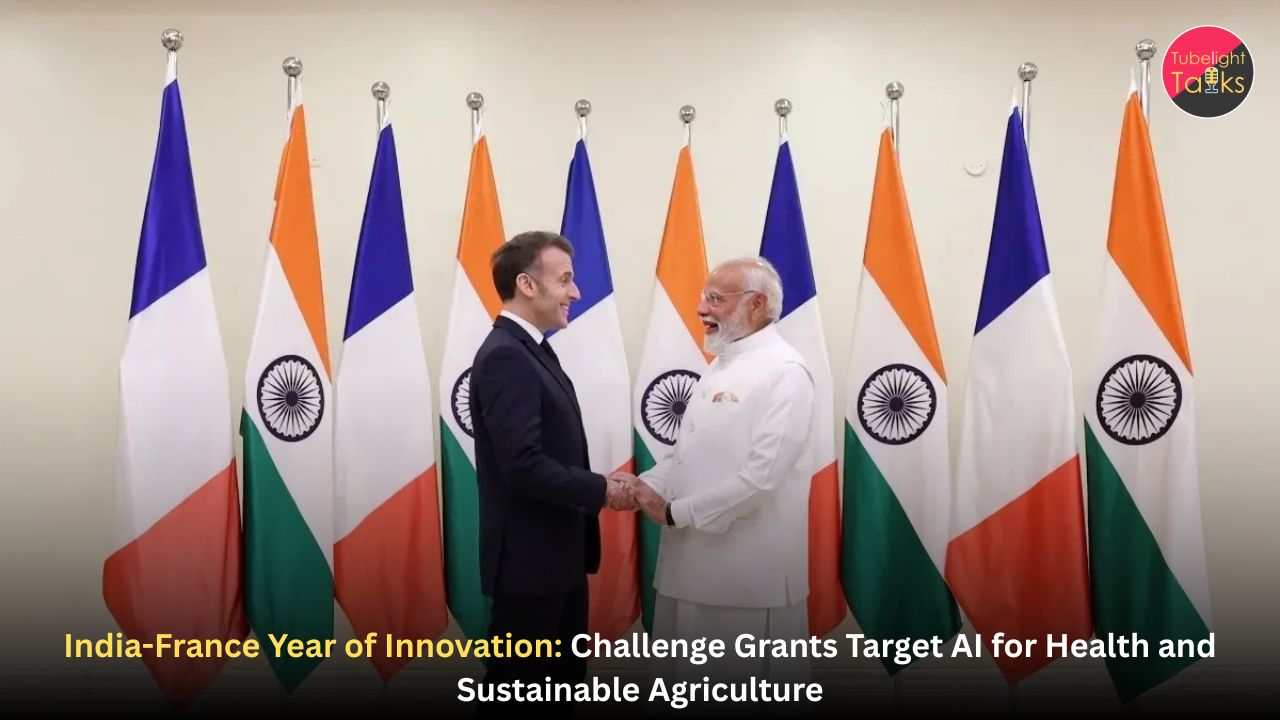
India-France Year of Innovation: Challenge Grants Open New Path for AI in Healthcare and Agricultural Sustainability
India and France have launched a new series of joint Challenge Grants under the India-France Year of Innovation, focusing on AI-driven solutions for global healthcare and agricultural sustainability. The initiative reflects the growing depth of India-France cooperation in technology, research, startups, public health, food systems and sustainable development. The Year of Innovation is structured around key pillars including aerospace, health, well-being and food, sustainable development, energy transition, and cultural industries.
The new Challenge Grants are expected to bring together Indian and French innovators to solve real-world problems such as disease prediction, rural healthcare access, precision farming, climate-resilient agriculture, nutrition, food security and responsible AI.
India-France Year of Innovation: A New Chapter in Strategic Partnership
Innovation as the New Diplomatic Bridge
India and France have built a strong strategic relationship over decades, but the Year of Innovation gives that relationship a future-facing direction. Instead of limiting cooperation to defence, diplomacy or trade, both nations are now focusing on technologies and solutions that can improve daily life.
The innovation year is designed to connect startups, researchers, academic institutions, businesses, public agencies and civil society. This is important because modern challenges cannot be solved by governments alone. Climate change, healthcare gaps, food insecurity, antimicrobial resistance, rural distress and digital inequality require collaboration across sectors.
The Challenge Grants add a practical layer to this partnership. They are not merely ceremonial announcements. They aim to fund focused projects that can be tested, scaled and adapted across countries.
Why Challenge Grants Matter
Challenge Grants are useful because they define a clear problem and invite innovators to solve it. Instead of giving broad funding without direction, a challenge model asks teams to develop solutions for specific needs. These may include AI tools for early disease detection, crop advisory platforms, medical imaging support, low-cost diagnostics, pest prediction models, water-use optimization, soil-health mapping or supply-chain transparency.
For India and France, such grants can support innovation that is both scientific and socially useful. They can help move ideas from research papers to field pilots and from prototypes to public impact.
AI for Global Healthcare
The Need for Smarter Health Systems
Healthcare systems worldwide are under pressure. Aging populations, chronic diseases, cancer, infectious diseases, mental health challenges, doctor shortages and rising costs are creating serious strain. In rural and remote areas, the challenge is even greater because hospitals, specialists and diagnostic facilities may be far away.
AI can support healthcare by improving disease screening, diagnosis, triage, medical imaging, drug discovery, hospital management, public health surveillance and personalized care. It can also help doctors handle large volumes of data and make faster decisions.
The India-France Challenge Grants can support AI solutions that are not designed only for elite hospitals. The real value will come if these technologies help public hospitals, district clinics, rural health workers and low-income patients.
AI in Diagnostics and Prevention
One promising area is early diagnosis. AI tools can analyze X-rays, scans, pathology slides, retinal images, ultrasound data and patient records to identify warning signs. In countries with limited specialists, such tools can support screening and referral.
Another area is disease prediction. AI can help identify outbreaks, track health risks, forecast medicine demand and support vaccination strategies. This is especially important after the COVID-19 pandemic, which showed the need for real-time health intelligence.
However, AI must be used responsibly. Medical AI should be tested carefully, validated across diverse populations and supervised by trained professionals. It should support doctors, not replace human care.
Also Read: India–France Defence Partnership Enters New Era with Focus on AI and Advanced Military Technology
AI for Agriculture and Food Security
Climate-Smart Farming
Agriculture is facing serious climate pressure. Heatwaves, floods, droughts, irregular rainfall, pest outbreaks and soil degradation are affecting farmers across the world. Food systems need innovation that can increase productivity while reducing environmental harm.
AI can help farmers make better decisions about sowing, irrigation, fertilizers, pest control, weather risks and market access. Satellite imagery, drones, sensors, mobile apps and machine learning models can provide timely guidance. If used well, these tools can reduce input costs and protect yields.
The India-France Challenge Grants can support climate-smart agriculture projects that are useful for both Indian farmers and global food systems.
Precision Agriculture and Small Farmers
Precision agriculture is often associated with large farms and expensive equipment. But India’s agricultural reality includes millions of small and marginal farmers. Innovation must therefore be affordable, multilingual and accessible.
AI solutions must work on basic smartphones, support local languages, and function even where internet access is weak. Advisory tools should be easy to understand and connected with local extension workers, cooperatives, farmer producer organizations and Panchayats.
France brings strong research and agritech expertise, while India brings scale, diversity of crops, digital public infrastructure and a huge farmer base. Together, the two countries can develop solutions that are practical, not just high-tech.
Health, Well-being and Food: A Shared Pillar
Connecting Nutrition, Health and Agriculture
The India-France Year of Innovation includes health, well-being and food as a major pillar. This is significant because healthcare and agriculture are deeply connected. Malnutrition, poor diet, contaminated water, pesticide exposure, food insecurity and climate stress directly affect public health.
Challenge Grants that combine AI, health and agriculture can support integrated solutions. For example, AI could help identify nutrition gaps in regions, forecast crop failures, guide fortified food distribution, monitor food supply chains or support maternal and child nutrition programmes.
This approach recognizes that health is not only about hospitals. It begins with food, environment, water, livelihood and social stability.
Sustainable Food Systems
Agricultural sustainability is not just about producing more. It is about producing better, wasting less, protecting soil, conserving water, reducing emissions and ensuring farmers earn fairly. AI can support these goals through predictive analytics, supply-chain tracking, crop disease alerts and efficient resource use.
India and France can also collaborate on food processing, cold chains, storage, post-harvest loss reduction and climate-resilient crop research. These areas are essential for food security.
Why India and France Are Natural Innovation Partners
India’s Scale and Digital Strength
India offers one of the world’s largest innovation testing grounds. Its digital public infrastructure, startup ecosystem, health platforms, agricultural diversity and large youth population make it a powerful partner for technology deployment.
If an AI solution works across India’s languages, climates, income levels and rural-urban differences, it can become globally relevant. India’s scale allows innovations to be tested in real-world complexity.
France’s Research and Technology Ecosystem
France brings deep strengths in science, healthcare, aerospace, agriculture, climate policy, engineering, design and advanced research. French universities, laboratories, hospitals and companies have strong experience in technology development and international collaboration.
The Challenge Grants can connect Indian implementation strength with French research depth. This can help both sides co-create solutions rather than simply exchange finished products.
Responsible AI Must Remain Central
Trust, Safety and Ethics
AI in health and agriculture must be safe, transparent and fair. In healthcare, wrong predictions can harm patients. In agriculture, wrong advice can damage crops and livelihoods. Therefore, AI systems must be tested carefully before deployment.
Data privacy is also essential. Patient health data, farmer data, land records, satellite images and financial information must be protected. Innovation should not become surveillance or exploitation.
Avoiding Digital Inequality
AI tools can increase inequality if they are accessible only to large hospitals, rich farmers or urban users. The Challenge Grants should prioritize inclusion. Solutions should be affordable, multilingual, easy to use and designed for public good.
The success of the India-France innovation partnership will depend on whether benefits reach ordinary citizens: patients in district hospitals, farmers in villages, women health workers, rural entrepreneurs and young researchers.
Also Read: One Health Movement: Global Leaders Push Integrated Human, Animal and Environmental Health Action
Startups and Research Institutions Get New Opportunities
From Prototype to Pilot
Many startups have promising ideas but lack funding for testing, validation and scaling. Challenge Grants can help bridge that gap. A health-tech startup may need hospital data partnerships. An agritech startup may need field trials across states. A university team may need industry support to convert research into a usable tool.
The challenge model can bring these actors together. It can create partnerships between Indian and French institutions, allowing teams to share data, expertise, technology and market access.
Youth Innovation and Deep-Tech Collaboration
India and France both want to strengthen deep-tech cooperation. AI, biotech, climate technology, digital health, robotics, sensors, remote sensing and data science all require skilled young researchers and entrepreneurs.
Challenge Grants can inspire students and startups to work on problems that matter. Instead of building technology only for convenience or entertainment, they can focus on healthcare access, food security and sustainable development.
Agricultural Sustainability and Global Climate Goals
Reducing Environmental Pressure
Agriculture contributes to emissions, water use and land pressure, but it is also vulnerable to climate change. AI-supported agriculture can help reduce unnecessary fertilizer use, optimize irrigation, detect crop stress early and reduce losses.
This can support both farmer income and environmental protection. A farmer who saves water, reduces pesticide waste and protects yield benefits personally and socially.
Food Security in a Changing Climate
Climate change threatens food production across regions. Heat stress affects wheat, rice, vegetables and livestock. Floods destroy fields. New pests move into new geographies. Supply chains can break during extreme weather.
India-France innovation in agricultural sustainability can support early warning systems, resilient cropping models, seed research, digital advisory tools and food storage solutions. Such work has global relevance, especially for the Global South.
Innovation With Moral Direction
The India-France Challenge Grants show how technology can be directed toward human welfare, but innovation becomes truly valuable only when guided by ethics and compassion. The teachings of Sant Rampal Ji Maharaj and Sat Gyaan emphasize truth, humility, righteous conduct and true worship according to holy scriptures. His teachings guide people away from intoxication, corruption, dishonesty, violence, greed and harmful social practices.
In the context of AI for health and agriculture, this message is deeply relevant. Technology should not become a tool of profit alone; it should reduce suffering, support farmers, protect patients and serve society honestly. Sat Gyaan teaches that outer progress must be accompanied by inner purity. A nation becomes truly advanced when science, policy and human conduct all move toward truth and welfare.
FAQs on India-France Year of Innovation Challenge Grants
1. What are the India-France Challenge Grants?
The Challenge Grants are a joint innovation funding mechanism under the India-France Year of Innovation, aimed at supporting focused solutions in areas such as AI, healthcare, agriculture and sustainability.
2. Why are healthcare and agriculture priority areas?
Healthcare and agriculture affect basic human survival. Both sectors face pressure from population growth, climate change, rising costs, access gaps and the need for smarter technology.
3. How can AI help healthcare?
AI can support disease screening, diagnostics, medical imaging, hospital management, public health surveillance, treatment planning and early warning systems, provided it is tested and supervised responsibly.
4. How can AI help farmers?
AI can provide weather-based advisories, pest alerts, soil-health insights, irrigation guidance, crop monitoring, market information and climate-risk predictions.
5. Why is India-France cooperation important?
India offers scale, digital talent and real-world implementation opportunities, while France brings strong research, healthcare, agriculture, climate and technology expertise. Together, both countries can co-create global solutions.
6. What precautions are needed in AI-based innovation?
AI systems must protect privacy, avoid bias, be tested across diverse populations, remain affordable, support human decision-making and ensure benefits reach rural and vulnerable communities.
Related Stories



Discussion (0)