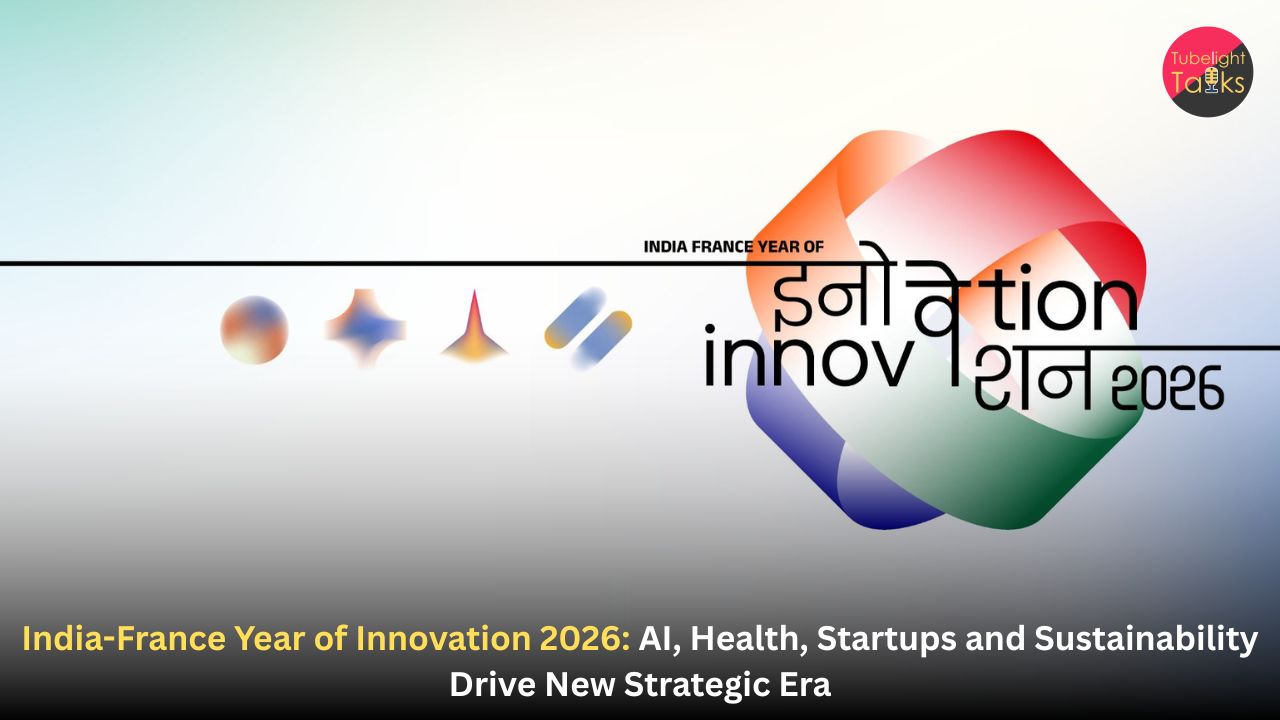
India-France Year of Innovation 2026: New Delhi and Paris Open a High-Impact Chapter in AI, Healthcare and Sustainable Development
India and France have officially launched the “Year of Innovation 2026,” opening a new chapter in bilateral cooperation focused on artificial intelligence, healthcare, sustainable development, research, education, startups, science and technology. Prime Minister Narendra Modi and French President Emmanuel Macron jointly inaugurated the initiative in Mumbai on February 17, 2026, during President Macron’s official visit to India.
The launch came alongside the elevation of India-France relations to a “Special Global Strategic Partnership,” reflecting both countries’ ambition to co-develop future-ready solutions for a smarter, more sustainable world. The initiative also connects innovation with broader global discussions on macroeconomic imbalances, economic security and resilient partnerships.
India-France Year of Innovation 2026: What Has Been Launched?
A New Innovation Framework Between Two Strategic Partners
The India-France Year of Innovation 2026 is a year-long collaborative platform designed to deepen cooperation between startups, researchers, universities, industries, government agencies and innovation ecosystems in both countries. According to the India-France Joint Statement issued by the Ministry of External Affairs on February 17, 2026, Prime Minister Modi and President Macron jointly inaugurated the initiative in Mumbai during the French President’s visit to India from February 17 to 19, 2026.
The initiative will feature high-impact collaborations across innovation, science and technology, cyberspace, artificial intelligence, healthcare, sustainable development, cultural and creative economy, research and education. The official joint statement says these engagements aim to strengthen existing collaborations and create new connections between startups, academic institutions, research bodies and industry.
Why Mumbai Was Chosen for the Launch
Mumbai was a natural choice because it represents India’s business energy, startup ambition, financial strength and global connectivity. PIB had announced that Prime Minister Modi and President Macron would inaugurate the India-France Year of Innovation 2026 in Mumbai and address business leaders, startups, researchers and innovators from both countries. The event was therefore not only diplomatic but also economic and entrepreneurial in character.
This matters because innovation today is not limited to laboratories. It grows where finance, policy, academia, manufacturing, digital infrastructure and young talent meet. Mumbai’s launch setting gave the initiative a practical business-facing direction.
A Special Global Strategic Partnership
India-France Relations Enter a Higher Phase
During President Macron’s 2026 visit, India and France agreed to elevate their relationship to a “Special Global Strategic Partnership.” The joint statement says this upgraded relationship will guide cooperation in the coming decades and reflects the growing ambitions of both leaders to build prosperity, resilience, security and a stable rules-based international order.
This is significant because India and France already have a long strategic history. Their partnership includes defence, security, civil nuclear energy, space, artificial intelligence, innovation, technology, health, economy, culture, education and people-to-people ties. The new title signals that both sides now see their relationship not only as bilateral but also as global in scope.
Horizon 2047 and Long-Term Vision
India and France celebrated 25 years of their Strategic Partnership in 2023 and adopted the Horizon 2047 Roadmap to guide bilateral relations up to 2047. The MEA’s bilateral brief states that the Strategic Partnership with France, launched in 1998, was India’s first-ever strategic partnership with a Western country and France’s first outside the European Union.
Horizon 2047 gives the India-France Year of Innovation 2026 a long-term foundation. It is not a temporary festival of events; it is part of a structured diplomatic roadmap meant to strengthen cooperation in the decades ahead.
AI Cooperation: Building Trustworthy Technology
Artificial Intelligence at the Center
Artificial intelligence is one of the strongest pillars of the India-France Year of Innovation 2026. President Macron visited India to participate in the Artificial Intelligence Impact Summit 2026, and the joint statement records that both leaders reaffirmed their commitment to secure and trustworthy AI serving people, public interest, planet and progress. The statement also highlights openness and bridging the global AI divide as important principles.
This is important because AI is becoming a core technology for healthcare, education, agriculture, climate action, manufacturing, financial services, governance, cybersecurity and language inclusion. If controlled by only a few private or geopolitical powers, AI could deepen inequality. India and France are therefore emphasizing trusted AI, democratic values, openness and inclusive access.
India-France Declaration on Artificial Intelligence
The foundation for this cooperation was laid earlier in the India-France Declaration on Artificial Intelligence issued on February 12, 2025. That declaration said both countries would seek AI norms and standards that reflect democratic values and harness AI for human development and the common good. It also emphasized AI systems that respect human rights, reduce discrimination, fight misinformation, preserve linguistic and cultural diversity and support areas such as global health, sustainable agriculture, education, climate change, disaster management, biodiversity protection, energy and food security.
The India-France Year of Innovation 2026 now gives this declaration a practical direction. Instead of remaining at the level of principles, AI cooperation is moving into healthcare, research institutions, student mobility, innovation showcases and startup partnerships.
Indo-French Centre for AI in Health: A Landmark Healthcare Initiative
AI for Medical Research and Clinical Innovation
One of the clearest outcomes linked to the innovation year is the launch of the Indo-French Centre for AI in Health at AIIMS New Delhi. PIB reported that Union Health Minister J. P. Nadda and President Emmanuel Macron inaugurated the centre on February 18, 2026. The centre is aimed at advancing AI-driven research, medical education and clinical innovation to address complex healthcare challenges.
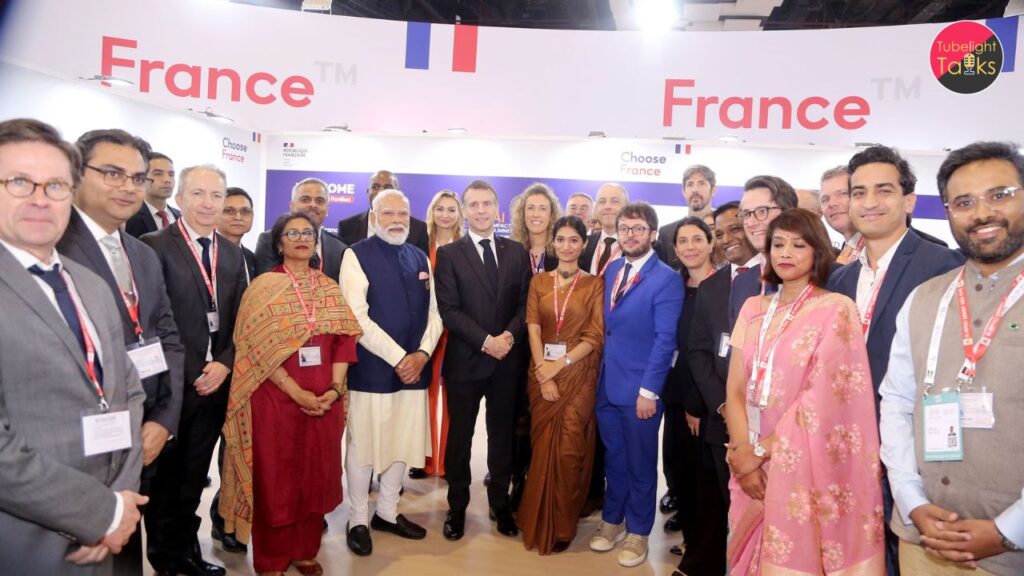
The initiative has been established pursuant to a Joint Memorandum of Understanding between AIIMS New Delhi, Sorbonne University and the Paris Brain Institute, with collaboration from IIT Delhi and leading French institutions. PIB says the centre promotes interdisciplinary research in artificial intelligence, brain health and global healthcare systems.
Health, Brain Science and Global Care
The Indo-French Centre for AI in Health builds on cooperation in priority areas such as digital health, antimicrobial resistance, human resources for health and responsible use of health data. The RUSH 2026 programme at AIIMS brought together scientists, clinicians, policymakers and academic leaders from both countries, including a forum on AI in brain health and global healthcare.
This is a crucial development because healthcare systems worldwide are under pressure from aging populations, chronic disease, mental health challenges, infectious threats, shortage of trained professionals and rising treatment costs. AI cannot replace doctors, but it can support diagnostics, drug discovery, hospital management, public health surveillance, medical education and personalized care when used ethically and transparently.
Sustainable Development and Green Collaboration
Innovation for Climate and Clean Growth
The India-France Year of Innovation 2026 is also linked to sustainable development. MEA’s bilateral brief states that the India-France partnership has broadened in recent years to include artificial intelligence, science and technology, innovation, blue economy, environment, renewable energy, sustainable development and trilateral cooperation focused on the Indo-Pacific.
This expansion reflects the reality that innovation cannot be separated from climate responsibility. Future technologies must reduce waste, protect biodiversity, lower emissions, strengthen adaptation and support inclusive growth. France brings expertise in clean energy, climate diplomacy, research and industrial technology, while India brings scale, digital public infrastructure, renewable energy ambition, engineering talent and a large innovation market.
Green Hydrogen and Renewable Energy
India and France have already identified green hydrogen as a priority area of cooperation. MEA’s bilateral brief notes that both countries adopted a Roadmap on Green Hydrogen in October 2022, including industrial partnerships, research and development, certification and a regulatory framework for developing a decarbonised hydrogen value chain.
Under the Year of Innovation 2026, such cooperation can move further through pilot projects, research collaboration, startup innovation, industrial partnerships and climate-friendly technology deployment. Green hydrogen, renewable energy storage, clean mobility, circular economy systems and low-carbon industry are areas where India-France cooperation can serve both national growth and global climate goals.
Startups, Research and Industry: The People-Centric Side
Connecting Innovators Across Borders
The official joint statement says the India-France Year of Innovation 2026 aims to foster new collaborations between startups, academic institutions, research bodies and industry. This is essential because innovation ecosystems grow through networks. A startup may need a research laboratory, a university may need industry data, a government may need scalable public solutions, and investors may need credible deep-tech pipelines.
The initiative can help Indian and French startups collaborate in artificial intelligence, health technology, clean energy, climate technology, quantum science, cybersecurity, space applications, language technology, education tools and creative industries. Such cross-border innovation can also support jobs, exports, patents, research publications and practical solutions for society.
Bharat Innovates Deep-Tech Momentum
The Ministry of Education announced “Bharat Innovates Deep-Tech Pre-Summit” in March 2026 as part of a broader innovation push. PIB reported that the event would showcase innovations across 13 sectors and culminate in an international innovation showcase in Nice, France, from June 14 to 16, 2026.
This kind of platform is important because deep-tech startups often require patient capital, research infrastructure, regulatory guidance, global market access and strong university-industry collaboration. India’s innovation talent can benefit from French and European partnerships, while France can gain from India’s scale, digital ecosystem and fast-growing startup base.
Research, Education and Talent Mobility
Academic Cooperation as a Foundation
Research and education form a major part of India-France cooperation. The MEA bilateral brief says both countries have a rich history of cooperation in science and technology, covering health, digital, energy, oceans and applied mathematics. It also lists institutional links between Indian ministries and agencies such as DST, DBT, CSIR and French institutions including ANR, CNRS, INSERM, INRIA and Institut Pasteur.
The Indo-French Centre for the Promotion of Advanced Research, known as IFCPAR/CEFIPRA, has played a key role in driving joint research. The MEA brief states that CEFIPRA’s programmes include collaborative scientific research, industry-academia research, fellowships, women in science support, emerging project partnerships and high-impact scientific research networks.
Student Mobility and Future Skills
India and France are also strengthening student mobility. MEA’s bilateral brief states that about 10,000 Indian students are estimated to be studying in France, with an ambition to host 30,000 Indian students in France by 2030.
This matters because innovation is ultimately driven by skilled people. Student exchanges, joint degrees, research fellowships, language access, internships and startup exposure can create a generation of professionals who understand both India and France. Such people-to-people innovation can outlast diplomatic cycles and build durable trust.
Innovation and Macroeconomic Imbalances
Why the G7 Context Matters
The India-France Joint Statement connects the innovation partnership with wider global economic concerns. President Macron invited Prime Minister Modi to participate in the G7 Summit to be hosted by France in 2026, with discussions expected on tackling global macroeconomic imbalances and defining a new paradigm for international partnerships and solidarity.
Prime Minister Modi welcomed the invitation and noted India’s commitment to contributing constructively to global discussions on economic imbalances, development financing, economic security, resilient supply chains, climate action and international security.
This link is important. Innovation is not only about technology; it is also about correcting structural gaps in the global economy. If access to advanced technology, capital, data, health tools, clean energy and research remains concentrated in a few countries, global inequality can deepen. The India-France Year of Innovation 2026 therefore has a larger message: innovation should help create a more balanced, inclusive and resilient international order.
Resilient Supply Chains and Economic Security
The joint statement notes that India and France are cooperating on trusted, reliable and resilient supply chains, as well as safeguarding economic security. This has become urgent because the world has faced pandemic disruptions, geopolitical tensions, energy shocks, semiconductor shortages and climate-linked instability.
India and France can work together on supply-chain diversification, critical technologies, trusted digital infrastructure, space systems, clean energy components, pharmaceuticals, medical devices and defence-industrial cooperation. Such collaboration can reduce overdependence on single sources and increase strategic autonomy.
Cultural and Creative Economy
Innovation Beyond Technology
The official list of sectors for the Year of Innovation includes cultural and creative economy. This is a smart addition because innovation is not only mechanical or digital. Film, design, heritage technology, animation, gaming, language tools, museums, crafts, publishing, music, fashion and immersive media can all become engines of economic and cultural cooperation.
India and France both have rich civilizational depth and strong creative traditions. India brings scale, diversity, languages and cultural industries, while France brings global experience in heritage preservation, design, cinema, fashion, museums and creative diplomacy. Together, they can build new opportunities for youth, artists and digital creators.
Language Diversity and AI
The AI declaration emphasizes generative AI that supports linguistic and cultural diversity. This is especially relevant for India, where hundreds of languages and dialects shape public communication, education, governance and culture. France also has a strong interest in protecting cultural identity and linguistic diversity in digital systems.
AI tools built only for dominant global languages can exclude millions of people. India-France cooperation can help create multilingual AI models, ethical translation tools, cultural archives, education platforms and public-interest digital services.
Strategic Autonomy and Global Balance
Shared Democratic Values
MEA’s bilateral brief says the India-France partnership is underpinned by shared democratic values, belief in multilateralism, respect for international law and strong economic, cultural, academic and people-to-people ties. These values make the innovation partnership more than a commercial arrangement.
In a world where technology is increasingly linked to surveillance, misinformation, monopoly power, cyber risks and geopolitical competition, democratic cooperation becomes essential. India and France can promote innovation that respects rights, privacy, transparency and public good.
Indo-Pacific and Global Development
The joint statement reaffirmed commitment to a rules-based order in the Indo-Pacific and beyond. It also referred to cooperation with Africa in areas including energy transition, artificial intelligence, health, agriculture and blue economy.
This shows that the India-France Year of Innovation 2026 may also support third-country cooperation. India and France can jointly help partner countries with digital health, climate resilience, renewable energy, agriculture technology, blue economy solutions and training programmes.
Also Read: India–France Defence Partnership Enters New Era with Focus on AI and Advanced Military Technology
Challenges Before the Innovation Year
Turning Announcements Into Outcomes
The success of the India-France Year of Innovation 2026 will depend on execution. Announcements are important, but real impact requires funded projects, clear timelines, regulatory support, measurable outcomes, institutional continuity and private-sector participation.
Both countries must ensure that the initiative does not remain limited to elite conferences. It should reach students, researchers, small startups, healthcare workers, climate innovators, women scientists, young entrepreneurs and local communities.
Responsible AI and Data Governance
AI cooperation will need strong safeguards. The India-France AI declaration already highlights concerns around discrimination, misinformation, privacy, intellectual property, safe development and responsible governance. These principles must be applied in real projects, especially in healthcare, education, public services and children’s digital environments.
AI in health must also protect patient privacy, medical ethics, data security and transparency. If algorithms are biased or poorly tested, they can harm vulnerable patients. Therefore, India-France innovation must remain human-centered and evidence-based.
Why This Matters for India
India’s Innovation Moment
India is entering a phase where innovation can define its global role. Digital public infrastructure, space missions, UPI, startup growth, pharmaceutical strength, renewable energy, AI talent and research capacity have already increased India’s visibility. The India-France Year of Innovation 2026 can help Indian innovators access French institutions, European markets, global investors and advanced research networks.
For Indian students and startups, this partnership can open doors in AI, climate technology, healthcare, deep tech, biotech, space, mobility and creative industries. It also strengthens India’s image as a technology partner that can co-create solutions rather than merely consume them.
France as a Trusted Partner
France has been one of India’s most reliable strategic partners across defence, space, civil nuclear energy, technology and global diplomacy. MEA notes that defence and security, civil nuclear matters and space constitute principal pillars of the strategic cooperation, while newer areas include AI, environment, renewable energy and sustainable development.
The innovation year expands this trust into future sectors. It makes the partnership more youth-oriented, research-oriented and economy-oriented.
Innovation With Conscience and True Purpose
The India-France Year of Innovation 2026 celebrates human intelligence, scientific research and technological progress, but true progress must also be guided by moral clarity. The teachings of Sant Rampal Ji Maharaj and Sat Gyaan emphasize that human life should be lived with truth, humility, compassion and true worship according to holy scriptures.
His teachings guide people away from intoxication, corruption, violence, dishonesty and harmful conduct, and toward devotion that leads to salvation. In the context of innovation, this spiritual understanding is deeply relevant. Technology without ethics can become exploitation, but technology guided by righteousness can serve humanity.
Just as India and France are working to build trustworthy AI and sustainable development, Sat Gyaan teaches that inner life must also become trustworthy, disciplined and connected with the Supreme God. The highest innovation is not only creating smarter machines but also transforming human conduct through true spiritual knowledge.
Call to Action: Make Innovation People-Centric and Spiritually Responsible
The India-France Year of Innovation 2026 should inspire students, researchers, startups, policymakers, health professionals and industry leaders to build solutions that serve people, protect the planet and reduce inequality. AI should improve healthcare, education, agriculture and public services. Sustainable development should support clean energy, resilient cities, responsible manufacturing and climate action. Research partnerships should help youth, women scientists, deep-tech entrepreneurs and public institutions.
At the same time, every individual should seek true spiritual knowledge, listen to the discourses of Sant Rampal Ji Maharaj, understand Sat Gyaan and adopt a disciplined life based on truth, devotion and moral conduct. External innovation can improve society, but inner transformation gives life its true direction. The article structure follows the uploaded Team 5 content style reference.
FAQs on India-France Year of Innovation 2026
1. What is the India-France Year of Innovation 2026?
The India-France Year of Innovation 2026 is a bilateral initiative jointly inaugurated by Prime Minister Narendra Modi and President Emmanuel Macron in Mumbai on February 17, 2026. It focuses on high-impact collaborations in innovation, science and technology, AI, healthcare, sustainable development, research, education and creative economy.
2. Why is the Year of Innovation important?
It is important because it connects startups, academic institutions, research bodies and industry from both countries to co-develop solutions for a smarter and more sustainable future. It also forms part of the newly elevated India-France Special Global Strategic Partnership.
3. What role does AI play in India-France cooperation?
AI is a central pillar. India and France have committed to secure, trustworthy and inclusive AI serving people, public interest, planet and progress. Their 2025 AI declaration also emphasizes democratic values, human rights, openness, linguistic diversity and AI for global good.
4. What is the Indo-French Centre for AI in Health?
The Indo-French Centre for AI in Health is a centre launched at AIIMS New Delhi to advance AI-driven research, medical education and clinical innovation. It involves AIIMS New Delhi, Sorbonne University, Paris Brain Institute, IIT Delhi and other leading institutions.
5. How does the innovation year support sustainable development?
The initiative includes sustainable development as a key sector and builds on India-France cooperation in renewable energy, environment, green hydrogen, blue economy and climate-related innovation.
6. How is this linked to global macroeconomic imbalances?
President Macron invited Prime Minister Modi to the 2026 G7 Summit in France, where discussions are expected on global macroeconomic imbalances and new international partnerships. The joint statement links India’s participation with development financing, economic security, resilient supply chains, climate action and a more balanced global order.
Related Stories





Discussion (0)