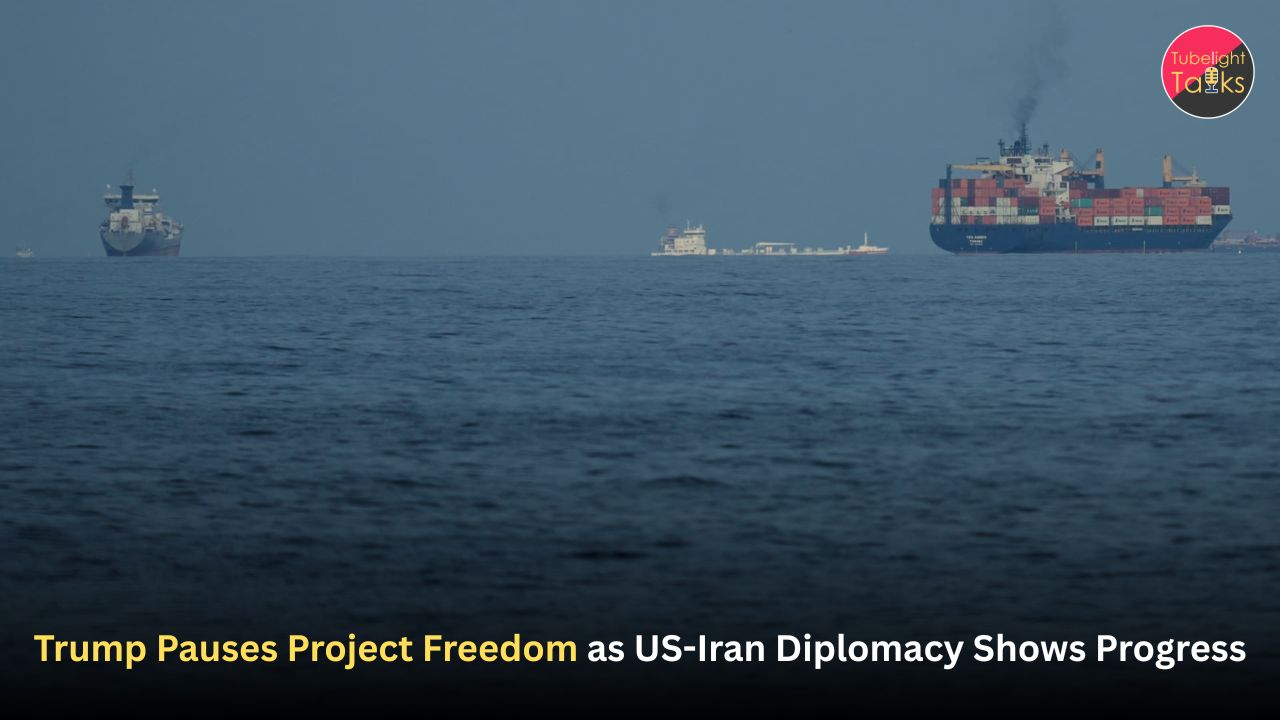
Trump Pauses Project Freedom as US-Iran Diplomacy Enters Critical Breakthrough Phase
President Donald Trump has temporarily paused “Project Freedom,” the U.S. naval escort mission launched to guide stranded ships through the Strait of Hormuz, citing major progress in diplomatic talks with Iran. The announcement came after just one day of the U.S. effort and followed requests from Pakistan and other countries involved in efforts to keep diplomacy alive.
The U.S. blockade on Iranian ports remains in place, but the pause signals a crucial shift from military pressure toward negotiation. With global oil flows, shipping safety, humanitarian movement, and regional stability at stake, this development has become one of the most closely watched diplomatic moments of 2026.
US-Iran Diplomacy Breakthrough: What Has Happened?
Trump Pauses Project Freedom After Citing Progress
President Donald Trump announced that the United States is pausing Project Freedom, the naval effort meant to guide commercial vessels through the Strait of Hormuz, while negotiators attempt to finalize a broader understanding with Iran. AP reported that Trump cited progress toward a potential peace deal and requests from countries such as Pakistan as reasons for the pause.
The Guardian’s live coverage also reported that Trump said the decision was based on requests from Pakistan and other countries, recent U.S. military success, and what he called “Great Progress” toward a complete and final agreement with Iranian representatives.
Project Freedom had been announced as a U.S. maritime effort to help neutral or non-combatant ships leave the Strait of Hormuz safely. CBS reported that the U.S. had set up an “enhanced security area” south of normal shipping lanes and urged mariners to coordinate closely with Omani authorities because of heavy traffic and mine-related hazards.
The pause does not mean the entire crisis has ended. AP reported that while the movement of vessels under Project Freedom has been halted, the U.S. naval blockade on Iranian ports remains active as diplomacy continues. This makes the announcement both hopeful and fragile: Washington is creating space for talks, but it is not yet removing its pressure tools.
Pakistan’s Role Becomes Central
Pakistan’s mediation has become one of the most important diplomatic elements in the US-Iran crisis. AP reported earlier that Trump extended the ceasefire with Iran at Pakistan’s request while awaiting a “unified proposal” from Tehran, even as the U.S. military maintained its blockade of Iranian ports.
This background matters because the Project Freedom pause appears to be part of a wider diplomatic rhythm. Pakistan has positioned itself as a channel between Washington and Tehran, while regional partners are seeking to prevent the Strait of Hormuz crisis from widening into a full regional war. In a conflict where direct trust is limited, mediators can help create face-saving steps, pass proposals, reduce misunderstandings, and keep talks alive during tense military moments.
Also Read: Project Freedom Launched to Secure Global Shipping Through Strait of Hormuz
What Is Project Freedom?
A Naval Escort Mission in a Dangerous Waterway
Project Freedom was presented as a U.S. effort to guide stranded commercial vessels through or out of the Strait of Hormuz. The operation followed a period of severe disruption in one of the world’s most important maritime corridors. CBS reported that the Joint Maritime Information Center warned that normal routes should be considered extremely hazardous because of mines that had not been fully surveyed and mitigated.
The mission was described by U.S. officials as separate from the broader offensive campaign. The Washington Post reported that Defense Secretary Pete Hegseth called the mission temporary and distinct from earlier military operations, saying it was aimed at protecting commercial shipping and helping vessels move through the strait.
However, the mission was risky from the start. Iran warned that U.S. military entry or interference in the strait could be treated as a ceasefire violation, according to CBS reporting on Iranian statements.
Why It Was Paused So Quickly
The quick pause shows that Project Freedom was not only a naval mission; it was also a diplomatic signal. By launching it, Washington showed it could act militarily to protect shipping. By pausing it, Washington showed it was willing to create room for negotiations.
AP reported that only a small number of U.S.-flagged commercial vessels had exited successfully while many vessels remained trapped, showing the operational challenge of restoring shipping confidence in the narrow and contested waterway.
The pause therefore reflects a practical calculation. A continued escort mission could have triggered direct U.S.-Iran confrontation. A temporary pause may allow mediators to test whether Tehran is willing to accept a wider arrangement on shipping, security, and ceasefire terms.
Why the Strait of Hormuz Is So Important
A Critical Energy Chokepoint
The Strait of Hormuz connects the Persian Gulf with the Gulf of Oman and the Arabian Sea. The U.S. Energy Information Administration describes it as one of the world’s most important oil chokepoints because large volumes of oil pass through it and there are very few alternative routes if it is closed.
The International Energy Agency states that in 2025 nearly 15 million barrels per day of crude oil, around 34% of global crude oil trade, passed through the Strait of Hormuz, with most exports headed to Asia. The IEA also reported that around 20 million barrels per day of crude oil and oil products passed through the strait in 2025, equal to around 25% of global seaborne oil trade.
This makes the Strait of Hormuz crisis a global economic issue, not just a regional security problem. Any prolonged disruption can affect oil prices, fuel availability, shipping insurance, fertilizer supply chains, power generation, transport costs, and inflation.
Asia’s Special Vulnerability
Asia is deeply exposed to Hormuz disruptions. IEA data shows that most crude exports through the strait are destined for Asia, with China and India together receiving 44% of these exports in 2025.
This is why countries beyond the Middle East are closely watching the diplomacy. India, China, Japan, South Korea, Southeast Asian importers, and European economies all have stakes in maritime stability. The crisis can affect fuel prices, industrial production, aviation, household costs, and strategic oil reserves.
Diplomacy Versus Military Escalation
Why Dialogue Has Become Urgent
The pause in Project Freedom suggests that the Trump administration recognizes the limits of naval pressure in a narrow and heavily contested waterway. The Council on Foreign Relations argued that trying to open the Strait of Hormuz by force could reignite wider conflict and expose U.S. warships to Iranian attacks in a confined space with little time to react.
That analysis helps explain why diplomacy is now central. Even a powerful navy can face serious risks in a chokepoint filled with mines, drones, missiles, patrol boats, and political red lines. A single miscalculation could endanger sailors, commercial crews, ports, energy infrastructure, and civilians across the region.
Military Pressure Created Leverage, But Talks Must Create Settlement
Supporters of Trump’s approach may argue that military pressure forced Iran back into talks. Critics may argue that the military campaign and blockade worsened the crisis and trapped commercial ships. Both sides of this debate now face the same reality: a sustainable solution requires a negotiated framework.
The immediate question is whether the pause can lead to a written agreement on safe passage, mine clearance, shipping coordination, humanitarian corridors, ceasefire guarantees, and de-escalation. If the pause lasts only briefly without progress, both sides may return to confrontation. If talks produce a pathway, the Strait of Hormuz could gradually reopen under monitored conditions.
Also Read: Global Crisis Unfolds: Strait of Hormuz Tensions and Tanker Explosion
What Iran May Want
Control, Security, and Sanctions Relief
Iran has long viewed the Strait of Hormuz as a strategic pressure point. Reports during the crisis indicate that Tehran has objected to foreign military activity in the strait and has demanded recognition of its security role in the waterway. CBS reported that Iranian officials warned U.S. interference would be seen as a violation of the ceasefire.
Iran may seek guarantees that U.S. naval operations will not become a permanent security regime on its doorstep. It may also seek sanctions relief, humanitarian trade guarantees, limits on the blockade, recognition of regional security concerns, or mechanisms for international shipping coordination.
A Face-Saving Route
For diplomacy to work, both sides need a face-saving outcome. Trump needs to show that American pressure protected global shipping and forced serious talks. Iran needs to show that it did not surrender its regional position under pressure. Pakistan and regional partners may try to build a formula that allows each side to claim success while reducing immediate danger.
That is why the wording of any agreement will matter. A deal may avoid language that looks like defeat for either side, while focusing on practical steps: safe lanes, verification, demining, humanitarian corridors, and staged reduction of military pressure.
Also Read: Strait of Hormuz Blockade: A Global Energy Flashpoint
What the United States May Want
Safe Passage and International Credibility
The United States wants to show that it can protect global shipping lanes and prevent Iran from using the Strait of Hormuz as a tool of coercion. AP reported separately that the U.S. and Gulf allies submitted a UN draft resolution threatening sanctions or other measures if Iran does not end its chokehold on the strait, stop attacks on ships, halt mine-laying, and cooperate with humanitarian corridors.
The Trump administration also wants to avoid being pulled into an open-ended regional conflict. A successful pause could allow Washington to claim that military strength created diplomatic success.
Keeping the Blockade as Leverage
AP reported that the U.S. blockade remains active despite the pause in Project Freedom. This is a strong signal that Washington is not fully stepping back. The blockade may be kept as leverage until Iran accepts terms on shipping and wider ceasefire issues.
However, this also carries risk. Iran may see the continued blockade as hostile, while U.S. partners may worry that pressure without a clear diplomatic exit could restart fighting. The balance between leverage and provocation will be delicate.
Regional Partners and the Gulf
Gulf States Seek Stability
Gulf countries have direct security and economic stakes in the Strait of Hormuz. Their ports, oil terminals, LNG flows, shipping insurance, aviation routes, tourism markets, and foreign investment climate all depend on maritime calm. AP reported that U.S. and Gulf allies were working through the UN to pressure Iran while avoiding language that would authorize direct military force, hoping to gain broader diplomatic support.
This approach shows that Gulf states want firm pressure but also international legitimacy. They do not want the crisis to become a permanent war on their doorstep.
Oman and Maritime Coordination
CBS reported that mariners were urged to coordinate closely with Omani authorities during Project Freedom because the strait sits between Iranian and Omani territory. Oman’s geography and diplomatic tradition make it important in maritime de-escalation. Even if Pakistan is a key mediator in political talks, Oman’s role in safe-passage coordination can be significant.
Global Market Impact
Oil, Refined Fuels, and Inflation
Hormuz disruptions can move quickly from geopolitics into household budgets. IEA reporting says crude and oil-product flows through the strait fell sharply during the crisis, forcing greater reliance on alternative routes such as Saudi Arabia’s west coast and the UAE’s Fujairah port.
Reuters reported that the disruption helped push the United States into a rare weekly position as a net crude exporter as global buyers sought alternatives amid halted or restricted transport through the strait.
For ordinary people, this can mean higher petrol and diesel prices, costlier flights, more expensive goods, pressure on electricity generation, and inflation in imported commodities. For governments, it means difficult decisions on fuel subsidies, reserves, trade balances, and inflation control.
Shipping Confidence Takes Time to Return
Even if Trump’s pause leads to talks, commercial shipping will not normalize instantly. Shipowners, insurers, crews, charterers, and cargo buyers need confidence that the waterway is safe. Mines must be surveyed, threats must be reduced, and communication channels must be clear.
A diplomatic agreement would be only the first step. The physical reopening of the strait would require maritime coordination, demining, escort protocols if needed, verification, and clear rules of engagement.
Humanitarian Dimension
Stranded Crews and Civilian Ships
The Project Freedom crisis is often discussed in strategic terms, but thousands of sailors, port workers, and logistics staff are directly affected. AP reported that many vessels remained trapped even after limited U.S.-flagged ships exited.
Commercial crews are not soldiers. They are workers moving food, fuel, medicine, industrial goods, and raw materials. A prolonged maritime crisis puts them at risk of attack, detention, stress, supply shortages, and uncertainty.
Humanitarian Corridors
AP reported that the UN draft proposal supported by the U.S. and Gulf allies calls for Iran to cooperate with U.N. efforts to establish a humanitarian corridor for essential goods.
This is critical. Even during conflict, humanitarian goods must move. If the Strait of Hormuz becomes a bargaining tool without humanitarian safeguards, civilians far beyond the conflict zone can suffer.
What Could Happen Next?
Scenario One: A Framework Agreement
The best-case scenario is that Pakistan and regional partners help produce a framework agreement. This could include a phased reopening of the strait, mine-clearance coordination, limits on attacks, humanitarian corridors, and steps toward easing the blockade.
Such a framework would not solve all U.S.-Iran disputes, but it could reduce immediate risk and reopen space for broader diplomacy.
Scenario Two: Temporary Pause, No Deal
A second possibility is that the pause lasts only briefly and talks fail. If that happens, the U.S. could restart Project Freedom, Iran could harden its position, and the risk of clashes may rise again. This would likely increase pressure on oil markets and shipping.
Scenario Three: Internationalized Maritime Mechanism
A third scenario is a multinational maritime arrangement under diplomatic or UN-linked coordination. This could reduce the appearance of a purely U.S.-Iran confrontation and give shipping companies greater confidence. However, such a mechanism would require agreement from major powers, regional states, and Iran.
India’s Perspective
Energy Security and Diplomatic Balance
India has strong reasons to welcome any pause that reduces the risk of war in the Strait of Hormuz. India depends on stable Gulf energy flows and has deep ties with Gulf countries, Iran, the United States, and regional partners. IEA data shows that India is among the major Asian buyers exposed to crude flows through Hormuz.
For India, the issue is not only oil. It also includes fertilizer supply, shipping costs, diaspora safety, remittances, inflation, and maritime security. A negotiated settlement would help protect India’s economic stability and strategic autonomy.
Pakistan’s Mediation and Regional Diplomacy
Pakistan’s role in mediation gives South Asia an unusual place in this crisis. While India and Pakistan have their own complex relationship, the wider region benefits when West Asia does not descend into uncontrolled escalation. If Pakistan’s mediation contributes to a de-escalation framework, it could reduce pressure on energy-importing economies across Asia.
Peace Requires Strength With Restraint
The pause in Project Freedom shows that even powerful countries eventually need dialogue, patience, and restraint to solve deep conflicts. The teachings of Sant Rampal Ji Maharaj and Sat Gyaan emphasize that real peace begins when human beings reject ego, violence, dishonesty, intoxication, greed, and harmful conduct, and instead follow true worship according to holy scriptures.
In global diplomacy too, pride and aggression can trap nations in suffering, while truth, humility, and righteous conduct can open the path to stability. Sant Rampal Ji Maharaj’s teachings explain that worldly power is temporary, but the right spiritual path gives permanent peace and liberation. The Strait of Hormuz crisis reminds humanity that military strength may control movement for a moment, but only wisdom, justice, compassion, and truthful dialogue can protect lives and create lasting harmony.
Call to Action: Support Diplomacy, Follow Authentic Updates, Seek True Knowledge
President Trump’s temporary pause of Project Freedom has created a narrow but important diplomatic opening. Governments should use this moment to protect shipping, enable humanitarian movement, reduce military confrontation, and build a verified framework for safe navigation in the Strait of Hormuz. Citizens should follow authentic sources, avoid misinformation, and understand how maritime crises affect energy prices, jobs, and household costs.
At the same time, every person should also seek true spiritual knowledge. Listen to the discourses of Sant Rampal Ji Maharaj, understand Sat Gyaan, and adopt a disciplined life based on truth, compassion, devotion, and moral conduct. External diplomacy can prevent war, but inner transformation creates lasting peace. The article structure follows the uploaded Team 5 content style reference.
FAQs on Trump Pauses Project Freedom and US-Iran Diplomacy
1. What is Project Freedom?
Project Freedom is the U.S. naval escort or guidance mission launched to help stranded commercial vessels move through or out of the Strait of Hormuz during the ongoing U.S.-Iran crisis. CBS reported that the operation involved an enhanced security area and coordination with Omani authorities.
2. Why did Trump pause Project Freedom?
Trump paused Project Freedom after citing progress in talks with Iran and requests from Pakistan and other countries. AP and The Guardian reported that he described major progress toward a possible agreement while keeping the U.S. blockade in place.
3. Does the pause mean the Strait of Hormuz crisis is over?
No. The pause is a diplomatic opening, not a final settlement. AP reported that the U.S. blockade on Iranian ports remains active, while many vessels are still affected by the crisis.
4. Why is Pakistan important in the talks?
Pakistan has been involved in mediation between the U.S. and Iran. AP reported earlier that Trump extended the ceasefire with Iran at Pakistan’s request while waiting for a proposal from Tehran.
5. Why is the Strait of Hormuz important for the world?
The Strait of Hormuz is one of the world’s most important oil chokepoints. The IEA says around 20 million barrels per day of crude oil and oil products passed through it in 2025, about 25% of global seaborne oil trade.
6. What could happen next?
The next steps may include continued Pakistan-mediated talks, a phased shipping agreement, humanitarian corridors, mine-clearance coordination, or a restart of naval operations if diplomacy fails. The outcome depends on whether the U.S., Iran, and regional partners can turn the pause into a written settlement.
Related Stories



Discussion (0)