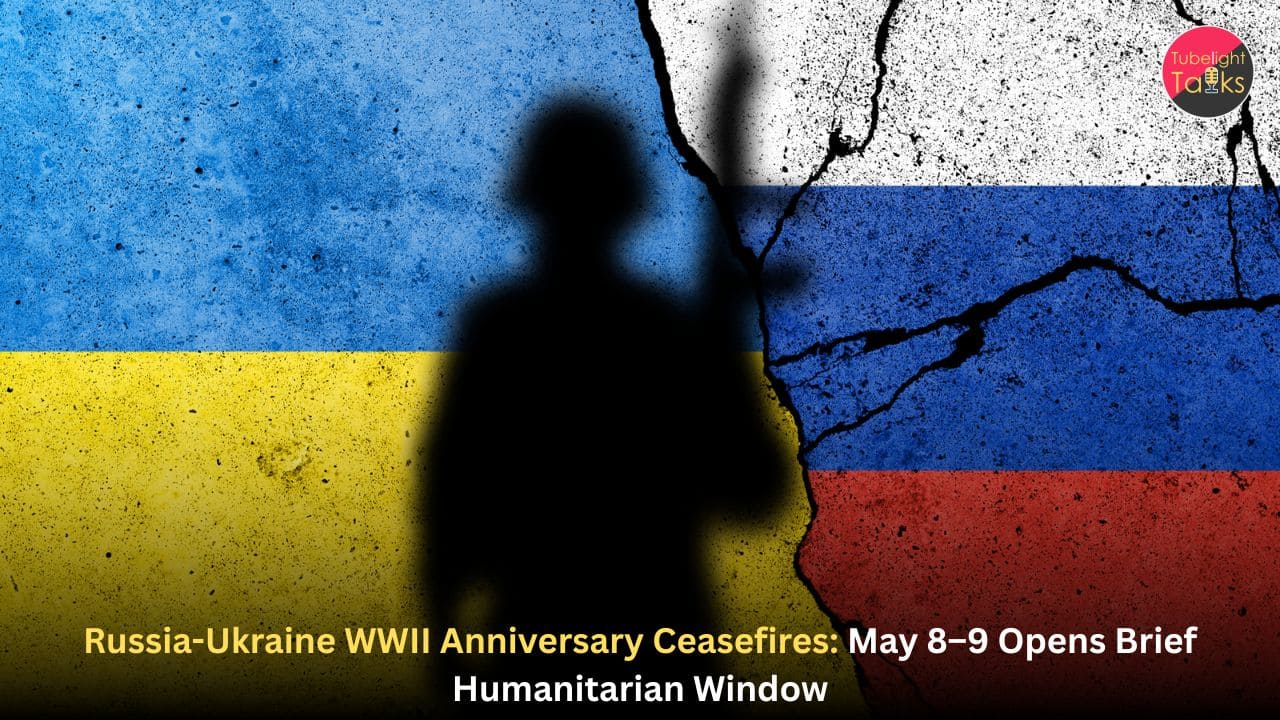
Russia-Ukraine WWII Anniversary Ceasefires: May 8–9 Brings a Fragile Humanitarian Window
Russia and Ukraine have announced separate unilateral ceasefire windows around May 8–9, the international period of remembrance for those who lost their lives during the Second World War. Moscow declared a temporary ceasefire for May 8–9 to coincide with Victory Day commemorations, while Kyiv proposed its own earlier and wider ceasefire window, accusing Russia of using symbolism while continuing deadly attacks.
The competing declarations are fragile and deeply political, but they still create a brief humanitarian opening. If respected even partially, the pause could help evacuate civilians, repair energy systems, recover bodies, deliver medical supplies, and remind both sides that remembrance of past war should not become justification for present suffering.
Russia-Ukraine Ceasefires: What Has Been Declared?
Moscow Announces a May 8–9 Victory Day Truce
Russia declared a unilateral ceasefire for May 8–9, when Moscow marks its annual World War II Victory Day commemorations. CBS News, citing AFP reporting, said Russia announced the truce for the two-day period and warned Kyiv of a “massive missile strike” if Ukraine violated it.
The Russian declaration comes as Moscow prepares for Victory Day, one of the most politically symbolic days in Russia’s public calendar. The Guardian reported that Moscow tightened security ahead of the May 9 parade, suspending airport operations and disrupting mobile internet access amid fears of Ukrainian drone strikes. It also reported that this year’s parade is being scaled back and will reportedly exclude heavy military equipment, reflecting security anxieties inside Russia.
Kyiv Proposes Its Own Ceasefire Window
Ukraine responded with skepticism toward Moscow’s May 8–9 ceasefire and proposed its own ceasefire beginning earlier. Reuters reported that Ukrainian President Volodymyr Zelenskiy criticized continued Russian attacks shortly before Kyiv’s proposed ceasefire window and emphasized the need for a longer-term truce.
The Guardian reported that Ukraine criticized Russia’s May 8–9 ceasefire move as manipulative and proposed a separate ceasefire beginning on May 6, while Russia had not acknowledged or accepted Ukraine’s proposal at the time of reporting.
This means the two sides have not agreed to one common ceasefire framework. They have declared separate and competing unilateral pauses. That distinction matters because unilateral ceasefires are easier to announce than to verify, and both sides may accuse each other of violations.
Also Read: Orthodox Easter Ceasefire Begins in Russia-Ukraine War, but the Truce Remains Fragile
Why May 8–9 Matters
A UN-Recognized Time of Remembrance
The United Nations General Assembly declared May 8–9 as a time of remembrance and reconciliation for those who lost their lives during the Second World War. The UN explains that Resolution 59/26 of November 22, 2004, invited member states, UN organizations, NGOs, and individuals to observe one or both of these days annually in an appropriate manner to pay tribute to all victims of the Second World War.
This gives the May 8–9 period international moral significance beyond national narratives. It is not only a day for military parades or national pride; it is also a time to remember the destruction caused by war, the suffering of civilians, and the responsibility to prevent future tragedies.
Different Historical Meanings in Russia and Ukraine
Russia marks Victory Day on May 9, commemorating the Soviet defeat of Nazi Germany. In Ukraine, the symbolism has shifted in recent years. Ukraine moved toward European-style remembrance on May 8, reflecting its desire to separate its memory culture from Moscow’s political use of the Second World War. The UN-recognized May 8–9 remembrance period gives both countries space to honor victims, but the ongoing war has turned memory into a contested political battlefield.
This is why the ceasefire declarations are so sensitive. Russia frames May 9 as a sacred Victory Day moment. Ukraine argues that Moscow is using the language of anti-fascist memory while continuing a war against Ukraine. The humanitarian value of a pause remains real, but the political symbolism remains deeply contested.
Humanitarian Window: Why Even a Brief Pause Matters
Civilians Need Relief
A temporary ceasefire can save lives even if it lasts only a few days. In frontline regions, civilians may use the pause to move out of dangerous areas, collect medicines, restore water access, receive humanitarian aid, or bury relatives. Local authorities may repair electricity, gas, heating, water, and communication systems damaged by strikes.
Reuters reported that Russian attacks across eastern Ukraine killed at least 27 people just hours before Kyiv’s proposed ceasefire was set to begin, including deaths in Zaporizhzhia, Kramatorsk, Dnipro, and Poltava region. That scale of civilian suffering explains why any humanitarian window matters.
Energy Infrastructure and Emergency Workers
Ukraine’s energy infrastructure has repeatedly been targeted during the war. Reuters reported that a Russian missile and drone strike on gas production facilities killed five people and injured 37, including Naftogaz employees and emergency service workers.
A ceasefire window can allow emergency teams to repair pipelines, substations, heating systems, and power networks without facing immediate follow-up strikes. This is especially important because Ukraine has accused Russia of using “double-tap” attacks, where first responders are hit after arriving at a damaged site.
Fragility of the Ceasefire
Mutual Distrust Remains Deep
The ceasefire declarations are fragile because neither side trusts the other’s intentions. Russia warned of retaliation if Ukraine disrupts Victory Day events. Ukraine accused Moscow of using the truce as a political performance while continuing deadly strikes before the pause.
This mistrust can quickly destroy a ceasefire. A drone strike, artillery shell, missile launch, sabotage accusation, or disputed frontline movement can lead both sides to claim the other violated the pause. Without independent monitoring, humanitarian corridors, and clear communication channels, unilateral ceasefires often collapse into accusations.
Attacks Before the Deadline Raise Doubts
Reuters reported that Russia launched major attacks before the deadline for Kyiv’s proposed ceasefire, killing civilians and hitting energy facilities. Ukraine also launched drone attacks inside Russia, with Russia claiming interceptions of 93 Ukrainian drones in seven hours.
This shows the central contradiction: both sides are talking about ceasefires while military operations continue. A real humanitarian pause requires not only public declarations but also operational instructions to commanders, communication to frontline units, air-defense coordination, and restraint from long-range strikes.
Russia’s Victory Day Security Concerns
Moscow Tightens Security
The Guardian reported that Moscow tightened security ahead of the May 9 Victory Day parade, including airport shutdowns and mobile internet disruptions. The measures followed fears of Ukrainian drone attacks and came after a recent drone strike on a Moscow apartment building.
This is an important development because the war has increasingly reached Russian territory through drone attacks. Moscow’s concern over security during Victory Day reflects Ukraine’s growing ability to strike symbolic and strategic targets inside Russia.
Scaling Back the Parade
According to The Guardian, the Victory Day parade has been scaled back this year and heavy military equipment has reportedly been excluded due to security concerns.
That image is politically striking. Victory Day has traditionally projected Russian military strength. A reduced parade amid wartime security fears suggests that the conflict has affected even Russia’s most symbolic public ceremonies.
Also Read: Russia-Ukraine War 2026: Global Fallout of an Unending Conflict
Ukraine’s Position: A Longer Truce, Not Symbolic Pause
Kyiv Calls for More Than Two Days
Ukraine has argued that a short ceasefire around Russia’s Victory Day is not enough. Reuters reported that President Zelenskiy proposed a separate ceasefire beginning earlier and called for a longer-term truce.
Kyiv’s position is that if Russia genuinely wants peace, it should accept a broader ceasefire rather than a narrow pause designed around Moscow’s ceremonial calendar. Ukraine sees a short May 8–9 ceasefire as potentially useful, but insufficient if attacks resume immediately afterward.
Humanitarian Pause Versus Strategic Pause
Ukraine may also fear that Russia could use a short ceasefire to regroup forces, move equipment, improve defensive positions, or create a propaganda narrative. Russia may make similar accusations against Ukraine. This is why humanitarian ceasefires need defined rules: no troop movement, no new offensive preparation, no long-range strikes, no drone attacks, and safe access for aid workers.
Without such rules, a ceasefire may become a tactical pause rather than a humanitarian one.
International Reaction and Global Stakes
Why the World Is Watching
The Russia-Ukraine war has global consequences. It affects food supplies, energy markets, defense spending, refugee flows, European security, nuclear risk, and diplomatic alignments. A May 8–9 ceasefire will not end the war, but it can test whether both sides are capable of limited restraint.
If the ceasefire holds even briefly, it may create pressure for more humanitarian pauses. If it collapses immediately, it will reinforce the belief that both sides are far from meaningful talks.
Symbolism of WWII Remembrance
World War II remembrance carries special weight because the conflict caused enormous human suffering across Europe, the Soviet Union, Asia, Africa, and beyond. The UN’s designation of May 8–9 as a time of remembrance and reconciliation is meant to focus attention on victims and lessons of war, not only military victory.
In this context, a ceasefire around May 8–9 carries moral meaning. It asks a simple question: can nations fighting today honor the dead of the past by sparing civilians in the present?
What Could a Humanitarian Ceasefire Achieve?
Evacuation of Civilians
Frontline areas often contain elderly people, children, disabled residents, and families unable to leave without organized support. A ceasefire could allow buses, ambulances, and humanitarian convoys to move civilians away from danger zones.
Medical Aid and Hospital Support
Hospitals near the front need medicine, generators, blood supplies, surgical equipment, fuel, and staff movement. Even a short pause can allow deliveries that save lives.
Repair of Energy and Water Systems
Energy, gas, and water systems are vital for civilian survival. Reuters reported serious damage to energy infrastructure and deaths among workers responding to strikes. A ceasefire can create safe time for repair crews.
Body Recovery and Prisoner Exchanges
Temporary ceasefires can also allow the recovery of bodies, exchange of remains, and sometimes prisoner swaps. These steps matter deeply for families and can reduce suffering even when political negotiations remain frozen.
Risks That Could Break the Ceasefire
Drone Warfare
Drone warfare has become one of the most difficult areas to control. Drones can be launched by military units, intelligence services, proxy actors, or even small teams. If a drone hits a target during a ceasefire, each side may accuse the other of bad faith.
Artillery and Frontline Ambiguity
Frontlines are long, complex, and heavily militarized. Local commanders may interpret threats differently. A single artillery exchange can escalate if there is no hotline or monitoring mechanism.
Propaganda and Public Pressure
Both Russia and Ukraine face domestic pressure. Each government must show strength. If one side appears to “concede” during a ceasefire, political opponents or military hardliners may criticize it. This makes symbolic ceasefires especially vulnerable.
Lessons From Previous Ceasefire Attempts
Announcements Are Not Enough
The Russia-Ukraine war has seen multiple temporary pause proposals, but fighting has continued across many fronts. The lesson is clear: public announcements do not automatically stop war. Command structures, monitoring, verification, and humanitarian coordination are essential.
Humanitarian Goals Must Be Specific
A ceasefire that simply says “stop fighting” may fail because each side interprets it differently. A better humanitarian truce should specify routes, times, zones, monitoring bodies, emergency contacts, and consequences for violations.
Trust Can Begin Small
Even if broader peace is far away, small successes matter. If evacuation routes work, if aid convoys move safely, if repair crews survive, and if attacks reduce for 48 hours, then future pauses become more possible.
India’s Perspective on the May 8–9 Ceasefires
Peace Matters for Global Stability
India has consistently emphasized dialogue and diplomacy in global conflicts. The Russia-Ukraine war affects India through energy markets, fertilizer availability, food prices, defense diplomacy, trade routes, and global inflation. A humanitarian ceasefire around May 8–9, even if limited, supports India’s broader interest in stability.
Humanitarian Values and Strategic Balance
India has historical ties with Russia and expanding partnerships with Europe, the United States, and Ukraine. This makes a balanced, humanitarian approach important. Supporting civilian protection and dialogue does not require abandoning strategic autonomy. It reflects the basic principle that war must not crush innocent people.
From War Memory to Peace Responsibility
May 8–9 should remind the world that war leaves wounds across generations. The teachings of Sant Rampal Ji Maharaj and Sat Gyaan explain that violence, ego, hatred, intoxication, corruption, dishonesty, and wrong conduct push human society toward suffering. Sant Rampal Ji Maharaj’s official teachings strongly emphasize true worship according to holy scriptures and a life free from social evils such as corruption, theft, intoxication, dowry and dishonesty.
In the context of the Russia-Ukraine ceasefire, this spiritual understanding is deeply relevant. Nations may declare ceasefires for two days, but lasting peace requires transformation of human conduct. Sat Gyaan teaches that real peace begins when people and leaders follow righteousness, compassion, humility, and devotion to the Supreme God. Just as May 8–9 honors the dead of World War II, true remembrance should inspire humanity to stop creating new graves through pride and conflict.
Call to Action: Turn a Brief Pause Into Real Humanitarian Relief
Russia and Ukraine should use the May 8–9 remembrance period to protect civilians, open humanitarian corridors, allow repair crews to work, support medical deliveries, and reduce attacks across frontline and civilian areas. International organizations should be prepared to assist evacuations, monitor violations where possible, and push both sides toward longer humanitarian pauses.
Citizens worldwide should follow authentic sources, avoid spreading war misinformation, and remember that behind every battlefield update are families, children, workers, doctors, and elderly people living under fear. At the same time, every individual should seek true spiritual knowledge, listen to the discourses of Sant Rampal Ji Maharaj, understand Sat Gyaan, and adopt a disciplined life based on truth, devotion, compassion, and moral conduct.
External ceasefires may stop weapons for a short time, but inner spiritual reform creates the foundation for lasting peace. The article structure follows the uploaded Team 5 content style reference.
FAQs on Russia-Ukraine WWII Anniversary Ceasefires
1. What ceasefire did Russia announce?
Russia declared a unilateral ceasefire for May 8–9, timed around Moscow’s World War II Victory Day commemorations. Reports said Moscow also warned Kyiv of a major retaliatory strike if Ukraine violated the truce.
2. What ceasefire did Ukraine propose?
Ukraine proposed a separate ceasefire window beginning earlier, with President Volodymyr Zelenskiy calling for a longer-term halt in fighting and criticizing Russia for continuing attacks before the proposed pause.
3. Why are May 8–9 important internationally?
The UN General Assembly declared May 8–9 as a time of remembrance and reconciliation for those who lost their lives during the Second World War, inviting states and organizations to honor WWII victims.
4. Is this a joint Russia-Ukraine ceasefire agreement?
No. The declarations are separate and unilateral, not a jointly negotiated ceasefire agreement. That makes the humanitarian window fragile and vulnerable to accusations of violations.
5. What humanitarian benefits could the ceasefire bring?
A temporary ceasefire could allow civilian evacuations, medical deliveries, repair of energy and water systems, recovery of bodies, and movement of humanitarian aid in frontline areas.
6. Why is the ceasefire considered fragile?
The ceasefire is fragile because attacks continued before the deadline, mutual distrust remains high, and there is no clear joint monitoring mechanism. Reuters reported deadly attacks across Ukraine shortly before Kyiv’s proposed ceasefire window.
Related Stories




Discussion (0)