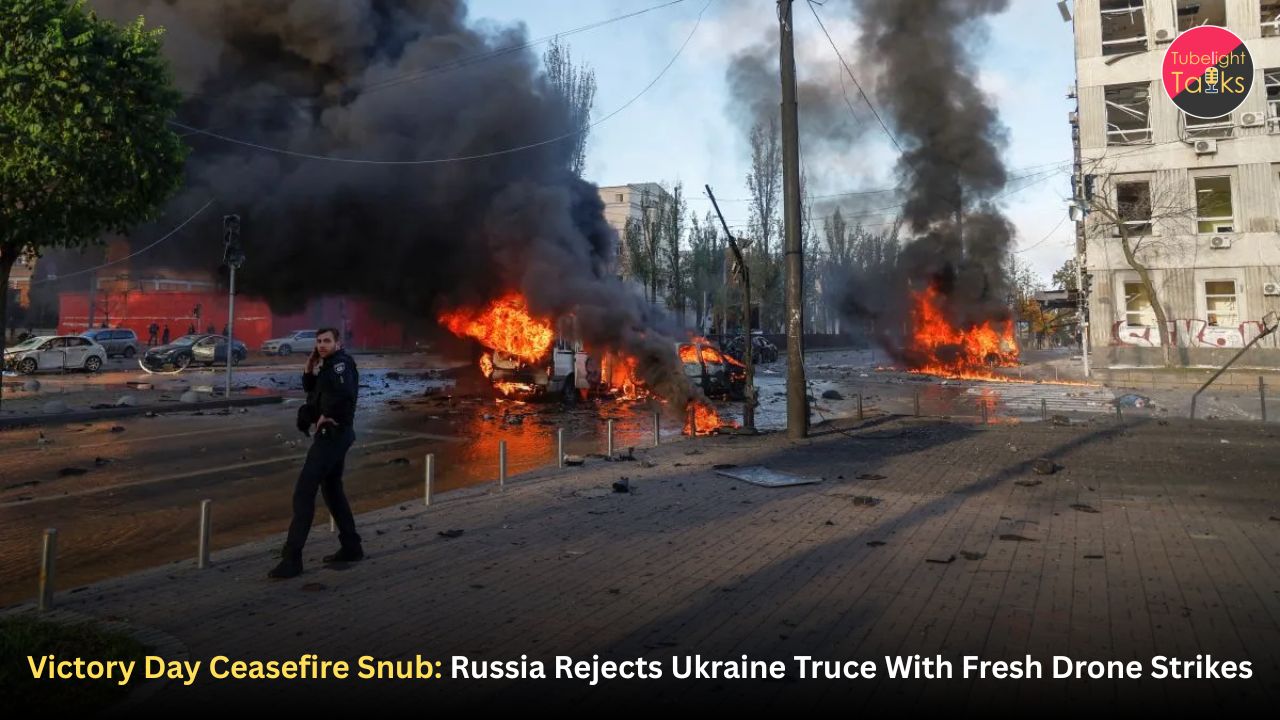
Victory Day Ceasefire Snub: Russia Rejects Ukraine’s May 9 Truce With Fresh Drone Strikes
Russia has reportedly rejected Ukraine’s proposal for a unilateral ceasefire around May 9, launching fresh drone and missile strikes across several Ukrainian cities just as Kyiv attempted to create a humanitarian pause ahead of Russia’s World War II Victory Day commemorations. Ukraine said Moscow fired more than 100 combat drones and three missiles overnight, hitting multiple regions and proving that Russia’s own Victory Day ceasefire rhetoric was hollow.
President Volodymyr Zelenskyy accused Moscow of caring more about military parades than peace, while Ukrainian officials said Russian forces carried out 1,820 ceasefire violations. The failed truce has deepened doubts over Russia’s intentions and renewed urgent calls for genuine, monitored de-escalation.
Ukraine’s Ceasefire Proposal and Russia’s Response
Kyiv Offered a Wider Pause
The latest ceasefire dispute began after Russia announced a short Victory Day-related truce for May 8–9. Ukraine responded by proposing an earlier ceasefire beginning on May 6, arguing that if Moscow genuinely wanted peace for symbolic World War II remembrance, it should agree to stop fighting sooner and more meaningfully.
Ukraine’s position was simple: human life should matter more than political ceremony. Kyiv wanted the pause to become a humanitarian window that could help civilians, allow emergency repairs, reduce deaths and test whether Russia was serious about de-escalation.
But almost immediately, Ukraine reported fresh Russian attacks. According to AP, Russia launched more than 100 drones and three missiles after Ukraine’s unilateral ceasefire began, striking multiple areas and showing no sign of accepting the pause.
Moscow Accused Ukraine Too
Russia, in turn, accused Ukraine of failing to honor its own ceasefire and claimed to have downed Ukrainian drones. Russian authorities also reported casualties in Russian-occupied Crimea after a Ukrainian drone strike. This exchange of accusations shows why temporary ceasefires in this war repeatedly collapse: both sides distrust each other deeply, and neither side accepts the other’s narrative.
However, the scale of Russian strikes reported by Ukraine has made Kyiv’s accusation more forceful. Ukrainian officials argue that Moscow’s actions prove the Victory Day ceasefire offer was designed for image management, not real peace.
Also Read: Russia-Ukraine WWII Anniversary Ceasefires: May 8–9 Brings a Fragile Humanitarian Window
Drone and Missile Strikes Across Ukraine
More Than 100 Drones Fired
Ukraine’s Foreign Ministry and military officials said Russia used 108 combat drones and three missiles in overnight attacks. Euronews reported that Ukrainian officials accused Russia of violating the ceasefire through drone and missile attacks against Ukrainian cities.
AP also reported that a kindergarten in Sumy was struck, killing one person and injuring others. This detail has become especially sensitive because attacks on civilian areas undermine any claim that a ceasefire or humanitarian pause is being respected.
Civilian Death Toll Continues to Rise
The Guardian reported that at least 28 civilians were killed on Tuesday alone and that recent Russian attacks had caused more than 70 deaths and over 500 injuries since the previous Friday, citing Ukrainian and UN-linked figures.
This is why the ceasefire issue matters beyond diplomacy. For civilians in Sumy, Kharkiv, Kryvyi Rih, Zaporizhzhia, Donetsk, Poltava, Dnipro and other regions, a ceasefire is not symbolic. It can decide whether families survive the night, whether hospitals function, whether children attend school and whether rescue workers can reach bombed sites.
Victory Day Symbolism and Political Messaging
May 9 Is Central to Russian State Identity
May 9, Victory Day, is one of Russia’s most important public commemorations. It marks the Soviet Union’s victory over Nazi Germany in World War II and has long been used by the Kremlin as a symbol of sacrifice, patriotism and national strength.
In wartime Russia, Victory Day has also become deeply political. The Kremlin uses it to frame the current war in Ukraine through historical memory and patriotic mobilization. That is why a ceasefire around May 9 carries heavy symbolism.
Ukraine Calls It Cynicism
Ukraine has accused Russia of using Victory Day rhetoric while continuing attacks on Ukrainian civilians. Foreign Minister Andrii Sybiha said Russia’s actions showed that Moscow rejected peace and that its calls for a May 9 ceasefire had nothing to do with diplomacy. Reuters reported Zelenskyy accusing Russia of prioritizing military parades over peace efforts.
This is the heart of the Ukrainian argument: if Russia truly wants to honor the memory of World War II victims, it should stop creating new victims in Ukraine.
Also Read: Fresh Missile Strikes in Eastern Ukraine Escalate Russia-Ukraine War
Why the Ceasefire Failed
No Shared Verification Mechanism
One major reason the ceasefire failed is the absence of a shared verification mechanism. A unilateral ceasefire depends heavily on trust, and trust between Moscow and Kyiv is almost nonexistent. Without international observers, agreed frontline rules, hotline communication and real-time incident monitoring, each side can accuse the other of violations.
Temporary ceasefires in modern wars require more than public announcements. They need maps, timelines, communication channels, prohibited actions, rules for drones, humanitarian routes and enforcement procedures.
Military Goals Still Dominate
Another reason is that both sides continue pursuing military objectives. Russia has been pressing offensives in eastern Ukraine, especially around Donetsk, while Ukraine has intensified long-range drone strikes on Russian military and infrastructure targets.
As long as battlefield advantage remains the priority, symbolic ceasefires are unlikely to last. A real truce would require political willingness to suspend operations, not just public messaging around a holiday.
Humanitarian Consequences
Civilians Lose the Most
When ceasefire proposals collapse, civilians suffer first. Drone and missile attacks damage homes, schools, hospitals, power systems, rail lines, water networks and emergency services. People living near the front cannot safely evacuate. Rescue workers may be hit while responding to earlier strikes.
The Guardian reported that recent attacks hit several Ukrainian regions and caused heavy civilian casualties, while AP reported continued Russian drone strikes despite Ukraine’s truce announcement.
Humanitarian Corridors Remain Urgent
A real ceasefire could allow evacuation of civilians, repair of energy infrastructure, prisoner exchanges, recovery of bodies, movement of medicine and delivery of food. The failure of the May 9 truce proposal means these humanitarian needs remain unresolved.
This is especially tragic because May 8–9 is internationally recognized as a period of remembrance for the victims of World War II. Instead of remembrance leading to restraint, the fighting has continued.
International Reaction and Pressure
Europe Backs Ukraine’s Ceasefire Gesture
Ukrainian and European officials described Kyiv’s ceasefire proposal as a sign of willingness for peace. Russia’s continued attacks are likely to strengthen calls for more sanctions and military support for Ukraine.
Western governments may now argue that Moscow’s conduct proves it is not serious about negotiations. Russia, meanwhile, will continue to claim that Ukraine also violates ceasefires and uses drone attacks to disrupt Russian territory and occupied regions.
Peace Talks Remain Stalled
The failed truce comes as broader peace talks remain stuck. Russia continues to press territorial and security demands that Ukraine rejects. Ukraine insists that any meaningful settlement must respect sovereignty and cannot reward aggression.
The ceasefire collapse therefore reflects a larger diplomatic deadlock. Temporary pauses cannot survive when the political framework for peace remains absent.
Also Read: Russia-Ukraine War 2026: Global Fallout of an Unending Conflict
What May Happen on May 9?
Russia’s Victory Day Security Fears
Russia has tightened security ahead of the May 9 Victory Day events. Previous reporting indicated Moscow had scaled back some parade elements and taken precautions due to fears of Ukrainian drone strikes. The atmosphere around the commemoration is therefore tense, not celebratory in the usual sense.
If Ukraine launches attacks on Russian territory or occupied areas during Victory Day, Moscow may respond with heavier strikes. If Russia escalates inside Ukraine during the same period, Kyiv will likely call the Victory Day truce a propaganda exercise.
Risk of Escalation
The biggest risk is that May 9 becomes a trigger for escalation rather than pause. Symbolic dates often create pressure on leaders to appear strong. Russia may want to show control. Ukraine may want to show that Russia cannot celebrate war while attacking Ukrainian cities.
This makes international diplomacy urgent. Even if a full ceasefire is not possible, pressure should focus on civilian protection, restraint around populated areas and emergency humanitarian access.
Memory of War and the Need for True Peace
The collapse of the Victory Day ceasefire proposal reminds humanity that remembering past wars has no meaning if present violence continues unchecked. The teachings of Sant Rampal Ji Maharaj and Sat Gyaan emphasize truth, humility, compassion, righteous conduct and true worship according to holy scriptures. His teachings guide people away from violence, intoxication, corruption, dishonesty, ego, greed and hatred.
In the context of the Russia-Ukraine war, this message is deeply relevant. Nations may hold parades and speak of sacrifice, but true tribute to the dead is stopping new suffering. Sat Gyaan teaches that real peace cannot come from pride or revenge; it comes when human beings follow righteousness, compassion and devotion to the Supreme God. War begins in ego, but peace begins in truth.
FAQs on Victory Day Ceasefire Snub
1. What ceasefire did Ukraine propose?
Ukraine proposed a unilateral ceasefire beginning on May 6, ahead of Russia’s May 8–9 Victory Day ceasefire window, to create a broader humanitarian pause.
2. How did Russia respond?
Ukraine says Russia effectively rejected the proposal by launching more than 100 drones and three missiles across Ukrainian territory after the ceasefire began.
3. What did Zelenskyy accuse Russia of?
President Volodymyr Zelenskyy accused Russia of rejecting peace and prioritizing military parades over human life and diplomacy.
4. Which areas were hit?
Reports mentioned attacks across several Ukrainian regions, including Sumy and other cities affected by drone and missile strikes. A kindergarten in Sumy was reportedly struck.
5. Why is May 9 important?
May 9 is Russia’s Victory Day, marking the Soviet victory over Nazi Germany in World War II. The date carries major political and symbolic importance in Russia.
6. Why did the ceasefire fail?
The ceasefire failed because there was no mutual agreement, no shared monitoring mechanism, deep distrust between both sides and continued military operations despite public ceasefire claims.
Related Stories





Discussion (0)