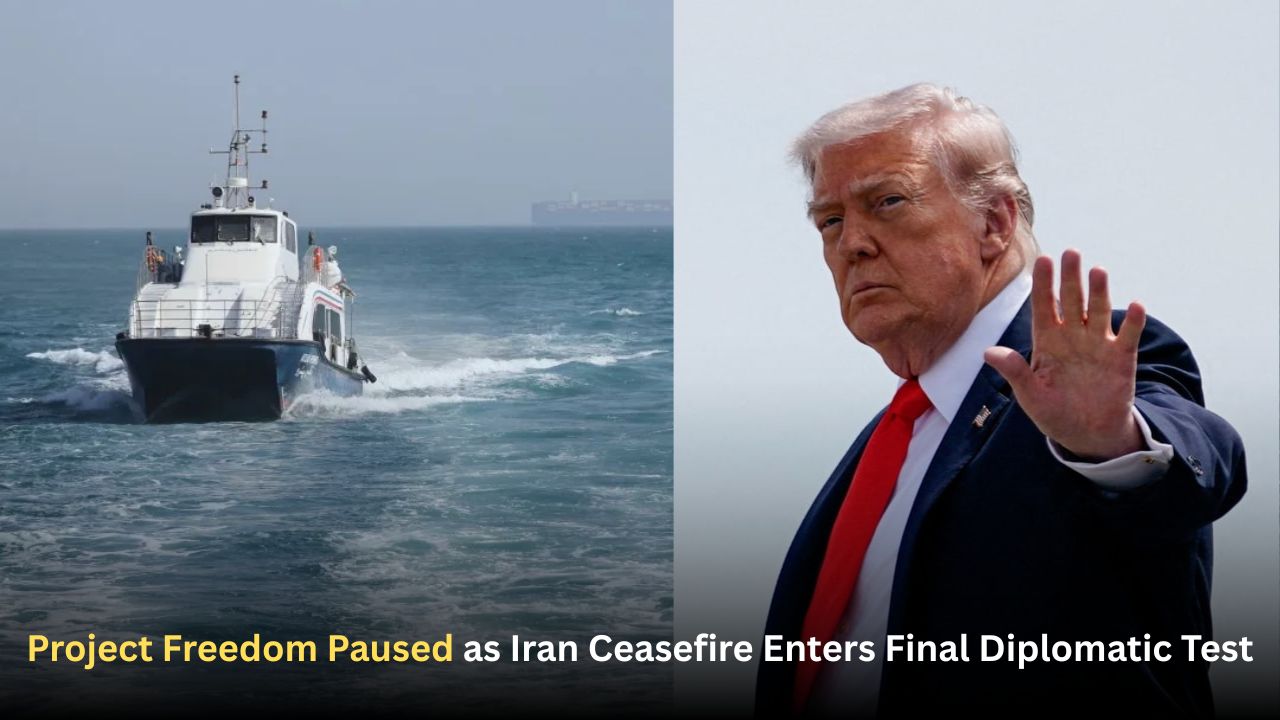
Project Freedom Paused: Strait of Hormuz Crisis Moves Toward Diplomatic Settlement
President Donald Trump has announced a brief pause in “Project Freedom,” the U.S. naval escort mission launched to guide stranded commercial vessels through the Strait of Hormuz, to allow room for a final diplomatic settlement with Iran. The decision came after Washington said there had been significant progress in indirect talks, reportedly supported by Pakistan and regional partners. Secretary of State Marco Rubio has also declared that the offensive campaign known as Operation Epic Fury is over, even as the U.S. naval blockade of Iranian ports remains in place.
The move marks a sharp shift from active escalation toward a defensive and diplomatic posture. Whether this pause becomes a breakthrough or only a temporary tactical delay now depends on Iran’s response and the details of the proposed settlement.
Project Freedom Paused: What Has Changed?
A Naval Mission Put on Hold
Project Freedom was launched as a U.S. effort to protect and guide commercial ships trapped or delayed in the Strait of Hormuz. The waterway had become a danger zone after weeks of military escalation, maritime blockades, alleged attacks, mines, drone threats and rising energy-market anxiety. The operation was meant to reopen safe passage and reassure global shipping markets.
Trump’s decision to pause the mission after only a short operational window is therefore significant. It signals that the White House believes diplomacy has advanced far enough to justify reducing immediate naval movement. The Guardian reported that Trump said the pause was intended to focus on finalizing a peace deal with Iran, though he also confirmed that the U.S. naval blockade of Iranian ports would continue.
This means Washington is not fully stepping back. Instead, it is trying to create diplomatic space while keeping pressure on Tehran. Project Freedom is suspended; the blockade remains.
Why the Pause Matters
The pause matters because the Strait of Hormuz is one of the most sensitive maritime zones in the world. Any direct clash between American and Iranian forces there could quickly escalate beyond shipping lanes and affect energy prices, regional security, allied military positions and global trade.
By pausing the escort mission, Trump is reducing the immediate risk of direct confrontation at sea. At the same time, by maintaining the blockade, he is signaling that Iran must still accept the proposed terms before full de-escalation can happen.
This is diplomacy under pressure: negotiation with naval power still visible in the background.
Also Read: Trump Pauses Project Freedom as US-Iran Diplomacy Enters Critical Breakthrough Phase
Rubio Says Operation Epic Fury Is Over
Offensive Phase Concludes
Secretary of State Marco Rubio said that Operation Epic Fury, the major offensive phase of the U.S.-Iran conflict, is over. Time reported that Rubio described the operation as effectively ended while warning that the ceasefire remained fragile and flare-ups in the Strait of Hormuz continued to test the situation.
This statement marks a change in official U.S. messaging. Operation Epic Fury represented active combat operations and military punishment. Its conclusion allows Washington to present the next phase as defensive, protective and diplomatic rather than offensive.
For Trump, this is politically useful. He can claim that military action achieved its purpose, while now giving diplomacy a chance. For Rubio, it helps frame U.S. policy as controlled rather than open-ended.
Not a Complete End to Risk
The end of Operation Epic Fury does not mean the crisis is over. Reports continue to mention stranded ships, disrupted shipping lanes and unresolved security issues in the strait. The Times reported that hundreds of civilians remained stranded at sea and that only a small number of ships had passed through the secured shipping lane before the pause.
This is why the language of “pause” is important. The U.S. has not abandoned the mission permanently. It has created a short diplomatic window. If talks fail, Trump has warned that military action could resume with greater intensity. Reuters reported that Trump said the war could end if Iran agrees to the proposal already outlined, but he also warned of stronger action if Iran refuses.
Pakistan’s Mediation Becomes Central
A Bridge Between Washington and Tehran
Pakistan has emerged as an important mediator in the crisis. Trump’s pause reportedly came after requests from Pakistan and other countries involved in the diplomatic effort. The Guardian reported that indirect negotiations with Iran were being facilitated by Pakistan, and that the pause was tied to progress in those talks.
This mediation role matters because the United States and Iran have limited direct trust. A third-party channel can help carry messages, test proposals, reduce misinterpretation and provide face-saving language for both sides.
For Iran, Pakistan’s involvement may make talks more politically acceptable. For the U.S., mediation allows Washington to push for maritime security and ceasefire terms without appearing to negotiate from weakness.
A Face-Saving Framework
Any final settlement will likely need language that lets both sides claim victory. Trump will want to say military pressure forced Iran to accept safe passage and de-escalation. Iran will want to say it defended sovereignty and secured fair treatment.
This is why mediators matter. They help convert hard military positions into practical diplomatic language. A possible agreement could involve safe shipping procedures, reduced attacks, humanitarian corridors, partial reopening of the strait, phased easing of pressure and continued monitoring.
Also Read: Project Freedom Launched to Secure Global Shipping Through Strait of Hormuz
Strait of Hormuz: The World’s Energy Nerve Point
Why the Waterway Matters
The Strait of Hormuz is a narrow but globally critical maritime route. A large share of the world’s oil and liquefied natural gas traffic moves through or near this corridor. When ships are delayed, threatened or blocked there, energy markets react quickly.
The Guardian reported that disruption in the strait has contributed to serious energy concerns and fuel-price pressure.
This is why the crisis is not only a U.S.-Iran issue. Asian economies, European markets, Gulf exporters, shipping companies, insurers, consumers and industries all feel the impact. A few days of maritime uncertainty can raise shipping costs, fuel prices, inflation concerns and political pressure on governments.
Commercial Confidence Takes Time
Even if a political deal is signed, ships may not immediately return to normal operations. Shipping companies need proof that lanes are safe, mines are cleared, attacks have stopped, insurance terms are manageable and ports can operate reliably.
South Korea’s decision to suspend review of possible participation in Project Freedom after Trump paused the mission shows how quickly allied planning can shift when Washington changes course.
This proves that maritime security is not only about warships. It is about confidence, coordination and predictability.
Iran’s Response and China Factor
Tehran Has Not Fully Closed the Door
Iran has sent mixed signals. Reports said Iranian officials expressed interest in a fair and comprehensive agreement, while also rejecting some U.S. military claims and warning against hostile actions. The Times reported that Iran’s foreign minister was continuing diplomatic discussions in Beijing, making China another important part of the wider diplomatic environment.
China matters because it has major energy and strategic interests in the region. If Beijing encourages de-escalation, Iran may find it easier to accept a compromise. If great-power rivalry hardens, diplomacy may become more complicated.
The Proposal Is the Key
Trump has said the war could end if Iran accepts the proposal already on the table. Reuters reported that he linked Iran’s compliance to reopening the Strait of Hormuz, concluding Epic Fury and easing the blockade.
The contents of the proposal are therefore crucial. It likely includes maritime security commitments, limits on attacks, safe transit rules and possibly broader issues tied to Iran’s military or nuclear posture. If the proposal is too one-sided, Iran may resist. If it is too weak, U.S. allies may object.
The Diplomatic Window Is Narrow
What Success Would Look Like
A successful outcome would include safe commercial shipping, reduced naval confrontation, a verified ceasefire, humanitarian movement, partial normalization of energy flows and continued talks on unresolved strategic issues. It would not solve every U.S.-Iran dispute overnight, but it could prevent a wider war.
What Failure Would Mean
If talks collapse, Project Freedom may restart. The blockade may intensify. Iran may renew threats or attacks in the strait. Energy markets may respond sharply. Regional allies may be pulled deeper into the crisis.
This is why the pause is so important. It is a small gap between confrontation and settlement.
Restraint, Peace and the Higher Lesson
The pause in Project Freedom shows that even powerful nations eventually need restraint, patience and dialogue. Weapons may create pressure, but only truthful negotiation can create lasting peace. The teachings of Sant Rampal Ji Maharaj and Sat Gyaan emphasize truth, humility, compassion, righteous conduct and true worship according to holy scriptures. His teachings guide people away from violence, intoxication, corruption, dishonesty, greed and ego.
In the context of the Strait of Hormuz crisis, this message is deeply relevant. War often grows from arrogance, fear and selfish interest, while peace requires moral discipline and wisdom. Sat Gyaan teaches that outer peace becomes stable only when human conduct becomes pure. Nations, like individuals, must choose truth over pride and welfare over destruction.
FAQs on Project Freedom Paused
1. What is Project Freedom?
Project Freedom is the U.S. naval escort mission launched to guide or protect commercial ships moving through the Strait of Hormuz during the Iran crisis.
2. Why did Trump pause Project Freedom?
Trump paused the mission to give diplomacy with Iran a chance to finalize a settlement, after reporting progress through indirect talks and mediation efforts.
3. Is the U.S. blockade over?
No. Reports state that the U.S. naval blockade of Iranian ports remains in place even though Project Freedom has been paused.
4. What did Rubio say about Operation Epic Fury?
Secretary of State Marco Rubio said Operation Epic Fury is over, meaning the U.S. is presenting the offensive phase as concluded while maintaining a defensive posture.
5. What role is Pakistan playing?
Pakistan is reportedly helping mediate indirect talks between Washington and Tehran, giving both sides a channel for negotiation and possible compromise.
6. What happens if Iran rejects the proposal?
Trump has warned that military action could resume with greater intensity if Iran refuses the proposed settlement.
Related Stories





Discussion (0)