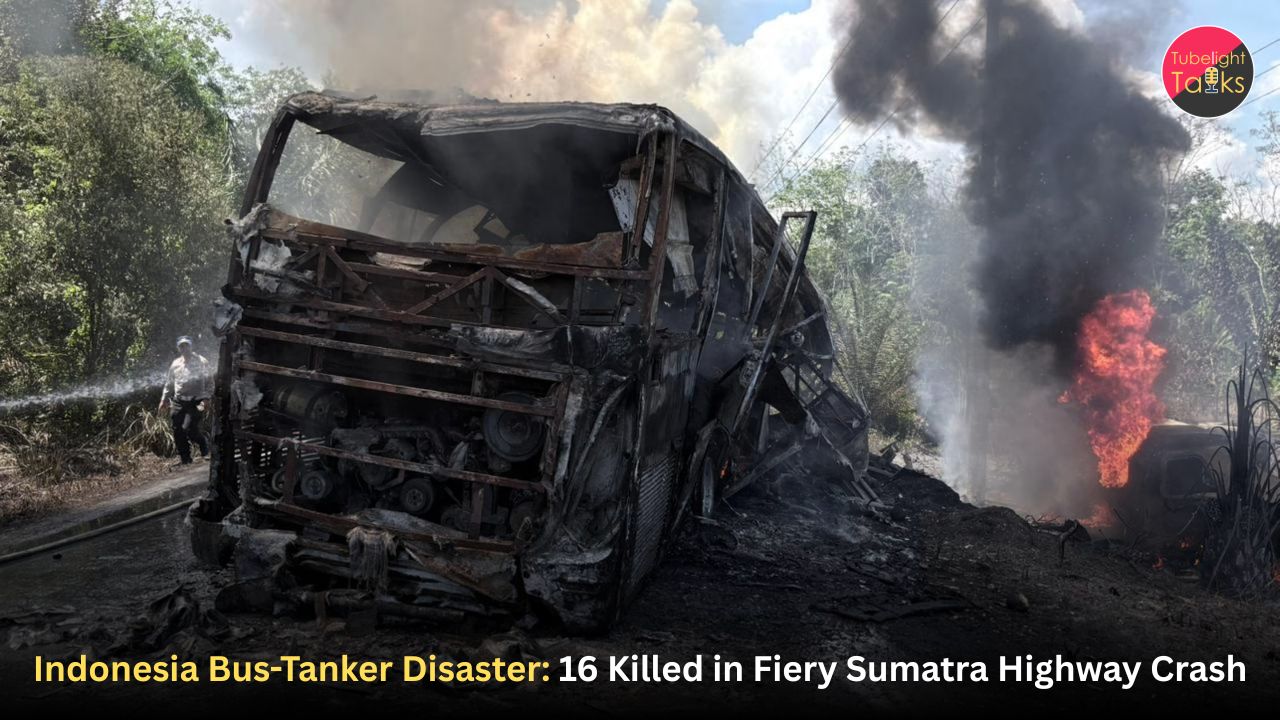
Indonesia Bus-Tanker Disaster: 16 Killed in Fiery Collision on Trans-Sumatra Highway
A horrific collision between a passenger bus and a fuel tanker truck on Indonesia’s Sumatra island has killed at least 16 people and injured four others, according to local disaster management officials. The crash occurred around midday on Wednesday on the Trans-Sumatra Highway in North Musi Rawas regency, South Sumatra province.
The intercity bus, carrying at least 20 people, was travelling from Lubuklinggau toward Jambi when it collided head-on with a tanker truck coming from the opposite direction. The impact triggered a massive fire, trapping many victims inside the burning vehicles. Officials said the dead included the bus driver, 13 passengers, the tanker driver and the tanker assistant.
Indonesia Bus-Tanker Disaster: What Happened?
Head-On Collision on Trans-Sumatra Highway
The deadly crash took place on the Trans-Sumatra Highway, a major road corridor connecting cities across Sumatra. According to disaster official Mugono, the bus was moving from Lubuklinggau city in South Sumatra toward Jambi when it struck a fuel tanker travelling in the opposite direction. The bus was reportedly carrying at least 20 people at the time of the crash.
Preliminary findings suggest the bus may have emitted sparks shortly before the collision. Mugono said this may have prompted the driver to steer toward the right side of the road in an attempt to avoid a more serious incident. However, a fuel tanker truck was approaching at high speed from the opposite direction, leaving little time to avoid impact.
This initial account remains part of the early investigation. Authorities are still expected to examine the condition of the bus, the tanker, road geometry, speed, driver decisions, mechanical failure, braking marks, witness statements and fire patterns before confirming the exact cause.
Fire Engulfs Both Vehicles
The collision became especially deadly because the impact triggered a fire that engulfed both vehicles. Mugono said the forceful crash caused flames to spread rapidly, leaving many people trapped inside. Photos and videos released by Indonesian rescue authorities showed firefighters battling thick black smoke and orange flames, while charred wreckage and twisted metal lay across the highway.
Fuel tanker crashes are particularly dangerous because collision impact can rupture tanks, spill flammable liquid and create intense fires within seconds. In such conditions, passengers may have very little time to escape, especially if doors are blocked, windows are jammed, victims are injured or the vehicle overturns.
Also Read: Nepal Bus Accident: 12 Dead, Dozens Injured After Vehicle Plunges Into River
Casualties and Rescue Efforts
Sixteen Killed, Four Injured
Officials said at least 16 people died in the disaster. The dead included the bus driver, 13 bus passengers, the tanker driver and the tanker assistant. All were reported to have burned to death inside the vehicles. Four bus passengers survived and were taken to a nearby health clinic. Three suffered severe burn injuries, while one sustained minor injuries.
Authorities were still collecting passenger data because the manifest was being traced. This means the casualty count could be revised if investigators find additional victims or clarify who was onboard. In major crashes involving fire, identification can take time because documents, phones and personal belongings may be destroyed.
Rescue Complicated by Fire and Wreckage
Rescue teams, disaster officers, firefighters and traffic police responded to the scene. Their work was complicated by intense fire, trapped victims and heavy wreckage. Several bodies were reportedly pinned inside the burned vehicles, making evacuation difficult. The crash also disrupted traffic along the highway.
In such incidents, rescuers must control fire before safely approaching the wreckage. They also have to manage fuel-spill risks, protect surrounding traffic, recover victims respectfully, move survivors quickly and preserve evidence for investigators. The emotional burden on rescue personnel is also heavy because highway fire disasters often involve severe burns and difficult victim recovery.
Why Road Accidents Remain a Serious Concern in Indonesia
Safety Standards and Infrastructure Challenges
Road accidents remain a recurring public safety challenge in Indonesia. AP noted that road crashes are common in the country due to poor safety standards and infrastructure issues.
Indonesia’s geography adds complexity. The country is spread across thousands of islands, with many long-distance road routes crossing mountains, forests, villages and mixed traffic zones. On roads such as the Trans-Sumatra Highway, buses, trucks, motorcycles, private cars and freight vehicles often share space across long distances. Driver fatigue, speeding, poor maintenance, narrow roads, overloaded vehicles and weak enforcement can increase risk.
Fuel Tanker Accidents Are Especially Dangerous
Collisions involving fuel tankers require special attention because they can escalate from traffic accident to fire disaster almost instantly. Tankers carrying flammable liquids need strict vehicle maintenance, driver training, route regulation, speed control, emergency equipment and safe operating procedures.
When a passenger bus collides with a fuel tanker, the consequences can be catastrophic. Buses carry many people, and tankers carry highly combustible material. A head-on collision between the two creates one of the deadliest road accident scenarios.
The Human Tragedy Behind the Numbers
Families Await Identification
The number “16 dead” cannot capture the full pain of the disaster. Each victim was someone’s family member, friend, colleague or neighbour. Some may have been travelling for work, family duties, study, medical needs or daily life. The suddenness of such a crash leaves families with grief, shock and unanswered questions.
In fire-related crashes, identification and body recovery can be traumatic for relatives. Authorities must provide clear information, respectful handling of remains, support for families and proper investigation updates.
Survivors Face Long Recovery
The four survivors, especially the three with severe burn injuries, may face a long medical journey. Burn injuries can require intensive treatment, infection control, surgeries, skin grafting, pain management and psychological care. Survivors may also experience trauma after witnessing fire, death and entrapment.
Public attention often fades after the first news cycle, but survivors and families live with the consequences for months or years.
Investigation: Questions Authorities Must Answer
Mechanical Failure or Driver Decision?
The early claim that the bus emitted sparks before the collision raises important questions. Did the bus have a mechanical problem? Was there an electrical fault, brake issue, engine problem, tyre friction or another source of sparks? Was the vehicle properly maintained before the journey? Did the driver have enough time and space to react safely?
Investigators will likely examine whether the bus driver’s maneuver was an emergency response or a misjudgment. They will also assess the tanker’s speed and whether the tanker driver had any chance to avoid the crash.
Road Design and Emergency Preparedness
Authorities may also examine whether the road section had adequate markings, visibility, shoulders, warning signs and safe passing space. If the highway has recurring accident patterns, road design improvements may be needed.
Emergency response timing is another factor. In remote highway areas, the distance to firefighters, ambulances and rescue equipment can affect survival chances. Fast response matters especially when fire is involved.
Also Read: Hyderabad Bengaluru Bus Tragedy: 19 People Burned to Death After Horrific Fire on NH-44
Lessons for Road Safety
Stronger Vehicle Inspections
Long-distance buses and fuel tankers must undergo strict inspections. Brakes, tyres, electrical systems, engines, fuel systems and emergency exits must be checked regularly. A small technical fault on a passenger vehicle can become deadly on a high-speed road.
Driver Training and Fatigue Control
Bus and tanker drivers carry major public responsibility. They need advanced training, rest periods, speed discipline and emergency-response knowledge. Fatigue is one of the biggest hidden risks in long-distance transport.
Better Emergency Exits in Buses
Passenger buses should have working emergency exits, breakable windows, fire extinguishers and clear evacuation instructions. Passengers should also know how to exit quickly during emergencies. In fire-related crashes, seconds can save lives.
Fuel Transport Regulation
Fuel tankers should follow strict route, speed and safety rules. High-speed movement of flammable cargo on mixed-traffic roads increases risk. Stronger enforcement and driver monitoring can reduce disasters.
Safety, Responsibility and the Value of Human Life
The Indonesia bus-tanker disaster reminds humanity that carelessness, weak systems and a single moment on the road can destroy many lives. The teachings of Sant Rampal Ji Maharaj and Sat Gyaan emphasize truth, compassion, discipline, righteous conduct and true worship according to holy scriptures. Sant Rampal Ji Maharaj’s teachings guide people away from intoxication, corruption, dishonesty, violence, greed and irresponsible behaviour.
In the context of road safety, this message is deeply relevant. Drivers, transport operators, officials and citizens must value human life above speed, profit or negligence. Sat Gyaan teaches that outer safety also begins with inner discipline. A society becomes safer when people follow truth, responsibility and compassion in every action.
FAQs on Indonesia Bus-Tanker Disaster
1. Where did the Indonesia bus-tanker crash happen?
The crash occurred on the Trans-Sumatra Highway in North Musi Rawas regency, South Sumatra province, Indonesia.
2. How many people died in the crash?
At least 16 people died, including the bus driver, 13 bus passengers, the tanker driver and the tanker assistant.
3. How many people were injured?
Four bus passengers survived and were taken to a nearby health clinic. Three had severe burn injuries and one had minor injuries.
4. What caused the collision?
The exact cause is still under investigation. Preliminary findings suggest the bus may have emitted sparks before the driver maneuvered toward the right, where the tanker was approaching at high speed.
5. Why was the crash so deadly?
The head-on impact triggered a massive fire that engulfed both vehicles, trapping many victims inside the burning wreckage.
6. What safety lessons does this disaster highlight?
The disaster highlights the need for stronger vehicle inspections, safer fuel transport, driver training, speed control, emergency exits and better highway emergency response.
Related Stories





Discussion (0)