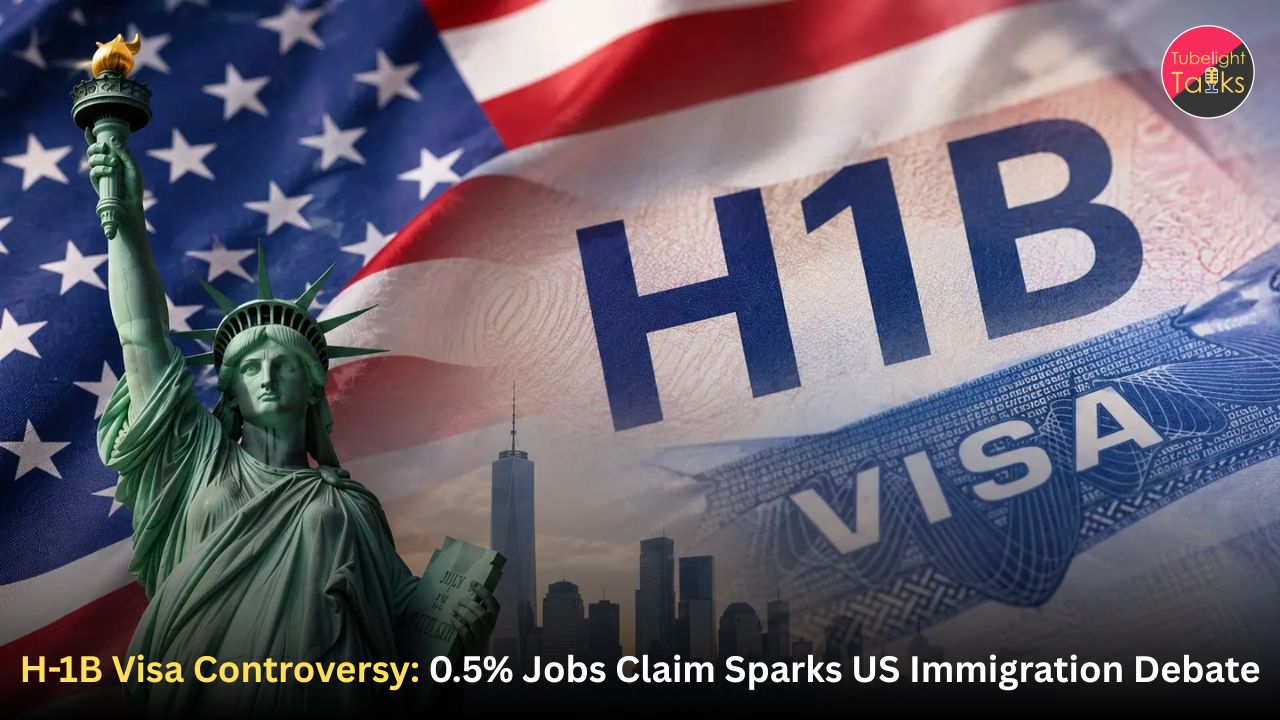
H-1B Visa Controversy: Less Than 0.5% Jobs Claim Triggers Fresh US Immigration Debate
A new H-1B visa controversy has erupted in the United States after a viral claim argued that H-1B visa holders occupy less than 0.5% of total American jobs. Supporters of the claim say it proves fears of foreign skilled workers “taking over” US employment are exaggerated. Critics say the comparison is misleading because H-1B workers are not spread evenly across the economy; they are heavily concentrated in technology, engineering, healthcare, education, research and other specialized sectors.
The debate comes as Republican lawmakers push the End H-1B Visa Abuse Act of 2026, a proposal that would sharply tighten the programme through a three-year pause on new visas, a lower cap and stricter wage requirements.
H-1B Visa Debate: Why the 0.5% Claim Went Viral
The Argument Behind the Number
The controversy began after a social media post by US entrepreneur James Blunt claimed that H-1B workers make up less than 0.5% of the US workforce. The argument was presented visually through charts comparing roughly 700,000 H-1B workers with a total American workforce of around 160 million. Supporters of this view say the numbers show that the political debate around H-1B visas is driven more by emotion than evidence.
The claim gained attention because immigration debates often rely on dramatic language. Phrases such as “job takeover,” “replacement,” or “foreign worker flood” can create a sense of crisis. The 0.5% figure pushes back by showing that H-1B workers are a tiny fraction of the overall US labour market.
However, the figure tells only part of the story. A worker can be a small share of the entire national workforce but still represent a meaningful share in specific industries, job categories or cities. This is where critics say the viral argument becomes too simple.
Why Critics Call the Comparison Misleading
Critics argue that comparing H-1B holders with all US jobs mixes very different labour markets. H-1B workers are not competing broadly for every job in retail, construction, hospitality, agriculture, public services or manual labour. They are concentrated in specialized roles that require technical or professional education.
USCIS data shows that computer-related occupations accounted for the largest share of approved H-1B petitions. In FY 2025, 62% of approved H-1B petitions were in computer-related occupations, while India remained the largest country of birth category for approved beneficiaries at 70%.
This means the real debate is not whether H-1B workers dominate the entire US workforce. They do not. The sharper debate is whether their concentration in technology and specialized sectors affects wages, hiring practices, entry-level opportunities and bargaining power for American workers in those fields.
Also Read: H-1B Visa Pause: A Turning Point for Global Talent and US Economy
The End H-1B Visa Abuse Act of 2026
Proposed Three-Year Pause
The political temperature rose further after lawmakers introduced the End H-1B Visa Abuse Act of 2026. The proposal calls for a three-year pause on new H-1B visas, a sharp reduction in the annual cap from 65,000 to 25,000, a $200,000 salary threshold, an end to Optional Practical Training and restrictions on green-card pathways for H-1B workers. Immigration lawyers have warned that if passed in its current form, the bill would amount to a near-total reset of America’s skilled migration system.
Such a bill would have major consequences for Indian professionals, US universities, technology companies, hospitals, research institutions, startups and international students. India has historically been the largest source of H-1B professionals, especially in technology and engineering roles.
Wage-Based Reform and Fraud Concerns
Supporters of stricter rules say the programme has been misused by companies to hire cheaper foreign labour, avoid hiring US workers or outsource jobs. The proposed bill reflects these concerns by seeking a high wage floor and a smaller cap.
The debate has also been intensified by investigations into alleged visa fraud. Texas Attorney General Ken Paxton recently launched an investigation into nearly 30 North Texas businesses over allegations of H-1B visa misuse, including claims involving “ghost offices.” The companies under scrutiny deny wrongdoing or are under investigation, but the case has strengthened calls for enforcement.
Critics of the programme say such cases show why the system needs stricter monitoring. Supporters of the programme respond that fraud should be punished without destroying a legal pathway used by thousands of legitimate employers and workers.
What USCIS Data Shows
India’s Dominant Share
USCIS data for FY 2025 shows that 70% of approved H-1B petitions were for beneficiaries whose country of birth was India. China was the second-largest category by a large margin. This has triggered political commentary in the US, including criticism from Senator Eric Schmitt, who expressed concern that large companies may be using the programme in ways that disadvantage American workers.
For Indian professionals, this data confirms the depth of India’s role in the US skilled labour market. Indian engineers, software developers, scientists, doctors, professors, analysts and researchers have long contributed to America’s innovation economy. But the same concentration also makes Indians the most vulnerable group when H-1B policy becomes restrictive.
Registrations Have Already Fallen
USCIS data on the H-1B electronic registration process for FY 2026 showed that the number of eligible unique beneficiaries was approximately 339,000, significantly lower than the previous year. The agency has also moved to beneficiary-centric selection to reduce multiple registrations and strengthen programme integrity.
This is important because it shows the programme has already been undergoing reform. The question now is whether lawmakers should continue targeted tightening or impose sweeping restrictions.
Economic Arguments: Talent Pipeline or Labour Pressure?
Supporters Say H-1B Fills Skill Gaps
Supporters of the H-1B programme argue that it helps the US attract global talent in sectors where skilled workers are in high demand. Technology companies, research universities, hospitals and engineering firms often say they cannot find enough qualified candidates domestically for certain roles.
Healthcare is one important example. KFF has noted that the H-1B programme helps supply high-skilled workers to the US workforce, including physicians, particularly in lower-income areas and in research universities or university-affiliated medical centres.
From this perspective, restricting H-1B too sharply could hurt innovation, healthcare access, research output and global competitiveness.
Critics Say the Programme Suppresses Wages
Critics argue that the programme can weaken worker bargaining power, especially when visa holders are tied to employers. Some research has suggested wage gaps between H-1B workers and comparable US-born workers, though the extent and interpretation of those gaps remain debated. A recent working paper cited evidence that H-1B workers may earn less than comparable US-born workers in similar occupations and locations.
This concern is not only about foreign workers replacing Americans. It is also about whether temporary visa status creates labour-market dependency. An H-1B worker who loses a job faces immigration consequences, which may reduce their ability to negotiate pay, challenge poor treatment or change jobs freely.
Impact on Indian Professionals and Students
Uncertainty for Skilled Workers
For Indian professionals, the H-1B debate creates deep uncertainty. Many workers spend years studying in the US, building careers, paying taxes, applying for green cards and raising families. Sudden changes to visa rules can affect housing, children’s schooling, career planning and long-term settlement.
A three-year pause or reduction in visa caps would also affect Indian students considering US education. If the path from student visa to OPT to H-1B becomes uncertain, many may choose Canada, Europe, Australia, Singapore or India’s own expanding technology ecosystem instead.
Indian IT Firms Already Face Decline
Indian IT services firms have already seen lower new H-1B approvals compared with earlier years. NFAP analysis reported that the top seven Indian-based companies had only 4,573 H-1B petitions approved for initial employment in FY 2025, a 70% drop from FY 2015 and 37% fewer than in FY 2024.
This suggests that the traditional outsourcing-heavy H-1B model has already changed significantly. The current debate may now affect a wider set of employers, including US tech companies, hospitals, universities and startups.
Also Read: H-1B Visa Fee Hike 2025: Impact on Indian IT Professionals
What a Balanced Reform Could Look Like
Target Fraud Without Blocking Talent
A sensible reform would strengthen enforcement against fraud, fake jobs, underpayment and misuse of third-party staffing, while preserving pathways for genuine high-skilled talent. That could include stricter audits, better wage transparency, faster penalties for fraud and stronger worker mobility protections.
Protect American and Foreign Workers
The debate should not turn American workers and foreign workers into enemies. Both can be exploited if companies misuse the system. Reform should protect US workers from unfair displacement while also protecting H-1B workers from employer dependency and underpayment.
Keep Innovation in Mind
The US benefits from attracting global talent. If the system becomes too restrictive, talent may go elsewhere. A balanced policy must protect domestic opportunity without weakening America’s innovation leadership.
Work, Justice and Moral Responsibility
The H-1B controversy shows how economic debates can easily become emotional, divisive and unfair when truth is ignored. The teachings of Sant Rampal Ji Maharaj and Sat Gyaan emphasize truth, humility, compassion, righteous conduct and true worship according to holy scriptures. Sant Rampal Ji Maharaj’s teachings guide people away from dishonesty, corruption, greed, exploitation, intoxication and harmful conduct. In the context of skilled migration, this message is deeply relevant.
Employers should not exploit workers, politicians should not mislead the public, and society should not target migrants with hatred. Sat Gyaan teaches that real progress comes through truth and justice. A fair system must protect local workers, foreign workers and human dignity together.
FAQs on H-1B Visa Controversy
1. What triggered the latest H-1B controversy?
The latest debate began after a viral claim said H-1B workers make up less than 0.5% of the US workforce, sparking arguments over whether the figure minimizes their role in specialized sectors.
2. Is the 0.5% claim accurate?
It may be broadly true when compared with the entire US workforce, but critics say it is misleading because H-1B workers are concentrated in technology and specialized occupations.
3. What does the End H-1B Visa Abuse Act of 2026 propose?
The bill proposes a three-year pause on new H-1B visas, reducing the annual cap to 25,000, setting a $200,000 wage threshold and ending OPT, among other strict changes.
4. Which country receives the largest share of H-1B approvals?
USCIS FY 2025 data shows that 70% of approved H-1B petitions were for beneficiaries whose country of birth was India.
5. Why do supporters defend the H-1B programme?
Supporters say it helps fill high-skilled gaps in technology, healthcare, research and engineering, while supporting US innovation and competitiveness.
6. Why do critics oppose the programme?
Critics argue that some employers misuse H-1B visas to lower wages, displace American workers or create dependency among foreign workers tied to employer sponsorship.
Related Stories








Discussion (0)