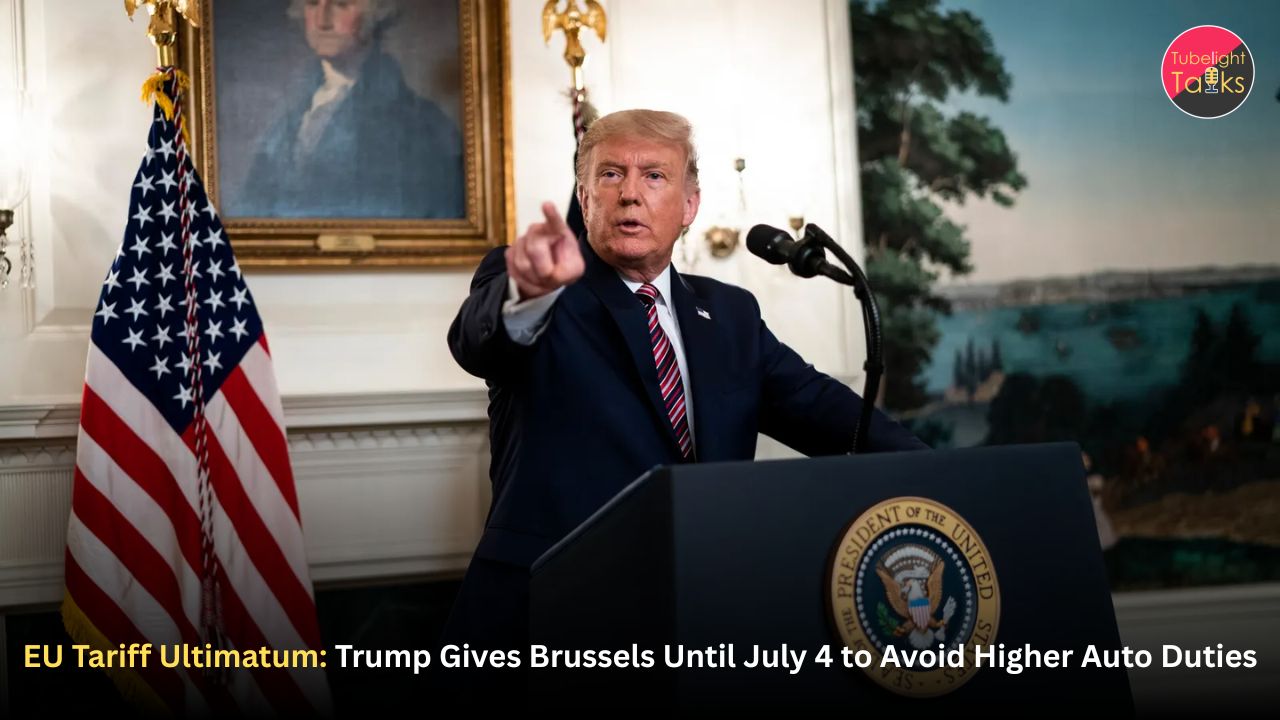
EU Tariff Ultimatum: U.S. Gives Brussels Until July 4 to Avoid Higher Tariffs on Cars and Trucks
President Donald Trump has issued a sharp trade ultimatum to the European Union, giving Brussels until July 4, 2026, to fulfill the terms of last year’s U.S.-EU trade agreement or face significantly higher tariffs. The warning came after Trump said he had a “great call” with European Commission President Ursula von der Leyen, temporarily stepping back from an immediate plan to raise duties on European cars and trucks.
U.S. officials say the EU has moved too slowly on implementing commitments made in the Turnberry trade deal, including reducing tariffs on American industrial goods and opening preferential access for U.S. farm and seafood products. Brussels says progress is continuing, but Washington is now using America’s 250th Independence Day as a hard deadline.
EU Tariff Ultimatum: What Trump Has Announced
July 4 Deadline for the European Union
Trump’s latest message gives the European Union until July 4 to implement its side of a trade agreement reached last year in Turnberry, Scotland. Reuters reported that Trump warned the EU must fulfill the agreement or face tariffs at “much higher levels.” The immediate focus is on vehicles, with U.S. auto tariffs on European cars and trucks threatened to rise from the current 15% level to 25% if Brussels does not move quickly enough.
The July 4 date is politically symbolic. It falls on the United States’ 250th Independence Day, giving the ultimatum a patriotic framing inside Trump’s domestic political narrative. It also gives the EU several more weeks to finalize legislative and administrative steps before Washington decides whether to escalate.
Immediate Tariff Hike Delayed
Before the call with von der Leyen, Trump had threatened to raise tariffs on EU cars and trucks almost immediately. After the conversation, he backed away from immediate action and granted the July 4 extension. AP reported that Trump’s delay came after what he described as a “great call” with the European Commission president, although he continued to criticize the EU for not acting fast enough.
This delay does not remove the threat. It only postpones it. For European automakers, exporters and trade officials, the next few weeks are now critical.
Why the U.S. Is Frustrated With the EU
Slow Implementation of the Turnberry Deal
The central U.S. complaint is that the EU has not fulfilled terms of the trade deal quickly enough. The agreement reportedly included EU commitments to reduce tariffs on U.S. industrial goods and provide duty-free or preferential quotas for American farm and seafood products. In return, the U.S. agreed to maintain a lower tariff ceiling on many European exports than Trump had previously threatened.
Washington argues that Brussels accepted the deal but has delayed implementation through political and legislative processes. From Trump’s perspective, delay equals non-compliance. From the EU’s perspective, trade implementation requires agreement across institutions, member states and parliamentary procedures.
European Parliament and Member-State Concerns
The EU’s trade system is more complex than a presidential order. The European Commission negotiates trade arrangements, but member states and the European Parliament often influence approval, implementation and safeguards. Some EU lawmakers want stricter conditions before granting tariff concessions to the United States.
Reuters reported that many EU countries want to avoid Trump’s tariff threat and are pushing for swift implementation, but trade officials also acknowledge that challenges remain. Talks are expected to continue later in May.
This is the core tension: Washington wants speed; Brussels needs process.
Auto Tariffs: Why Cars and Trucks Are at the Center
Europe’s Auto Industry Is Highly Exposed
The tariff threat is especially serious for European carmakers. Germany, in particular, has major automotive exports to the United States. Brands such as Volkswagen, BMW, Mercedes-Benz, Audi and Porsche depend on access to the American market. Higher tariffs can raise prices, reduce competitiveness, squeeze margins and disrupt supply chains.
European automakers already face pressure from electric-vehicle transition costs, Chinese competition, weak demand in some markets and stricter emissions rules. A jump in U.S. tariffs from 15% to 25% would add another burden.
Trucks and Auto Parts Could Also Be Affected
The user-facing headline is often “cars and trucks,” but the broader issue may also affect auto parts and related supply chains. Modern vehicles are built through integrated international production networks. A tariff on finished vehicles may also influence parts, components, logistics, assembly decisions and investment planning.
If tariffs rise, European manufacturers may consider shifting more production into the United States to reduce exposure. That is likely one of Trump’s strategic goals: use tariffs to push foreign companies to build more inside America.
EU Response: Progress, But Not Panic
Von der Leyen Signals Commitment
European Commission President Ursula von der Leyen described the call with Trump positively and said the EU remains committed to implementing the deal. Reports said she pointed to progress toward tariff reduction, even as the process remains unfinished.
Brussels is trying to avoid a public confrontation while preserving its institutional process. The EU does not want to appear weak before Washington, but it also does not want a tariff war that could damage industries on both sides of the Atlantic.
EU May Seek Safeguards
Some European lawmakers want safeguards to ensure that EU concessions are not met with additional U.S. tariff threats later. This is a major trust issue. If Brussels reduces tariffs and Washington still raises duties, the EU would look politically exposed.
That is why the final implementation may include conditions, review mechanisms or clauses that allow the EU to respond if the U.S. changes the deal unilaterally.
Trade War Risk: What Could Happen If Talks Fail?
Higher Tariffs on European Goods
If the EU misses the July 4 deadline, Trump could raise auto tariffs and possibly consider broader measures on European goods. Reuters reported that U.S. officials have discussed more retaliatory options if the EU does not move fast enough.
This could trigger countermeasures from Brussels. The EU has a long history of responding to U.S. tariffs with its own targeted duties on politically sensitive American products. A tariff spiral would hurt both economies.
Consumer Prices Could Rise
Tariffs often work like taxes on imported goods. If European cars face higher duties, U.S. consumers may pay more. Companies may absorb some costs, but over time, tariff pressure usually affects prices, investment or jobs somewhere in the chain.
Higher vehicle costs could also affect dealers, parts suppliers, repair networks and consumers who depend on imported models or components.
Market Uncertainty
Businesses dislike uncertainty. If companies do not know what tariff rate will apply after July 4, they may delay shipments, adjust inventory, pause investment or revise pricing. This can slow trade even before tariffs actually rise.
Also Read: Trump’s “Plan B”: Global Tariffs Signalled at 15% After Supreme Court Setback
Why Trump Is Using Tariffs Again
Tariffs as Negotiating Pressure
Trump has long treated tariffs as leverage. His argument is that the U.S. has been treated unfairly in global trade and that tough tariff threats force partners to negotiate. Supporters say this approach extracts concessions and protects American industry. Critics say it creates instability, raises consumer costs and strains alliances.
The EU ultimatum fits Trump’s broader trade style: set a deadline, threaten penalties, demand faster concessions and frame the dispute as a test of fairness.
Domestic Political Message
The July 4 deadline also allows Trump to connect trade policy with national pride. By choosing Independence Day, he is signaling that foreign partners must respect American economic power. This message plays well with voters who support industrial protection, manufacturing revival and tougher trade enforcement.
Why the EU Cannot Ignore the Threat
U.S. Market Is Too Important
The United States is one of the EU’s most important trade partners. European companies sell cars, machinery, pharmaceuticals, chemicals, luxury goods, food products and technology-related goods into the American market. A tariff escalation would create real economic pain.
Transatlantic Alliance Already Under Strain
The U.S. and EU are allies on many issues, including security, technology, Ukraine and China policy. But trade disputes can spill into wider diplomacy. If tariff tensions grow, cooperation on defence spending, sanctions, industrial policy and strategic technology could become harder.
India and Global South Angle
Ripple Effects Beyond Europe and America
A U.S.-EU tariff fight would not remain limited to the Atlantic economy. Global supply chains connect European, American and Asian suppliers. If European exports to the U.S. slow, companies may adjust sourcing, pricing and production across other markets.
India could see both risks and opportunities. If European and American companies diversify supply chains, India may attract new manufacturing interest. But global trade uncertainty can also reduce demand, disrupt markets and raise costs.
Trade Fragmentation Is a Global Concern
The bigger concern is that global trade is becoming more fragmented. Tariff threats, sanctions, industrial subsidies and supply-chain nationalism are replacing older assumptions about open trade. Countries now want resilience, domestic production and strategic control.
This may help some sectors but can hurt smaller economies that depend on stable trade rules.
What to Watch Before July 4
EU Legislative Movement
The first thing to watch is whether the EU speeds up tariff legislation and parliamentary approval. If Brussels passes the needed measures, Trump may claim victory and avoid raising tariffs.
U.S. Trade Representative Statements
Statements from U.S. Trade Representative Jamieson Greer and White House trade officials will show whether Washington thinks the EU is complying.
Auto Industry Reaction
European and American automakers will closely track the deadline. If they begin warning about price increases, job risks or supply-chain disruptions, political pressure may rise on both sides.
Possible Compromise
A compromise may involve phased implementation, temporary tariff relief, safeguard clauses and renewed talks after May 19. Both sides have reasons to avoid a full tariff war.
Trade, Justice and Moral Responsibility
The EU tariff ultimatum shows how economic power can quickly become a tool of pressure between nations. Trade should ideally support workers, farmers, consumers and peaceful cooperation, not become a source of ego and conflict. The teachings of Sant Rampal Ji Maharaj and Sat Gyaan emphasize truth, humility, compassion, righteous conduct and true worship according to holy scriptures.
His teachings guide people away from greed, dishonesty, corruption, intoxication, violence and misuse of authority. In the context of global trade, this message is deeply relevant. When leaders act with fairness and truth, agreements can benefit ordinary people. When greed and pride dominate, trade becomes a battlefield. Sat Gyaan teaches that true progress must be guided by moral responsibility.
FAQs on EU Tariff Ultimatum
1. What deadline has Trump given the European Union?
Trump has given the EU until July 4, 2026, to implement its side of last year’s trade agreement or face significantly higher tariffs.
2. What tariffs could increase?
The immediate threat focuses on European cars and trucks, with duties potentially rising from 15% to 25%.
3. Why is the U.S. angry with the EU?
Washington says the EU has moved too slowly in fulfilling commitments from the Turnberry trade agreement, including tariff reductions on U.S. industrial goods and market access for American farm and seafood products.
4. What did Ursula von der Leyen say?
Von der Leyen described her call with Trump positively and said the EU remains committed to implementing the agreement.
5. Why are European automakers worried?
Higher U.S. tariffs would make European vehicles more expensive in the American market and could hurt sales, margins and supply chains.
6. Could this become a wider trade war?
Yes. If the U.S. raises tariffs and the EU responds with countermeasures, the dispute could expand beyond autos and affect wider transatlantic trade.
Related Stories










Discussion (0)