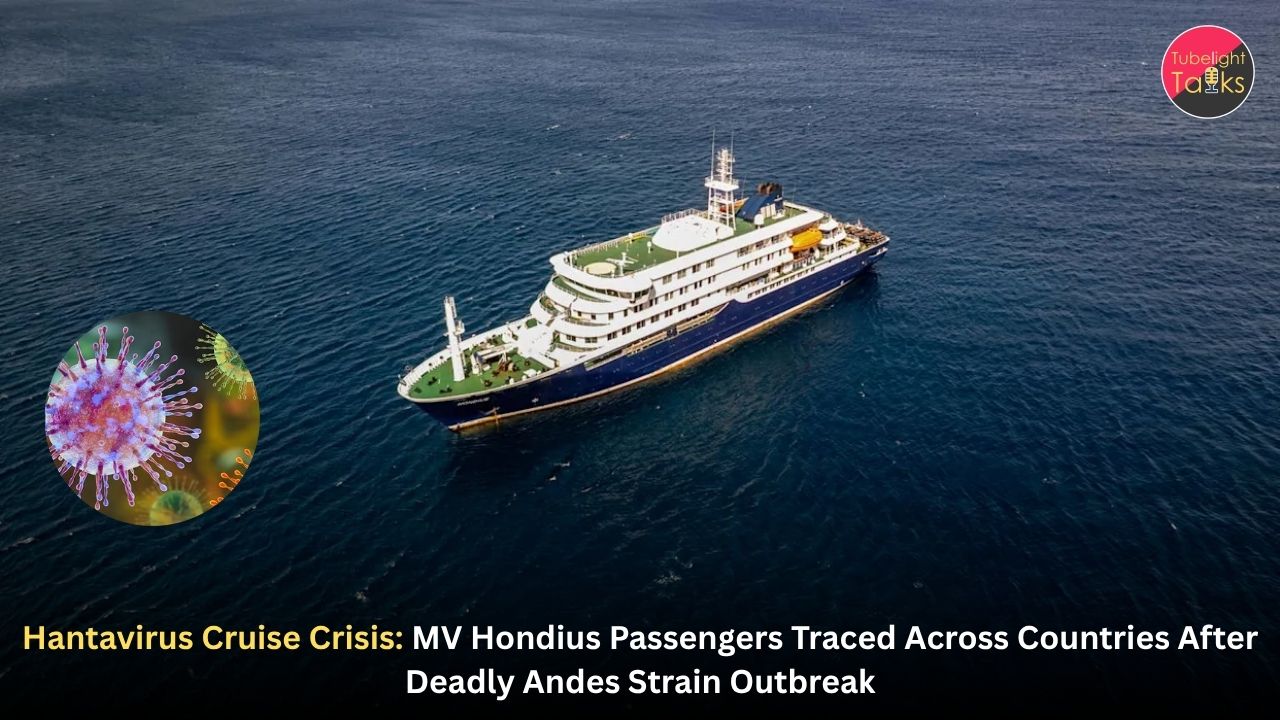
Hantavirus Cruise Crisis: MV Hondius Passengers Traced Worldwide After Deadly Andes Strain Outbreak
The MV Hondius cruise crisis has widened into a global contact-tracing operation after passengers who left the ship before a deadly hantavirus outbreak was confirmed returned to several countries. Health authorities are monitoring people in the UK, US, Australia, Singapore, Switzerland, New Zealand and other locations after the vessel became linked to the Andes strain of hantavirus.
Three people have died, and eight infections or suspected infections have been linked to the ship in recent reporting. The World Health Organization has assessed the wider public risk as low, but officials remain alert because the Andes strain is unusual among hantaviruses: rare human-to-human transmission can occur in close-contact settings.
MV Hondius Crisis: How a Cruise Outbreak Became International
Passengers Left Before Confirmation
The most urgent concern is that passengers disembarked before the outbreak was fully confirmed. The Guardian reported that authorities worldwide were trying to locate and monitor 29 passengers of 12 nationalities who left the MV Hondius at Saint Helena on April 24, before isolation protocols were activated. The ship had departed Ushuaia, Argentina, on April 1, and the first death linked to the outbreak occurred before the diagnosis was confirmed.
This timeline explains why the crisis has become international. A cruise ship is not a closed environment once passengers leave and board flights. People may pass through airports, sit near other travellers, return home, meet family members and enter health systems in different countries before authorities realize they may have been exposed.
The situation is not being treated as a pandemic threat, but as a targeted contact-tracing operation. Health officials are identifying exposed passengers, monitoring symptoms, testing suspected cases and asking some travellers to isolate.
Countries Now Monitoring Returnees
Several countries are now involved in tracing or monitoring passengers. Singapore has isolated and tested two male residents, aged 67 and 65, who had travelled on the MV Hondius and were also on a flight from Saint Helena to Johannesburg with a confirmed case who later died in South Africa. One of the Singaporean men reported mild symptoms, while the other was asymptomatic. Singapore’s Communicable Diseases Agency said the risk to the public remained low.
The Guardian reported that passengers had returned to countries including the US, UK, Australia, Singapore and Switzerland. New Zealand media also reported that a Kiwi was among those who left the vessel before hantavirus was confirmed.
This shows how one shipboard outbreak can quickly involve multiple health systems. Even when public risk is low, coordination becomes complex.
What Is the Andes Strain of Hantavirus?
A Rare but Serious Virus
Hantaviruses are usually rodent-borne viruses. People generally become infected when they inhale particles from infected rodents’ urine, droppings or saliva, or when contaminated dust is disturbed. The Andes strain is associated mainly with Argentina and Chile and is known to cause severe hantavirus pulmonary syndrome. Reuters reported that the strain identified on the MV Hondius is the Andes hantavirus.
The disease can begin with fever, fatigue, muscle pain, headache, nausea or stomach symptoms. It can later progress to serious breathing difficulty, fluid buildup in the lungs and shock. The severity is why authorities are treating the MV Hondius cluster with caution.
Why Human-to-Human Transmission Is Being Watched
Most hantaviruses do not spread easily between people. The Andes strain is the exception that concerns health officials because limited human-to-human transmission has been documented in close-contact situations. WHO has stated that human infection is primarily linked to rodents, but limited person-to-person transmission has been observed in previous Andes virus outbreaks.
This does not mean casual public transmission is likely. Health authorities are focusing on people who shared cabins, provided care, travelled closely with confirmed cases or spent prolonged time near exposed passengers. The risk is targeted, not general.
Three Deaths and Eight Linked Cases
Fatalities Raise Alarm
The outbreak has led to three deaths: a Dutch couple and a German national, according to major international reporting. Reuters reported on May 8 that the outbreak had resulted in three deaths and eight total infections or suspected infections.
The deaths have intensified concern because cruise passengers and crew may be far from advanced medical care when symptoms worsen. Hantavirus pulmonary syndrome can progress quickly, and severe cases may require intensive care, oxygen support or ventilation.
Confirmed and Suspected Cases Still Under Review
WHO’s earlier disease outbreak update said that, as of May 4, seven cases had been identified, including two laboratory-confirmed hantavirus cases and five suspected cases, with three deaths, one critically ill patient and three people reporting mild symptoms. Later reporting indicated that the count had risen to eight linked infections or suspected infections.
Because investigations are ongoing, case numbers may change. Some suspected cases may test negative, while new close contacts may develop symptoms later. This is why authorities are continuing follow-up.
Also Read: Hantavirus Outbreak on Cruise Ship: 3 Dead, WHO Probes Cases Near Cape Verde
MV Hondius and the Tenerife Docking Plan
Ship Heads Toward Spain
The MV Hondius, operated by a Dutch company, was allowed to head toward Spain’s Canary Islands after being held near Cape Verde. Reuters reported that Spain gave permission for the vessel to dock in the Canary Islands after being asked by WHO and the European Union to accept the ship in line with humanitarian principles.
The planned docking is not a normal cruise arrival. It involves strict health protocols, coordination with Spanish authorities and possible repatriation of asymptomatic passengers. Spain has indicated that asymptomatic passengers may be allowed to return to their countries under controlled conditions, while infected or suspected cases require medical management.
Local Concern in the Canary Islands
The expected arrival has created concern among local communities in the Canary Islands. This is understandable because the words “deadly virus” and “cruise ship” naturally produce anxiety. But health authorities have repeatedly stated that the general public risk is low when appropriate isolation, testing and contact-tracing measures are followed.
The priority is to handle the situation calmly: isolate suspected cases, monitor close contacts, move people safely and avoid unnecessary panic.
Possible Origin of the Outbreak
Argentina Under Investigation
Argentina is investigating the possible origin of the outbreak because the MV Hondius departed from Ushuaia. Argentina has higher hantavirus incidence than many other countries, and the Andes strain is known in parts of Argentina and Chile. The Guardian reported that investigators are examining possible exposure points, including a potential link to birdwatching activity by one of the deceased passengers.
At this stage, no final origin has been publicly confirmed. Investigators need to reconstruct travel routes, excursions, cabins, passenger interactions, symptom timelines and possible environmental exposures.
Rodents, Excursions or Close Contact?
There are several possibilities. The first is that one or more passengers were exposed to rodent-contaminated material during a land excursion before or during the trip. The second is that exposure occurred in a location connected to the ship’s route. The third is limited close-contact transmission after an initial infection.
Authorities will need laboratory testing, sequencing, interviews and environmental evidence before concluding the outbreak pathway.
Why Cruise Ships Create Outbreak Challenges
Closed Spaces and Shared Travel
Cruise ships create a unique public health challenge. Passengers sleep in cabins, share dining spaces, attend activities, use common corridors and travel together for days or weeks. Even when a disease is not highly transmissible, prolonged close contact can increase concern.
The MV Hondius case is especially complicated because expedition cruises often visit remote areas and operate far from large hospitals. Medical evacuation is harder, and early symptoms may be mistaken for travel fatigue, seasickness or ordinary respiratory illness.
International Coordination Is Essential
A cruise ship outbreak rarely belongs to one country. In this case, the ship began in Argentina, visited Saint Helena, was held near Cape Verde, is heading toward Spain, and includes passengers from multiple nations. Some passengers flew through Johannesburg. Singapore is testing travellers. The UK, US, Australia, Switzerland and New Zealand are monitoring returnees.
This is why global contact tracing matters. Without coordination, exposed travellers may be missed.
Public Health Response: What Authorities Are Doing
Testing and Isolation
Health authorities are isolating suspected cases, testing exposed passengers and monitoring symptoms. Singapore’s response shows the model: exposed residents were isolated and tested, with quarantine plans depending on results.
Other countries are using similar steps: identify exposed travellers, assess symptoms, test if needed, and advise isolation or monitoring.
Contact Tracing Flights and Close Contacts
One concern is the flight from Saint Helena to Johannesburg, where some passengers travelled with a confirmed case. Travellers on that route are being traced because prolonged flight contact may increase exposure risk.
Health officials will focus on seating proximity, cabinmates, caregivers, travel companions and anyone who had prolonged close contact with confirmed or suspected patients.
How Worried Should the Public Be?
Risk Is Low, But Not Zero
WHO and national agencies have not described this as a broad public emergency. The general public risk is low because Andes virus transmission is uncommon and usually requires close contact or rodent-linked exposure. However, the virus can be severe for infected individuals, which is why the response is intense.
The correct public response is neither panic nor dismissal. People who were on the ship or in close contact with exposed passengers should follow health instructions. The broader public should rely on official updates and avoid spreading rumours.
Health Crisis and the Value of Compassion
The MV Hondius hantavirus crisis reminds humanity that fear can spread quickly during disease outbreaks, but compassion and truth must guide public response. The teachings of Sant Rampal Ji Maharaj and Sat Gyaan emphasize truth, humility, compassion, righteous conduct and true worship according to holy scriptures. Sant Rampal Ji Maharaj’s teachings guide people away from intoxication, corruption, dishonesty, violence, greed and harmful behaviour.
In this crisis, patients, crew members, families, doctors and officials need patience and kindness, not stigma or blame. Sat Gyaan teaches that human life is precious and temporary. Real security comes not only from medical systems but also from truthful living, moral discipline and connection with the Supreme God.
FAQs on MV Hondius Hantavirus Cruise Crisis
1. What happened on the MV Hondius?
The MV Hondius became linked to a deadly outbreak of Andes strain hantavirus, with three deaths and several confirmed or suspected infections reported.
2. Why are countries tracing passengers?
Passengers left the ship before the outbreak was confirmed and returned to multiple countries. Authorities are tracing them to monitor symptoms, test suspected cases and prevent possible spread.
3. Which countries are involved in contact tracing?
Reports mention monitoring or tracing in countries including the UK, US, Australia, Singapore, Switzerland and New Zealand.
4. What is the Andes hantavirus?
The Andes hantavirus is a serious hantavirus strain associated mainly with Argentina and Chile. It can cause severe respiratory illness and is unusual because limited human-to-human transmission can occur.
5. Is the general public at high risk?
No. WHO and national agencies assess the wider public risk as low, but close contacts and exposed travellers are being monitored carefully.
6. Where is the MV Hondius going now?
The ship has been allowed to head toward Spain’s Canary Islands under strict health protocols after being held near Cape Verde.
Related Stories







Discussion (0)