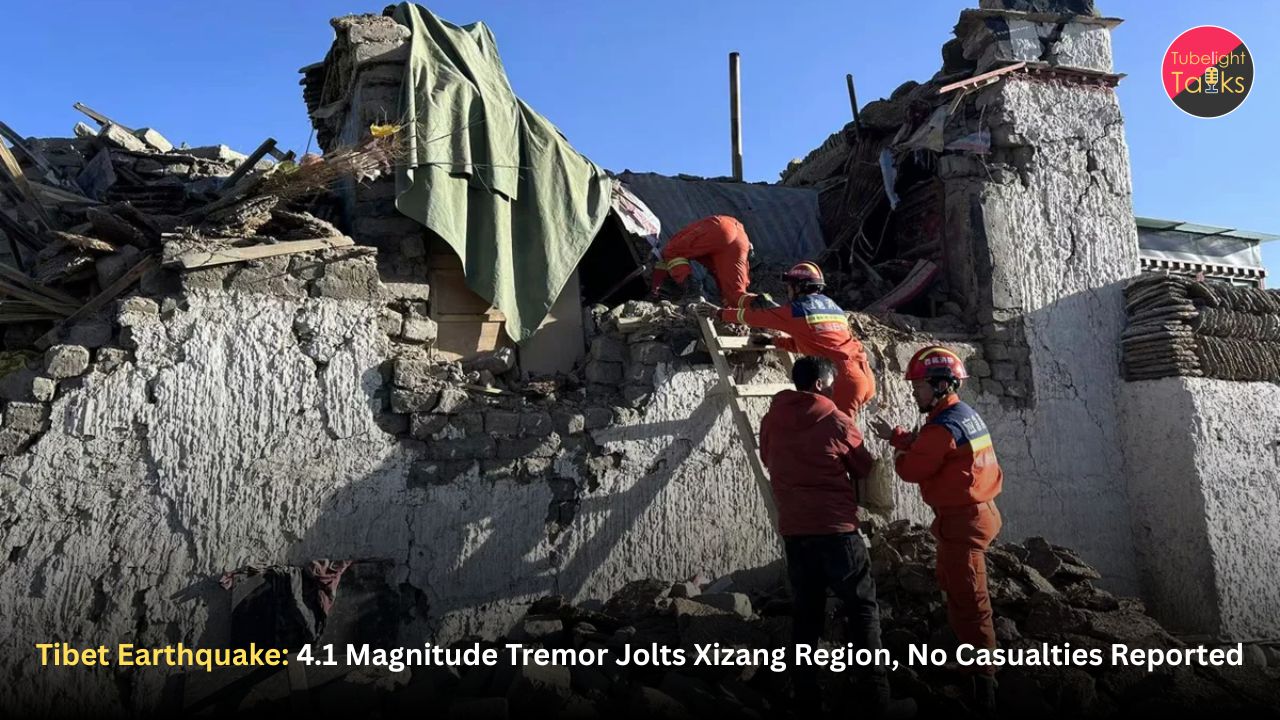
Tibet Earthquake: Mild Tremor Jolts Xizang Region, No Immediate Casualties Reported
A mild earthquake struck Tibet’s Xizang region early on Friday, May 8, 2026, prompting renewed attention to seismic activity in the Himalayan-Tibetan belt. Initial news reports cited the tremor as a magnitude 4.1 earthquake, while India’s National Centre for Seismology listed an early-morning Tibet event at 3.6 magnitude, recorded at 00:22:12 IST, with its epicentre about 293 km north of Lachung, Sikkim, at a depth of 10 km.
No immediate reports of casualties or major damage have been received. The quake was relatively moderate, but its location matters because the Tibetan Plateau lies in one of the world’s most geologically active regions, shaped by the continuing collision of the Indian and Eurasian tectonic plates.
Tibet Earthquake: What Happened Early Friday?
Mild Tremor Recorded in Xizang
The earthquake was reported in Tibet’s Xizang region during the early hours of Friday. The Tribune, citing the National Centre for Seismology, reported that an earthquake of magnitude 4.1 struck Tibet early on May 8, 2026. India’s National Centre for Seismology public event list, accessed the same morning, recorded a Tibet earthquake at 00:22:12 IST with magnitude 3.6, latitude 30.283, longitude 89.311, depth 10 km, and location listed as 293 km north of Lachung, Sikkim.
The difference between early media reporting and official event-list values is not unusual in earthquake reporting. Magnitude estimates may be revised after additional seismic stations process the data. Initial reports often circulate quickly, while official agencies may later update magnitude, depth, epicentre and intensity values.
No Immediate Casualties Reported
There were no immediate reports of casualties or major structural damage. This is consistent with the nature of many moderate Himalayan-region tremors, especially when the epicentre is in a remote high-altitude zone. However, officials and residents usually remain alert for aftershocks, landslides or delayed damage reports in mountain areas.
Even a moderate earthquake can matter in remote terrain. High-altitude settlements may have older homes, fragile roads, limited emergency access and risk of slope instability. Therefore, “no immediate casualties” does not mean authorities can ignore the event. It means the first available information does not indicate a major disaster.
Why Tibet Is Seismically Active
Collision of Indian and Eurasian Plates
The Tibetan Plateau exists because of one of Earth’s most powerful tectonic processes: the Indian plate is pushing into the Eurasian plate. This collision has built the Himalayas and uplifted Tibet over millions of years. The same force continues today, creating faults, stress zones and frequent earthquakes.
The region around Tibet, Nepal, Bhutan, Sikkim, Arunachal Pradesh and the broader Himalayan arc regularly experiences tremors. Some are mild and cause little damage. Others can be devastating, as seen in major Himalayan earthquakes in past decades.
Shallow Depth Can Increase Shaking
The NCS-listed early-morning Tibet event had a depth of 10 km, which is considered shallow in earthquake terms. Shallow earthquakes can create stronger surface shaking than deeper earthquakes of similar magnitude because seismic waves travel a shorter distance before reaching the ground.
That said, magnitude also matters. A magnitude 3.6 or 4.1 event is generally considered mild to light. It may be felt locally, especially near the epicentre, but it usually does not cause major damage unless local conditions are highly vulnerable.
Also Read: Afghanistan 5.9 Magnitude Earthquake Kills 8, Damages Homes Across Multiple Provinces
Why the Quake Drew Attention
Recent Memory of Deadly Tibet Earthquake
The latest mild tremor drew attention partly because Tibet experienced a deadly earthquake in January 2025. That quake struck near Shigatse/Tingri and killed at least 126 people, injured 188 and damaged thousands of homes, according to Reuters and AP reporting at the time. The 2025 event was much stronger, measured at 6.8 by Chinese authorities and 7.1 by the U.S. Geological Survey.
Because of that recent disaster, even smaller tremors in Tibet now receive heightened public attention. Residents, disaster managers and neighbouring Himalayan communities remain alert whenever new seismic activity is reported.
Border-State Sensitivity for India
The event was also notable for Indian readers because the NCS located the early-morning Tibet tremor 293 km north of Lachung in Sikkim. Tremors in Tibet can sometimes be felt in parts of India’s Himalayan states depending on magnitude, depth and local geology.
Sikkim, Arunachal Pradesh, Uttarakhand, Himachal Pradesh, Ladakh and parts of the Northeast lie in seismically sensitive zones. Even when a tremor occurs outside India’s borders, Indian agencies monitor it closely because seismic waves and aftershock patterns can affect nearby regions.
What Residents Should Do After a Mild Earthquake
Stay Alert for Aftershocks
After any earthquake, aftershocks are possible. They may be weaker than the main tremor, but they can still create fear or damage already weakened structures. People in affected areas should avoid rushing back into visibly damaged buildings, especially in mountain settlements where walls, roofs and slopes may be unstable.
Check Structures and Utilities
Residents should check for cracks in walls, damaged roofs, broken water lines, gas leaks, electrical sparks and loose stones on slopes. In remote areas, even small infrastructure damage can disrupt daily life. Local authorities should inspect schools, clinics, bridges, roads and public buildings where possible.
Avoid Rumours
Earthquakes often generate misinformation on social media. People may circulate exaggerated magnitudes, false casualty figures or fake videos from older disasters. Residents should rely on official seismology agencies, local administration and verified media updates.
Earthquake Preparedness in High-Altitude Regions
Stronger Buildings Matter
The 2025 Tibet disaster showed how vulnerable traditional or weakly reinforced structures can be in high-altitude areas. Earthquake-resilient construction is essential in the Himalayan-Tibetan region. Homes, schools, monasteries, hospitals and government buildings must be built or retrofitted to withstand shaking.
Emergency Supplies Are Essential
Mountain communities should maintain emergency kits with water, dry food, medicines, flashlights, batteries, blankets, basic tools and communication devices. During winter or high-altitude conditions, shelter and warmth become critical.
Community Training Saves Lives
Earthquake drills, first-aid training and evacuation planning can save lives. Schools should teach children how to “drop, cover and hold on.” Villages should identify safe open spaces, emergency routes and vulnerable residents such as elderly people, children and those with disabilities.
Why Moderate Quakes Should Not Be Ignored
Small Tremors Reveal Active Stress
A mild earthquake may not cause damage, but it reminds scientists and residents that the region remains active. Earthquakes are part of the natural stress-release process along faults. A single mild tremor does not necessarily predict a major quake, but regular seismic monitoring helps build risk awareness.
Preparedness Must Be Continuous
The danger in earthquake-prone areas is complacency. People may ignore mild tremors because they cause no damage. But when a larger event occurs, preparedness must already be in place. Earthquake safety is not something that can be arranged after strong shaking begins.
Science, Safety and the Human Response
Monitoring Networks Are Crucial
Seismology agencies such as the National Centre for Seismology, USGS and regional networks play an important role by recording events quickly, estimating magnitude and depth, and helping authorities assess risk. In border regions, data from multiple networks may differ slightly, but together they improve understanding.
Disaster Communication Must Be Clear
For mild events, the public needs calm and accurate information. Overstating the danger can create panic. Understating seismic risk can create complacency. Good disaster communication should say clearly: what happened, where it happened, how strong it was, whether damage has been reported, and what residents should do next.
Earthquake Awareness and Inner Responsibility
The Tibet earthquake is a reminder that human life is fragile and nature is powerful beyond human control. Science helps us measure tremors and prepare for disasters, but wisdom teaches us how to live responsibly. The teachings of Sant Rampal Ji Maharaj and Sat Gyaan emphasize truth, humility, compassion, righteous conduct and true worship according to holy scriptures. His teachings guide people away from intoxication, dishonesty, corruption, violence, greed and harmful habits.
In the context of natural disasters, this message is deeply relevant. When people live with discipline, compassion and truth, they respond to crises with service instead of panic. Sat Gyaan teaches that human life is precious and should be used for true devotion and righteous action before uncertainty arrives.
FAQs on Tibet Earthquake
1. When did the Tibet earthquake occur?
The early-morning Tibet tremor was recorded on Friday, May 8, 2026. India’s National Centre for Seismology listed a Tibet event at 00:22:12 IST.
2. What was the earthquake magnitude?
Initial news reports cited magnitude 4.1, while the NCS event list showed an early-morning Tibet earthquake of magnitude 3.6.
3. Where was the epicentre?
The NCS event list placed the epicentre in Tibet, around 293 km north of Lachung, Sikkim, India.
4. Were there any casualties?
No immediate casualties or major damage were reported in early updates.
5. Why does Tibet experience frequent earthquakes?
Tibet lies in a highly active tectonic region where the Indian plate continues to push into the Eurasian plate, creating the Himalayas and producing frequent earthquakes.
6. Should people worry about aftershocks?
Aftershocks are possible after earthquakes, especially in active seismic zones. Residents should stay alert, avoid damaged structures and follow official advisories.
Related Stories







Discussion (0)