U.S. Military Strikes in Iran: Qeshm and Bandar Abbas Hit as Strait of Hormuz Ceasefire Faces Fresh Crisis
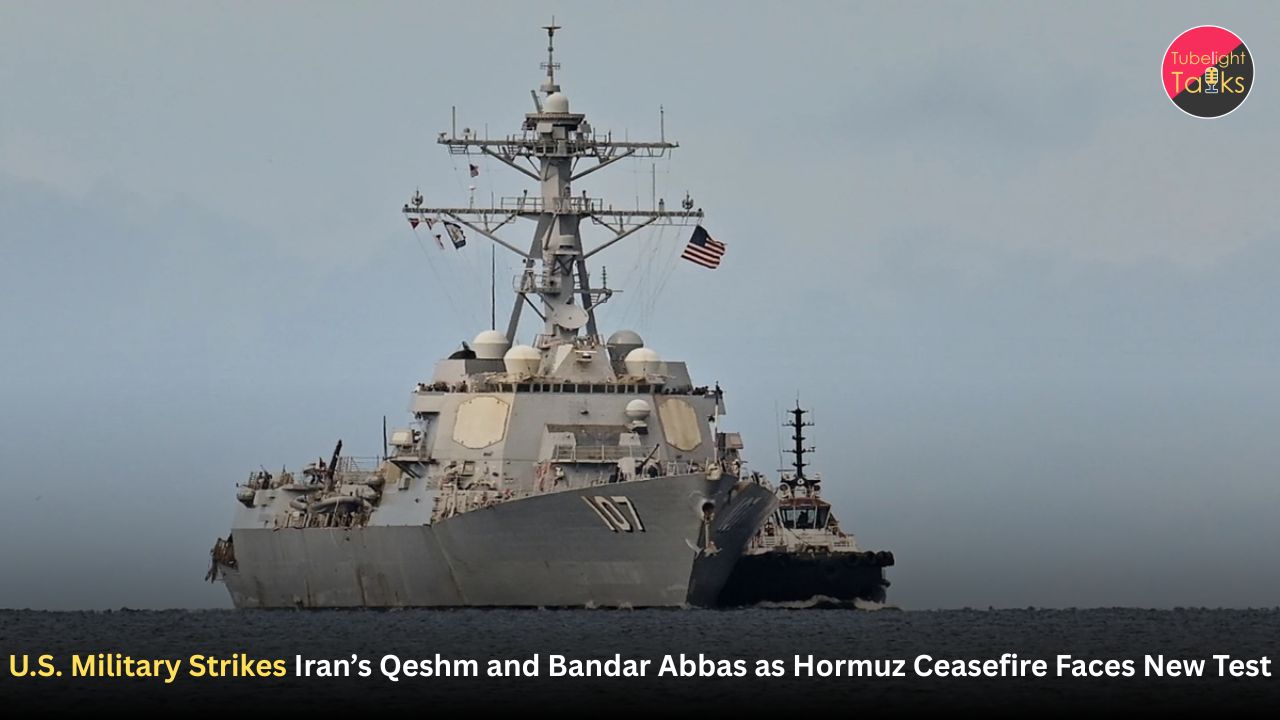
The fragile U.S.-Iran ceasefire came under severe pressure after U.S. forces carried out targeted strikes on Iranian military facilities near Qeshm Island and Bandar Abbas, two strategic locations overlooking the Strait of Hormuz. U.S. Central Command said American forces responded with self-defense strikes after Iranian missiles, drones and small boats targeted three U.S. Navy destroyers—USS Truxtun, USS Rafael Peralta and USS Mason—while they were transiting the Strait of Hormuz toward the Gulf of Oman.
CENTCOM said no U.S. assets were struck. Iran has disputed the U.S. version and accused Washington of violating the ceasefire by attacking Iranian targets. President Donald Trump said the ceasefire remains “in effect,” but the exchange has raised urgent concerns about a wider military escalation.
U.S. Strikes Iran: What Happened Near Qeshm and Bandar Abbas?
CENTCOM Says U.S. Acted in Self-Defense
U.S. Central Command said American forces intercepted “unprovoked Iranian attacks” and responded with self-defense strikes while three U.S. Navy guided-missile destroyers moved through the Strait of Hormuz. According to CENTCOM, Iranian forces launched multiple missiles, drones and small boats as the destroyers passed through the international sea passage. The command said no U.S. assets were struck.
The U.S. response reportedly targeted military facilities linked to Iran’s missile, drone and coastal attack capabilities. Reuters reported that U.S. strikes hit Iranian military installations, including missile and drone launch sites, command centers and surveillance infrastructure. CBS News, citing multiple U.S. officials, reported that the U.S. targeted Bandar Abbas and Qeshm, both strategically important locations near the Strait of Hormuz.
This is why the incident is being described as one of the most serious tests of the month-old ceasefire. A ceasefire may still exist officially, but direct exchange of fire near one of the world’s most important maritime chokepoints creates immediate global concern.
Iran Gives a Different Account
Iran has disputed Washington’s version of events. Iranian state-linked reporting accused the U.S. of initiating violence and violating the ceasefire by targeting Iranian vessels, civilian areas or maritime infrastructure. Iranian media also reported explosions around Qeshm Island during what it described as an exchange of fire. CBS News reported that Iranian state television said blasts occurred at Bahman pier on Qeshm Island during a clash between Iranian forces and “the enemy.”
This competing narrative matters. The U.S. says it acted defensively after Iranian aggression. Iran says the U.S. violated the ceasefire first. Until independent verification is available, the world is watching two sharply different versions of the same dangerous incident.
Also Read: Project Freedom Paused: Strait of Hormuz Crisis Moves Toward Diplomatic Settlement
Why Qeshm and Bandar Abbas Matter
Strategic Location Near Strait of Hormuz
Qeshm Island and Bandar Abbas sit close to the Strait of Hormuz, the narrow waterway connecting the Persian Gulf with the Gulf of Oman and the wider Arabian Sea. This makes them strategically vital. Military assets in this area can monitor, threaten or influence shipping movement through the strait.
Bandar Abbas is especially important because it is one of Iran’s key southern port cities and a major naval and commercial hub. Qeshm Island, located inside the strait area, also has maritime and military significance. Any strike near these locations is not a routine battlefield event; it sends a direct signal about control, deterrence and freedom of navigation.
Hormuz Is a Global Energy Lifeline
The Strait of Hormuz is one of the world’s most important energy corridors. Oil and liquefied natural gas shipments from Gulf producers pass through or near this route. Disruption can influence fuel prices, shipping insurance, inflation and energy security across Asia, Europe and beyond.
That is why the U.S.-Iran clash is being monitored not only by military analysts but also by energy traders, shipping companies, insurance firms, Gulf governments and import-dependent economies. Even a limited exchange can raise the cost of shipping and fuel if companies fear that vessels may be targeted.
The Three U.S. Destroyers at the Center of the Incident
USS Truxtun, USS Rafael Peralta and USS Mason
CENTCOM identified the U.S. destroyers involved as USS Truxtun, USS Rafael Peralta and USS Mason. These guided-missile destroyers are equipped for air defense, missile interception, surface warfare and escort missions. Their transit through the Strait of Hormuz had both military and symbolic importance because it demonstrated continued U.S. presence in the waterway despite Iranian threats.
The U.S. military said the destroyers were attacked by a combination of missiles, drones and small boats. That mix reflects Iran’s layered maritime strategy: missiles create long-range pressure, drones complicate air defense, and fast boats can swarm or harass naval vessels at close distance.
No U.S. Assets Hit
CENTCOM emphasized that no U.S. assets were struck. This detail is important because if a U.S. ship had been hit, the escalation pressure on Washington would have been far greater. Even without damage, however, the U.S. treated the attack as serious enough to respond with strikes on Iranian facilities.
The military message from Washington is clear: U.S. ships transiting international waters will be defended, and attacks on them will trigger immediate response.
Trump Says the Ceasefire Still Holds
“Ceasefire Is in Effect”
President Donald Trump told reporters and media outlets that the ceasefire remains in effect despite the strikes. CBS News reported that Trump described the U.S. strikes as “just a love tap,” while warning Iran against further provocation. He also said future responses could be harder and more violent if Iran does not sign a deal quickly.
This language reflects Trump’s dual message. He wants to avoid declaring the ceasefire dead, but he also wants to show that Iran will face consequences for military action. It is a strategy of pressure without formal abandonment of diplomacy.
Diplomacy Still Moving, But Under Pressure
Reuters reported that the U.S. is still waiting for Iran’s response to a proposal that would halt the fighting, though some of the most contentious issues—such as Iran’s nuclear programme and the full status of maritime access—may remain unresolved for now.
This means diplomacy is not over, but it has become more fragile. Every exchange of fire makes compromise harder. Iranian leaders may find it difficult to accept a deal after U.S. strikes. Trump may face pressure to respond more forcefully if Iran launches another attack. Regional partners may worry that the crisis could spiral.
Impact on Global Markets and Shipping
Oil Prices React to Escalation
Middle East maritime tension often affects oil prices quickly. The Times reported that oil prices rose after the latest exchange, reflecting market fear that the Strait of Hormuz could again become unstable.
Even a short disruption can affect global markets because shipping companies may reroute, delay departures or demand higher insurance coverage. If tankers avoid the area, fuel supply chains may tighten. If they continue operating under military escort, risk premiums may rise.
Shipping Confidence Remains Fragile
The crisis comes as the U.S. has been trying to restore shipping confidence under Project Freedom and related escort arrangements. However, repeated clashes create doubt among commercial operators. Shipping firms care less about official statements and more about practical risk: Can crews pass safely? Are mines cleared? Are drones still active? Are ports secure? Will insurance cover the journey?
The latest strikes make those questions more urgent.
Regional Risks and International Reaction
Gulf States Are Watching Closely
Gulf countries have strong reasons to fear escalation. A U.S.-Iran military exchange near Hormuz can threaten energy exports, port operations, desalination infrastructure, trade routes and civilian security. Even countries not directly involved can suffer economic and security consequences.
Some Gulf governments may support freedom of navigation but fear being pulled into a wider conflict. Their diplomatic challenge is to balance security cooperation with the U.S. against the need to prevent regional war.
Pakistan Mediation Becomes More Difficult
Earlier diplomatic efforts involved Pakistani mediation between Washington and Tehran. The latest exchange makes such mediation harder but also more necessary. If neither side wants full-scale conflict, a trusted intermediary may be needed to clarify terms, prevent misunderstanding and produce a face-saving exit.
However, mediation works only if both sides believe talks can protect their interests. If the battlefield continues to dominate, diplomatic channels may weaken.
Also Read: Trump’s War Powers Deadline: A Defining Moment for US Foreign Policy
What Could Happen Next?
Limited Escalation Scenario
The best-case scenario is that both sides treat the exchange as limited. The U.S. may say it defended its ships and does not seek wider conflict. Iran may claim it responded to U.S. provocation and then avoid further direct escalation. Talks could resume quietly.
Renewed Military Cycle
The dangerous scenario is a cycle of retaliation. Iran may strike another ship or base. The U.S. may respond with wider strikes. Regional partners may become involved. Shipping may freeze. Oil prices may spike. In that case, the ceasefire could collapse even if neither side formally announces its end.
Diplomatic Settlement Still Possible
A settlement is still possible if both sides agree on safe maritime transit, limits on attacks, monitoring mechanisms and phased de-escalation. But after strikes near Qeshm and Bandar Abbas, any agreement will require stronger verification and clearer red lines.
Power, War and the Need for True Peace
The U.S. strikes near Qeshm and Bandar Abbas show how quickly fragile peace can be shaken when mistrust, weapons and pride dominate international relations. The teachings of Sant Rampal Ji Maharaj and Sat Gyaan emphasize truth, humility, compassion, righteous conduct and true worship according to holy scriptures. Sant Rampal Ji Maharaj’s teachings guide human beings away from violence, intoxication, corruption, dishonesty, greed, ego and harmful actions.
In the context of the U.S.-Iran crisis, this message is deeply relevant. Military power may create pressure, but it cannot create lasting peace without truth and restraint. Sat Gyaan teaches that real peace begins when human beings abandon arrogance and follow righteous conduct. Nations, like individuals, must choose wisdom over anger and welfare over destruction.
FAQs on U.S. Military Strikes Iran’s Qeshm and Bandar
1. Where did the U.S. strikes take place?
Reports say U.S. strikes targeted Iranian military facilities near Qeshm Island and Bandar Abbas, close to the Strait of Hormuz.
2. Why did the U.S. carry out the strikes?
U.S. Central Command said American forces acted in self-defense after Iranian missiles, drones and small boats targeted three U.S. Navy destroyers transiting the Strait of Hormuz.
3. Which U.S. ships were involved?
CENTCOM identified the ships as USS Truxtun, USS Rafael Peralta and USS Mason.
4. Were any U.S. ships hit?
No. CENTCOM said no U.S. assets were struck during the Iranian attack.
5. Is the U.S.-Iran ceasefire over?
President Donald Trump said the ceasefire remains in effect, but the latest exchange has severely tested it.
6. Why is the Strait of Hormuz important?
The Strait of Hormuz is a critical global energy route. Disruption there can affect oil and gas shipments, shipping costs, fuel prices and global economic stability.
Related Stories







Discussion (0)