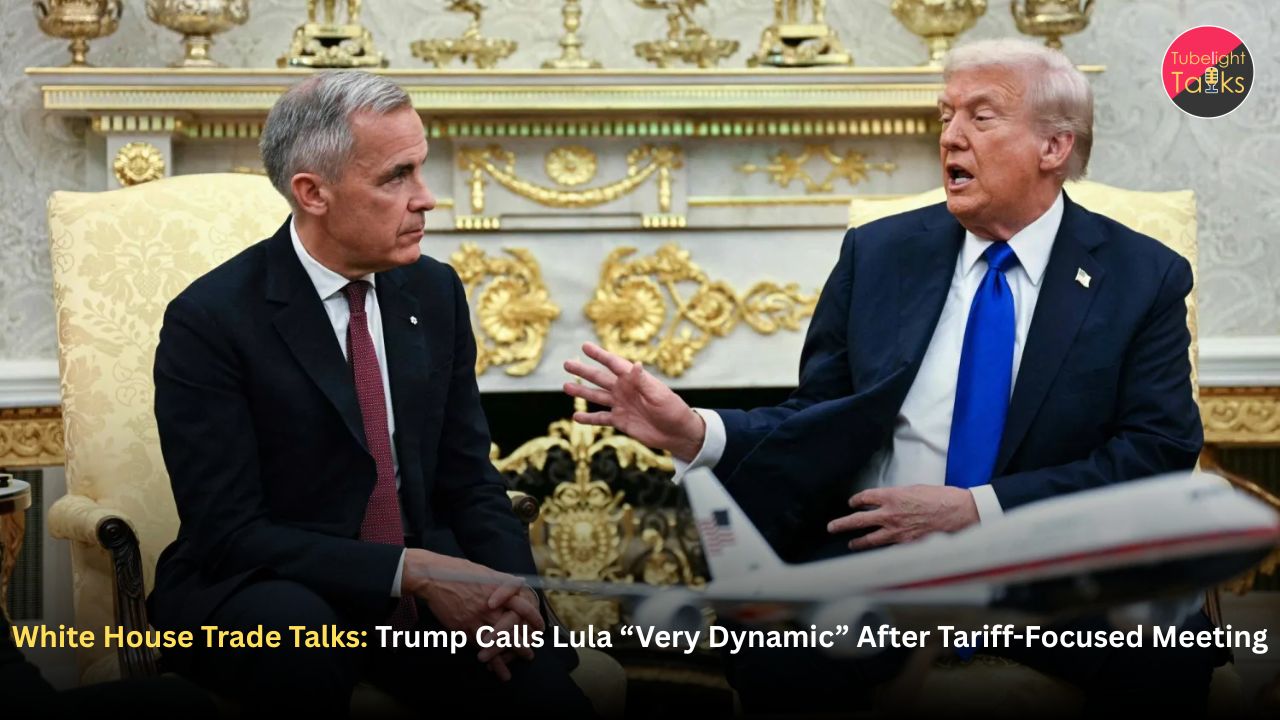
White House Trade Talks: Trump Calls Lula “Very Dynamic” After Closed-Door Meeting on Trade and Tariffs
President Donald Trump has described Brazilian President Luiz Inácio Lula da Silva as “very dynamic” after a closed-door White House meeting focused on trade, tariffs and the future of U.S.-Brazil relations. The meeting, held on Thursday in Washington, lasted about three hours and came after months of tension over Trump-era tariffs, political disagreements and Washington’s criticism of Brazil’s handling of former president Jair Bolsonaro.
Trump said the talks “went very well” and focused especially on trade and tariffs. Lula, speaking later at the Brazilian embassy, said the two sides had made progress toward stabilizing relations. The meeting signals a possible reset between two major economies led by politically opposite but highly influential leaders.
Trump-Lula Meeting: Why It Matters
A Diplomatic Reset After Months of Strain
The White House talks were closely watched because U.S.-Brazil relations had gone through a difficult period. The Trump administration had imposed a 50% tariff on Brazilian goods during an earlier dispute linked to the prosecution of former Brazilian president Jair Bolsonaro over an alleged coup plot. Brazil saw the move as economic pressure, while Washington framed its tariff policy as part of a broader attempt to defend U.S. interests.
Against that background, a cordial meeting between Trump and Lula is significant. Lula is a left-wing leader with deep roots in labour politics, while Trump represents a right-wing nationalist trade agenda. Their political styles and ideologies are very different, yet both leaders appear to have chosen pragmatism over confrontation in this meeting.
Trump’s praise of Lula as “very dynamic” was especially notable because it suggested a personal softening. He said the two discussed many subjects, including trade and tariffs, and that the meeting went well. Lula later said relations had become more stable after the talks.
No Joint Press Conference
The meeting had initially been expected to include some media-facing interaction, but it ultimately happened behind closed doors. Lula did not appear with Trump in a joint press conference and instead held a separate press briefing at the Brazilian embassy. Reuters reported that Lula said the absence of a joint press conference was at his request.
This detail matters because both leaders had political reasons to control the optics. Trump likely wanted to show he could extract trade concessions and manage Latin American diplomacy. Lula, facing a tight election environment in Brazil, likely wanted to avoid appearing too close to Trump before his domestic audience.
Also Read: Marco Rubio’s India Visit: New Delhi Prepares for High-Stakes Bilateral Talks and Quad Diplomacy
Trade and Tariffs Dominate the Agenda
Brazil Seeks Relief From U.S. Tariffs
The central issue in the meeting was trade. Brazil has been seeking relief from U.S. tariffs that have affected exports and added friction to the bilateral relationship. Trump’s tariff approach has been aggressive across several partners, and Brazil has been one of the countries trying to reduce exposure to punitive measures.
After the meeting, Lula said the two sides would continue working on tariff issues. Reuters reported that the talks included plans for a working group on tariffs, suggesting that both governments want a structured process rather than public confrontation.
For Brazil, tariff relief is economically and politically important. Brazilian exporters want predictable access to the U.S. market, while Lula needs to show domestic audiences that he can defend Brazil’s economic interests. For Trump, the challenge is to show that any tariff adjustment produces benefits for American workers, farmers or industries.
Trump’s “Reciprocal” Trade Logic
Trump’s trade policy has often been built around the idea of reciprocity. He argues that if other countries impose high tariffs or barriers on American goods, the U.S. should respond with tariffs of its own. Brazil, like many major emerging economies, has tariff and non-tariff barriers that U.S. officials want reduced.
This creates a complicated negotiation. Brazil wants U.S. tariffs reduced. The U.S. wants better access for American products and investment. Both sides must decide where they can compromise without appearing weak at home.
A trade breakthrough is possible, but not guaranteed. Agriculture, industrial goods, digital trade, environmental standards, minerals and market access remain sensitive.
Critical Minerals Enter the Conversation
Brazil’s Resource Strength
Critical minerals were another important topic. Brazil has large mineral resources, including rare earth potential, lithium-related opportunities, niobium and other materials important for clean energy, defence, electronics and advanced manufacturing. The U.S. is trying to diversify critical mineral supply chains and reduce dependence on China.
Reuters reported that Brazil showed willingness to open parts of its mineral sector to U.S. investment, while Brazil has also emphasized that it does not want to remain only a raw-material exporter.
This issue is strategically important. Minerals are no longer just commodities. They are central to electric vehicles, batteries, semiconductors, renewable energy, military systems and artificial intelligence infrastructure. A U.S.-Brazil minerals partnership could reshape supply chains in the Americas.
Brazil Wants Industrial Value
Lula’s government has repeatedly emphasized industrial development. Brazil wants to process minerals, build domestic value chains and create jobs instead of simply exporting raw resources. This may become a key negotiation point.
The U.S. wants secure supply. Brazil wants investment, technology and industrial upgrading. If both sides find balance, critical minerals could become one of the strongest pillars of a renewed U.S.-Brazil relationship.
Organized Crime and Regional Security
Crime Cooperation on the Table
The talks also covered organized crime. The U.S. has been focusing more strongly on transnational criminal networks across the Americas, especially drug trafficking, illegal arms flows and cross-border gangs. Brazil has powerful criminal organizations, including Red Command and First Capital Command, which have been discussed in U.S. policy circles.
Brazil wants cooperation but remains cautious about any U.S. move that could interfere with its sovereignty. Reports before the meeting noted concerns over possible U.S. designation of Brazilian criminal factions as foreign terrorist organizations, a step Brazil may oppose if it gives Washington too much operational leverage inside Latin America.
Security Without Sovereignty Loss
For Lula, the issue is sensitive. Brazil needs international cooperation against organized crime, but it does not want to appear subordinate to Washington. For Trump, counter-cartel and anti-crime cooperation are part of his broader Western Hemisphere security agenda.
A practical outcome could include intelligence sharing, financial tracking, law-enforcement coordination and border-security cooperation, but only if Brazil feels its sovereignty is respected.
Also Read: White House Revises India-US Trade Deal Factsheet After Indian Objection on Pulses
Lula’s Domestic Political Calculations
Election Year Sensitivity
Lula is seeking to strengthen his position ahead of Brazil’s upcoming election cycle. A successful White House visit can help him show voters that he can defend Brazil’s interests even when dealing with a powerful ideological opponent.
However, the meeting also carries domestic risk. Some of Lula’s supporters may distrust Trump because of his past support for Bolsonaro and his pressure on Brazil. Lula therefore needed to show that he was negotiating with dignity, not yielding.
Lula later said he did not believe Trump would influence Brazil’s upcoming election and expected the U.S. president to respect the Brazilian people’s decision.
Trump’s Interest in Latin America
For Trump, the meeting helps strengthen his focus on the Western Hemisphere. His administration has increasingly emphasized trade, security and influence across the Americas. Brazil, as Latin America’s largest economy, is too important to ignore.
A stable relationship with Brazil could support U.S. goals on trade, minerals, regional security and competition with China. But the relationship will remain complex because Lula also works closely with the Global South, BRICS partners and countries outside Washington’s preferred diplomatic circle.
What the Meeting Could Change
Tariff Working Group Could Reduce Tensions
The most immediate outcome may be a working group on tariffs. If the group produces concrete concessions, U.S.-Brazil trade tensions could ease. Exporters, investors and industries in both countries would welcome stability.
Minerals Cooperation Could Expand
Critical minerals may become a long-term strategic pillar. Brazil can offer resources; the U.S. can offer capital, technology and market access. But Brazil will demand industrial benefits.
Political Trust Could Improve
The meeting may not erase disagreements, but it can reduce mistrust. Personal diplomacy matters, especially between leaders who previously clashed. Trump calling Lula “very dynamic” gives both sides a softer public tone.
Trade, Power and the Need for Righteous Conduct
The Trump-Lula talks show that even leaders with opposing ideologies must eventually sit together when national welfare, trade and public interest are at stake. The teachings of Sant Rampal Ji Maharaj and Sat Gyaan emphasize truth, humility, compassion, righteous conduct and true worship according to holy scriptures. Sant Rampal Ji Maharaj’s teachings guide people away from greed, dishonesty, corruption, intoxication, violence and misuse of power.
In the context of international trade, this message is deeply relevant. Economic agreements should not be driven only by profit, pressure or political ego. They should protect ordinary people, workers, farmers and future generations. Sat Gyaan teaches that real progress becomes meaningful only when guided by truth and moral responsibility.
FAQs on White House Trade Talks
1. Who met at the White House?
U.S. President Donald Trump met Brazilian President Luiz Inácio Lula da Silva at the White House for talks focused mainly on trade and tariffs.
2. What did Trump say about Lula?
Trump described Lula as “very dynamic” and said their meeting went very well, especially on trade and tariff issues.
3. Why were the talks important?
The talks were important because U.S.-Brazil relations had been tense due to tariffs, political disagreements and disputes linked to former president Jair Bolsonaro.
4. What trade issue was discussed?
The leaders discussed U.S. tariffs on Brazilian goods and possible steps to reduce trade tensions through further negotiations and a tariff working group.
5. Were critical minerals discussed?
Yes. Critical minerals were part of the talks, with Brazil showing willingness to attract U.S. investment while also seeking industrial development at home.
6. Did the two leaders hold a joint press conference?
No. The meeting was held behind closed doors, and Lula later held a separate press conference at the Brazilian embassy.
Related Stories




Discussion (0)