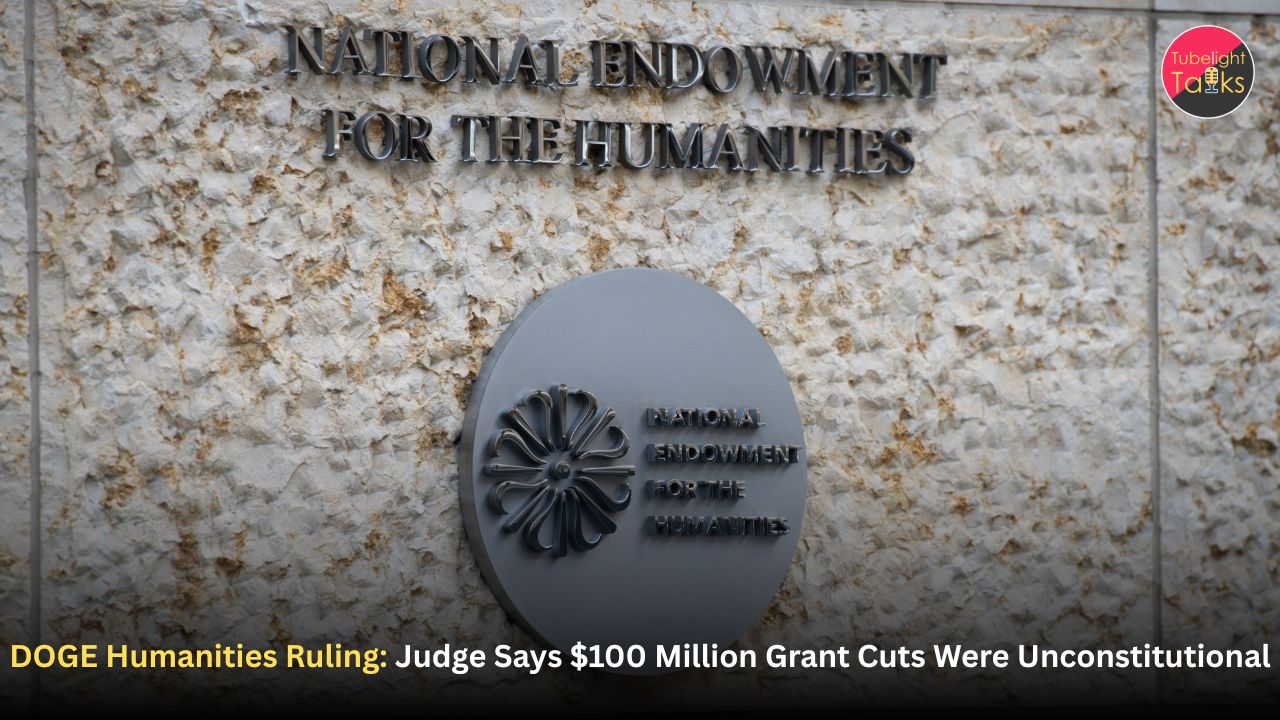
DOGE Humanities Ruling: Federal Judge Says $100 Million Grant Cancellations Were Unconstitutional
A federal judge in New York has ruled that the Trump administration’s cancellation of more than $100 million in humanities grants was unconstitutional, delivering a major legal setback to the Department of Government Efficiency, widely known as DOGE. The grants had been awarded through the National Endowment for the Humanities to scholars, writers, museums, research groups and cultural organizations before being terminated under DOGE-backed cost-cutting efforts.
U.S. District Judge Colleen McMahon ruled that DOGE lacked authority to direct the cancellations and that the process violated constitutional protections, including free speech and due process. The court also sharply criticized the use of AI tools to identify projects connected to diversity, equity and inclusion, calling the process legally flawed and discriminatory.
DOGE Humanities Ruling: What the Court Decided
Judge Says DOGE Had No Authority
The central finding of the ruling was that DOGE did not have legal authority to cancel humanities grants already awarded through the National Endowment for the Humanities. The court said Congress had created and funded the NEH, and that the executive branch could not simply erase those commitments through an outside cost-cutting initiative.
This point is important because it goes beyond one agency or one grant programme. In the United States, Congress controls federal appropriations. Agencies administer those funds under law. A presidential initiative may influence policy direction, but it cannot override statutes or cancel congressionally authorized funding without lawful authority.
Judge McMahon’s ruling therefore reaffirmed a basic constitutional principle: federal spending decisions must follow the law, not merely political preference or administrative pressure.
First and Fifth Amendment Violations
The court also found that the cancellations violated constitutional protections. The First Amendment issue centered on viewpoint discrimination. Grants were allegedly targeted because they were connected, directly or loosely, to diversity, equity and inclusion themes. The judge said the government cannot punish or defund speech, scholarship or cultural work simply because officials dislike the viewpoint or subject matter.
The Fifth Amendment issue involved due process. Grant recipients were not given a fair, reasoned or legally adequate process before their awards were terminated. Many organizations had already planned programmes, hired staff, committed resources or begun work based on approved funding. Sudden cancellation without proper procedure created serious harm.
How DOGE Became Involved
Cost-Cutting Push Targets NEH Grants
DOGE was created as a government efficiency initiative aimed at reducing waste and cutting discretionary spending. Supporters argued that federal spending had become bloated and politically biased. Critics argued that DOGE operated with little transparency, weak legal authority and ideological goals.
The humanities grant cuts became one of the most controversial examples of DOGE’s approach. More than $100 million in NEH grants were cancelled, affecting major scholarly organizations, museums, writers, educators and public humanities programmes.
The lawsuit was brought by groups including the American Council of Learned Societies, the American Historical Association and the Modern Language Association. These organizations argued that the cuts devastated humanities work across the country and violated both statutory and constitutional limits.
AI Use Draws Judicial Criticism
One of the most striking parts of the case involved DOGE’s alleged use of AI tools, including ChatGPT, to identify grants related to diversity, equity and inclusion. Court filings and reporting indicated that DOGE staff used brief prompts and keyword-like screening to flag projects for termination.
The judge criticized this method because it treated complex scholarly, cultural and public-history projects as if they could be reduced to short automated labels. Projects could be flagged simply because they mentioned access, inclusion, community history, underrepresented groups or educational outreach.
This raised a major legal and ethical problem: if an AI tool or automated screening process mislabels a grant, the consequences can be severe. A museum, scholar or nonprofit may lose funding not because the project is unlawful, but because a machine-generated classification marks it as politically disfavored.
Why Humanities Grants Matter
More Than Academic Funding
Humanities grants support history, literature, languages, philosophy, ethics, archives, museums, public education, preservation and cultural memory. They may fund local history projects, museum exhibitions, teacher training, oral histories, digitization of manuscripts, documentary research, translation work and educational programming.
To some, humanities funding may seem less urgent than roads, hospitals or defence. But humanities work helps societies understand identity, memory, law, ethics, citizenship, culture and democracy. It preserves records, supports public knowledge and gives communities tools to understand their past.
The cancelled grants reportedly included projects involving Holocaust education, Indigenous cultural work, museum preservation, community history and academic research. Cutting such projects suddenly affects not only scholars but also students, teachers, visitors, local communities and public institutions.
Small Organizations Hit Hard
Large universities may sometimes survive grant disruptions through reserves or alternative funding. Smaller museums, regional archives, local cultural centres and independent scholars often cannot. A terminated grant can mean cancelled jobs, delayed exhibitions, broken contracts and unfinished preservation work.
This is why the court ruling matters practically. It does not only settle a legal argument; it may allow important cultural and educational work to continue.
The Political Debate Behind the Case
Trump Administration’s Anti-DEI Agenda
The grant cancellations were part of a broader Trump administration push to end federal support for diversity, equity and inclusion programmes. The administration argued that DEI-related spending was ideological, wasteful and discriminatory against other groups.
Supporters of the cuts saw them as a correction against politicized federal funding. They argued taxpayers should not fund projects they viewed as promoting identity politics or ideological bias.
Critics responded that the government was using anti-DEI rhetoric to attack legitimate scholarship, cultural history and public education. They argued that studying race, gender, language, migration, disability, Indigenous history or community access is not government waste—it is part of understanding society.
Court Focused on Law, Not Political Preference
The ruling did not say the government must fund every humanities project forever. Governments can change policy, modify grant priorities and set lawful conditions. But the judge said they must do so within constitutional and statutory limits.
The key issue was not whether officials disliked DEI. The issue was whether they could terminate already awarded grants through an unauthorized process that discriminated against viewpoints and denied due process. The court said they could not.
What the Ruling Does and Does Not Do
Blocks Further Terminations
The ruling blocks the government from carrying out the challenged terminations. It also requires the administration to rescind termination notices connected to the unlawful process. This is a major relief for affected organizations.
However, the ruling does not necessarily mean money will immediately appear in every recipient’s account. Administrative steps, appeals, agency review and further court proceedings may affect timing. The Department of Justice may also decide whether to appeal.
Does Not End the National Debate
The court decision is legally significant, but it will not end the political debate over federal arts and humanities funding. Conservatives and progressives remain divided over the role of government in culture, education and identity-related scholarship.
The ruling will likely become part of a larger national argument over presidential power, agency independence, congressional spending authority, AI in government decision-making and ideological tests for public funding.
Also Read: Trump Questions $21 Million Voter Grant, Sparks Political Storm as DOGE Pulls Funding
AI in Government Decision-Making
Efficiency Versus Accountability
The case raises a broader question: Can government use AI tools to make funding decisions? The answer is not simply yes or no. AI can help sort documents, identify patterns and support administrative work. But AI cannot replace legal judgment, human review, due process and constitutional accountability.
When AI is used to cut public grants, deny benefits, flag speech or classify projects politically, the stakes become serious. People must know how decisions were made, what criteria were used, how errors can be corrected and who is accountable.
Need for Transparent Standards
Government AI use must be transparent, explainable and reviewable. If a grant is cancelled, recipients should receive a clear reason grounded in law, not a vague label produced by a prompt. Public agencies must also ensure that AI tools do not reproduce political bias, factual errors or arbitrary classifications.
The DOGE humanities case may become an important warning for future administrations: efficiency cannot override constitutional rights.
Reaction From Scholars and Cultural Groups
Plaintiffs Call It a Victory
Scholarly and cultural organizations welcomed the ruling as a victory for academic freedom and democratic governance. For many recipients, the decision validates their argument that the grant cancellations were not just financially harmful but legally improper.
Academic groups say the ruling protects the principle that government cannot punish scholarship because of political disagreement. Cultural organizations say it restores confidence that grants awarded through lawful processes cannot be erased overnight by outside political operatives.
Administration May Appeal
The Department of Justice has not clearly indicated whether it will appeal. If it does, the case could move to a higher court and become a major test of executive power over federal grants.
Even if an appeal follows, the ruling has already shaped the legal landscape. It sends a strong signal that courts may scrutinize politically motivated grant cancellations closely.
Why This Ruling Matters for Democracy
Congress Controls Spending
One of the deepest issues in the ruling is separation of powers. If an executive project can cancel congressionally authorized grants without legal authority, then Congress’s spending power is weakened. The judge’s ruling pushes back against that.
Viewpoint Neutrality Matters
A democracy depends on allowing scholarship and cultural work even when the government dislikes the viewpoint. If public funding can be withdrawn because a project studies unpopular history or politically sensitive communities, academic freedom is weakened.
Due Process Protects Everyone
Due process is not only for one political side. Any future administration could misuse power if procedures are weak. Today one viewpoint may be targeted; tomorrow another may be. Clear legal process protects all citizens and institutions.
Truth, Knowledge and Moral Responsibility
The DOGE humanities ruling reminds society that knowledge, culture and history should not be controlled by political ego or arbitrary power. The teachings of Sant Rampal Ji Maharaj and Sat Gyaan emphasize truth, humility, compassion, righteous conduct and true worship according to holy scriptures.
His teachings guide people away from dishonesty, corruption, intoxication, violence, greed and misuse of authority. In the context of this ruling, the message is deeply relevant. Government power must be guided by truth and justice, not bias or pride. Sat Gyaan teaches that real knowledge should uplift society and lead human beings toward moral clarity. When decisions are made without fairness, both society and conscience suffer.
FAQs on DOGE Humanities Ruling
1. What did the federal judge rule?
The judge ruled that the Trump administration’s cancellation of more than $100 million in humanities grants was unconstitutional and unlawful.
2. What role did DOGE play?
DOGE was involved in identifying and directing cancellation of grants through a cost-cutting process, but the court found that it lacked authority to do so.
3. Which agency awarded the grants?
The grants were awarded through the National Endowment for the Humanities.
4. Why were the cancellations considered unconstitutional?
The court found violations linked to viewpoint discrimination under the First Amendment and due process concerns under the Fifth Amendment.
5. Why was AI use controversial?
DOGE reportedly used AI tools to flag projects connected to diversity, equity and inclusion, raising concerns about arbitrary classification, bias and lack of human legal review.
6. What happens next?
The government must stop carrying out the challenged terminations and rescind termination notices, though appeals or further administrative steps may affect the final outcome.
Related Stories









Discussion (0)