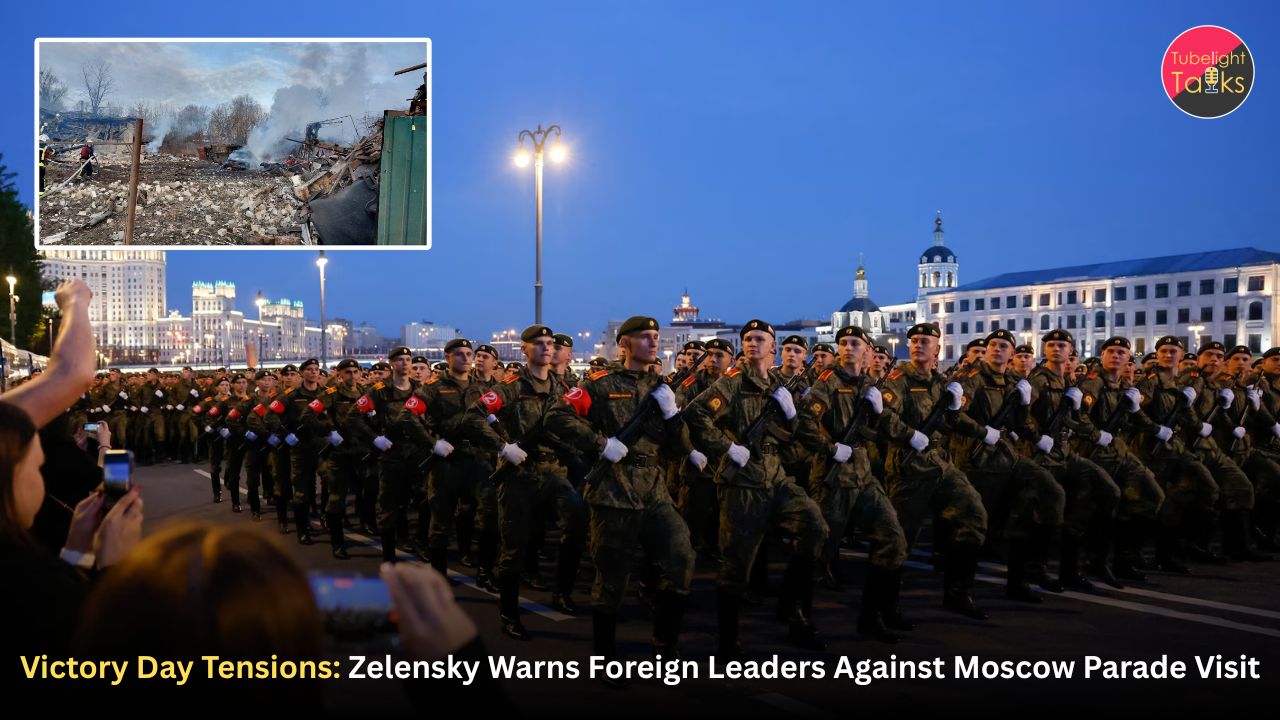
Victory Day Tensions: Zelensky Warns International Allies Against Attending Russia’s May 9 Parade
Victory Day Tensions: Ukrainian President Volodymyr Zelensky has warned foreign representatives and Russia-friendly states against attending Moscow’s May 9 Victory Day parade, saying Ukraine “does not recommend” such visits while the war continues and Russia issues fresh threats against Kyiv. The warning comes on the eve of one of Russia’s most symbolic annual events, commemorating the Soviet victory over Nazi Germany in World War II.
Moscow has announced a short unilateral ceasefire around Victory Day, but Kyiv says Russia rejected Ukraine’s broader ceasefire proposal and continued attacks. Russia has meanwhile tightened security in Moscow, scaled back military displays and warned of retaliation if Ukraine disrupts the parade. The event has now become not only a commemoration but also a tense wartime test.
Zelensky’s Warning: “We Do Not Recommend It”
Message to Foreign Representatives
In his evening address, Zelensky said Ukraine had received messages that representatives of some states close to Russia were planning to attend the May 9 parade in Moscow. He described that as a “strange desire” and said Ukraine did not recommend such travel. The wording was careful but unmistakable. It was not a casual comment; it was a warning that the security environment around Moscow’s parade is unstable and politically charged.
Zelensky’s message was aimed especially at countries maintaining friendly or pragmatic ties with Russia. Attendance at the parade could be seen by Kyiv as legitimizing Moscow’s wartime narrative. Ukraine argues that Russia is using World War II memory to justify present aggression, while continuing attacks on Ukrainian territory.
For Kyiv, foreign attendance is therefore not neutral. It carries diplomatic meaning. A leader or envoy appearing in Moscow while Ukrainian cities remain under attack may be interpreted as a sign of political sympathy toward the Kremlin.
Ukraine Says Russia Wants Safety for Parade, Not Peace
Zelensky accused Russia of wanting a temporary pause only to secure its parade. He said Moscow wanted permission to stand safely on Red Square for an hour and then continue killing Ukrainians afterward. Ukrainian media quoted him as saying Russia had ignored Ukraine’s proposal for a wider ceasefire beginning May 6 and instead continued attacks.
This has become Kyiv’s central argument: a real ceasefire should protect civilians, not only a national ceremony. Ukraine has repeatedly called for a broader and unconditional ceasefire, while dismissing Russia’s short Victory Day truce as symbolic and self-serving.
Also Read: Victory Day Ceasefire Snub: Russia Rejects Ukraine’s May 9 Truce With Fresh Drone Strikes
Russia’s Victory Day: A Powerful Symbol Under Pressure
May 9 in Russian State Memory
Victory Day is one of Russia’s most important national holidays. It commemorates the Soviet Union’s victory over Nazi Germany and carries deep emotional, historical and political meaning. The annual parade on Moscow’s Red Square is traditionally used to display military strength, national unity and President Vladimir Putin’s role as supreme commander.
During the current war, however, Victory Day has become more complicated. Moscow continues to frame its war in Ukraine through historical language connected to World War II, while Ukraine and its allies reject that framing as propaganda. As a result, the parade is not only a memorial event but also a political statement.
Parade Scaled Back Amid Security Fears
This year’s parade is expected to be unusually restrained. Reuters reported that Kremlin security has been tightened for Putin ahead of the Victory Day events due to what Russian officials describe as a “terrorist threat.” Reports also said the military parade would be scaled back, with no heavy military equipment such as tanks or missiles displayed.
That scaling back is significant. Russia has traditionally used the parade to display military power. Avoiding heavy equipment suggests concern over possible Ukrainian drone attacks, security vulnerabilities or operational pressures from the war. For Ukraine, this is being interpreted as evidence that Moscow’s own war has made even its most symbolic ceremony vulnerable.
Moscow’s Threats Against Kyiv
Russia Warns of Retaliation
Russian officials have warned that any attempt to disrupt the Victory Day events could trigger retaliation against Kyiv. Reports said Russia’s Defence Ministry and Foreign Ministry issued warnings about possible strikes on what they described as “decision-making centres” if Ukraine targets Moscow during the parade period.
Such language has increased concern among foreign missions, humanitarian groups and civilians in Ukraine. Threats of large-scale retaliation around a symbolic national event raise the risk of escalation. Even if both sides claim to be observing ceasefires, the atmosphere remains highly volatile.
Foreign Missions Advised to Consider Security
Russia’s warnings reportedly included messages directed at foreign embassies and international organizations in Kyiv. The Times reported that Moscow urged foreigners in Kyiv to consider evacuation due to possible retaliatory strikes if the parade is disrupted.
Ukraine has not shown signs of panic or mass evacuation, but the warnings underline how the symbolic date has become a military pressure point. The international community will be watching closely on May 9 to see whether Moscow and Kyiv exercise restraint or move toward another cycle of retaliation.
Competing Ceasefires and Mutual Accusations
Russia’s Short Victory Day Ceasefire
Russia announced a unilateral ceasefire around Victory Day, presenting it as a gesture linked to the commemoration. But Ukraine has argued that the ceasefire is too short, too symbolic and designed mainly to protect Moscow’s public ceremonies. Reuters reported that Zelensky criticized the logic of pausing for commemoration only to resume fighting afterward, calling it strange and inappropriate.
A ceasefire tied to a parade can be difficult to trust because it may serve political optics more than humanitarian protection. Ukraine wants a wider pause that begins earlier and lasts longer. Russia has not accepted that framework.
Drone Attacks and Continued Strikes
Tensions have been worsened by drone attacks and missile exchanges. AP reported that Russia said Ukraine launched a major drone attack after Moscow rejected Kyiv’s ceasefire offer, with Russian authorities reporting the interception of hundreds of drones across multiple regions. Ukraine, meanwhile, reported continued Russian drone and missile attacks on Ukrainian territory.
This pattern shows why ceasefire claims are so fragile. Each side accuses the other of escalation. Each side says it is defending itself. Without international monitoring or agreed verification, both sides use battlefield events to justify further action.
Also Read: Russia-Ukraine WWII Anniversary Ceasefires: May 8–9 Brings a Fragile Humanitarian Window
Why Zelensky’s Warning Matters Diplomatically
Foreign Attendance Could Signal Legitimacy
If foreign leaders or officials attend Moscow’s Victory Day parade, Russia can present their presence as proof that it is not isolated. The Kremlin may use images of foreign dignitaries on Red Square to show domestic audiences that Russia still has partners and respect abroad.
Ukraine wants to prevent that image. Zelensky’s warning is therefore diplomatic as much as security-related. He is telling governments that attendance would have consequences for perception and may be remembered as political support for Russia during wartime.
Pressure on Russia-Friendly States
Some countries maintain relations with Russia for reasons of energy, trade, arms supplies, historical ties or geopolitical balancing. Zelensky’s statement puts pressure on those states to reconsider the optics of sending representatives to Moscow.
Even if they do not fully support Ukraine, they must now weigh the risk of appearing to endorse Russia’s wartime symbolism. In diplomacy, presence matters. Sitting in Moscow on May 9 could be interpreted far beyond ceremonial protocol.
Security in Moscow: Fear Behind the Parade
Drone Threats Over the Capital
Moscow has experienced drone disruptions in recent months, and Russian authorities are treating Victory Day as a high-risk event. Reuters reported that Putin’s security is being tightened, and AP reported disruptions to Moscow-area air travel linked to drone threats.
This is a remarkable development. A parade intended to project strength is being held under visible security anxiety. For the Kremlin, that is a challenge to the image of control. For Ukraine, it is a sign that Russia’s war has consequences inside Russia too.
Reduced Military Display Changes the Message
The absence or reduction of heavy equipment changes the parade’s symbolic tone. Instead of a full display of military might, Moscow may emphasize infantry, veterans, patriotic speeches and political messaging. This could make the event less visually powerful but still politically important.
The Kremlin will likely present the parade as a sign of resilience. Ukraine will likely present it as proof that Russia’s war has weakened the confidence of its own capital.
Humanitarian Meaning of May 9
Remembering World War II While Fighting a New War
May 9 should be a day of remembrance for the millions who died in World War II. But the ongoing Russia-Ukraine war has transformed the date into a tense political and military moment. Both sides refer to history, sacrifice and national survival, but civilians continue to suffer in the present.
The tragedy is that a day meant to remember the cost of war is now surrounded by threats of new strikes. That contradiction is at the heart of Zelensky’s criticism.
Real Commemoration Requires Peace
Ukraine’s position is that true respect for World War II victims should mean stopping new aggression, not staging parades while fighting continues. Russia’s position is that Victory Day is sacred and must be protected from Ukrainian attacks.
The international community is left watching whether remembrance will produce restraint or escalation.
War Memory, Ego and the Need for True Peace
The Victory Day tensions show how historical memory can become dangerous when mixed with political pride and ongoing war. Remembering past sacrifice should inspire peace, not new destruction. The teachings of Sant Rampal Ji Maharaj and Sat Gyaan emphasize truth, humility, compassion, righteous conduct and true worship according to holy scriptures.
His teachings guide people away from violence, intoxication, corruption, dishonesty, ego, greed and hatred. In the context of Russia’s Victory Day crisis, this message is deeply relevant. Parades and speeches cannot create real peace if human conduct remains ruled by arrogance. Sat Gyaan teaches that true peace begins when people abandon pride and follow truth, compassion and devotion to the Supreme God.
FAQs on Victory Day Tensions
1. What did Zelensky warn foreign representatives about?
Zelensky warned foreign representatives and Russia-friendly states against attending Moscow’s May 9 Victory Day parade, saying Ukraine “does not recommend” such travel.
2. Why is the May 9 parade important to Russia?
May 9 is Russia’s Victory Day, marking the Soviet victory over Nazi Germany in World War II. The Red Square parade is one of Russia’s most symbolic national events.
3. Why does Ukraine oppose foreign attendance?
Ukraine believes attendance could legitimize Russia’s wartime narrative and send a political signal of support while Russia continues its war against Ukraine.
4. Has Russia announced a ceasefire?
Yes. Russia announced a short unilateral ceasefire around Victory Day, but Ukraine says the move is symbolic and rejected Kyiv’s broader ceasefire proposal.
5. Why is Moscow tightening security?
Russian officials cite threats from Ukraine and possible drone attacks. Reports say security around Putin and the parade has been increased.
6. Is there a risk of escalation on May 9?
Yes. Russia has threatened retaliation if the parade is disrupted, while Ukraine has warned that Russia’s ceasefire is not genuine. The risk of escalation remains high.
Related Stories




Discussion (0)