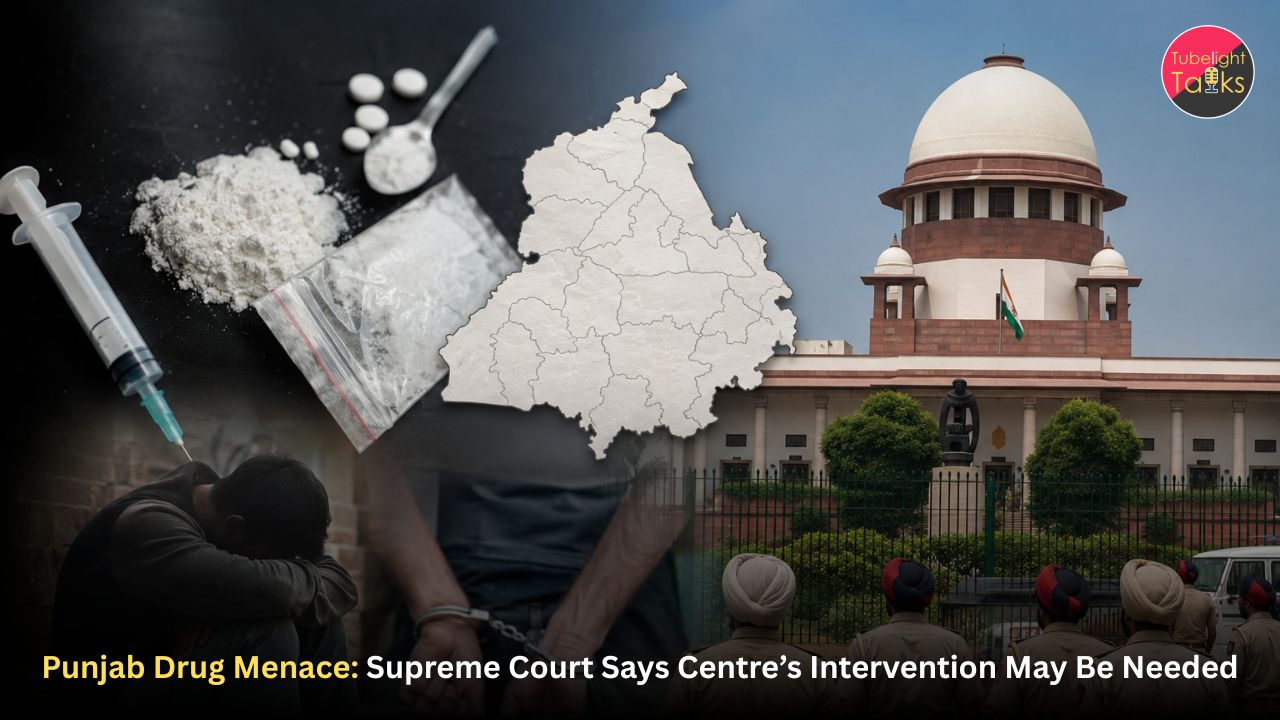
Punjab Drug Menace: Supreme Court Suggests Central Intervention May Be Needed to Tackle Escalating Crisis
Punjab Drug Menace: The Supreme Court has expressed serious concern over the escalating drug menace in Punjab, observing that the human toll of narcotics abuse has become alarming and that central government intervention may be needed. A bench led by Chief Justice Surya Kant pulled up Punjab authorities for allegedly failing to target influential persons and major traffickers behind drug networks while focusing on small-level peddlers for publicity.
The court said state and central agencies must work toward the common goal of curbing the drug menace rather than treating central involvement as interference. The remarks have placed fresh pressure on the Punjab government, police and enforcement agencies to move beyond surface-level action and confront the deeper supply chains, addiction crisis and rehabilitation gaps affecting the state.
Supreme Court on Punjab Drug Crisis: What Did the Court Say?
“Centre’s Intervention May Be Needed”
During Friday’s hearing, the Supreme Court made strong observations on the worsening drug crisis in Punjab. The bench said the situation had reached a point where central government intervention may become necessary. Chief Justice Surya Kant clarified that if the Centre intervenes, it should not be viewed as political interference because the common goal must be to curb the drug menace.
This remark is significant because drug trafficking in Punjab is not only a state policing issue. Punjab is a border state with long-standing concerns over cross-border smuggling, narcotics networks, illegal liquor, local peddling, youth addiction, rehabilitation needs and organized crime. When the Supreme Court speaks of central involvement, it reflects concern that the crisis may require coordination between Punjab Police, central agencies, border security forces, narcotics authorities, financial investigators and health departments.
The court’s statement also sends a message that drug abuse cannot be treated as routine crime. It is a public health crisis, a social crisis, a policing challenge and a national security concern.
Police Asked to Target “Big Sharks”
The Supreme Court also criticized Punjab Police for allegedly focusing on small peddlers while failing to catch the “big sharks” behind narcotics trafficking. Reports from Bar and Bench, LiveLaw and The Tribune said the court observed that police often arrest low-level offenders for publicity but do not act effectively against influential persons running the rackets.
This is one of the most important parts of the court’s warning. A drug crisis cannot be solved only by arresting addicts, carriers or street-level sellers. Such arrests may produce numbers, press notes and public claims of action, but they do not break the network. The real challenge is identifying suppliers, financiers, transporters, political protectors, corrupt officials, hawala channels, storage points and cross-border handlers.
The Supreme Court’s message is clear: enforcement must move upward in the chain.
Why Punjab’s Drug Crisis Is So Serious
Human Toll Is Alarming
The court described the human toll of drug abuse as alarming. This phrase matters because addiction is not an abstract statistic. It destroys families, drains savings, increases crime, weakens youth productivity, causes deaths by overdose, increases disease risk and creates long-term mental health trauma.
Punjab has faced years of public concern over heroin, synthetic drugs, opioid abuse, pharmaceutical misuse and alcohol-related harm. Villages and families have repeatedly reported young men falling into addiction, parents selling assets for treatment, and households losing sons to overdose or chronic substance abuse.
The Supreme Court’s remarks came amid continuing reports of overdose deaths. For example, Times of India reported another alleged drug overdose death in Kapurthala, with local leaders claiming multiple drug-related deaths in a short period in the region.
Youth at the Centre of the Crisis
The crisis is especially painful because youth are among the most affected. Addiction among young people weakens education, employment, family stability and social confidence. A state known for agriculture, military service, entrepreneurship, sports and migration now faces the challenge of saving its youth from narcotics.
Drug addiction also creates a cycle. A young person first becomes a consumer, then may become a small peddler to fund addiction, and eventually may get pulled into criminal networks. Without timely intervention, addiction becomes both a health problem and a crime pipeline.
Also Read: Mumbai Drug Lord Arrested: Global Crackdown on Organized Crime
Law Enforcement Challenge: Beyond Small Arrests
Publicity Arrests Do Not Break Supply Chains
The Supreme Court’s criticism of small-level arrests reflects a deeper policing problem. In many drug cases, street-level arrests are easier. Small peddlers are visible, vulnerable and replaceable. But the people controlling supply chains are harder to reach because they may use intermediaries, encrypted communication, cash networks, local protection and political influence.
If enforcement stops at small arrests, the market continues. One peddler is replaced by another. One addict is arrested, another becomes trapped. The supply network survives.
Need for Financial Investigation
A stronger anti-drug strategy must follow the money. Major traffickers operate for profit. Police and central agencies must trace bank accounts, property purchases, shell businesses, cash movement, luxury assets, hawala channels and benami holdings. Seizing narcotics is important, but seizing the profit structure can hurt networks more deeply.
Drug cases should not end with seizure and arrest. They should expand into financial investigation, property attachment and prosecution of organizers.
Accountability of Local Police
The court’s observations also raise questions about local police accountability. If narcotics are openly available in certain areas, local officers cannot always claim ignorance. There may be negligence, fear, political pressure or corruption. The Supreme Court’s warning increases pressure on the state to identify weak policing zones and hold officials accountable where networks operate freely.
Punjab as a Border State
National Security Dimension
Punjab’s location gives the drug issue a national security dimension. Cross-border smuggling through drones, tunnels, couriers, river routes and local contacts has been a recurring concern. Narcotics trafficking can also connect with weapons smuggling, terror financing and organized crime.
The Supreme Court reportedly noted that Punjab is a border state and that insecurity there can affect national security. This expands the issue beyond state politics. If drug money strengthens criminal or anti-national networks, the consequences go far beyond individual addiction.
Need for State-Centre Coordination
Central agencies can help through intelligence, border surveillance, narcotics control operations, forensic capacity, financial investigations and interstate coordination. But central intervention must be cooperative, not competitive. The court’s point was that Centre and state should share one goal: eradication of the menace.
Political blame games can weaken enforcement. Drug networks benefit when agencies compete for credit or shift responsibility.
Rehabilitation Must Match Enforcement
Addiction Is Also a Health Issue
Strong policing is necessary, but addiction cannot be solved only through arrests. Many users need medical treatment, counselling, family support, mental health care, livelihood assistance and long-term follow-up. Without rehabilitation, users may relapse and return to illegal markets.
Punjab needs accessible de-addiction centres, trained counsellors, community outreach, opioid substitution therapy where medically appropriate, aftercare programmes, peer support groups and family counselling. Treatment must be available in villages and small towns, not only major cities.
Stigma Prevents Treatment
Many families hide addiction because of shame. Young people may avoid treatment due to fear of police, social insult or marriage-related stigma. Public policy must separate users needing help from traffickers profiting from addiction. This distinction is essential.
If users fear arrest more than addiction, they may stay hidden until overdose or severe illness occurs.
Also Read: Interstate Arms Bust: Aligarh Police Arrest 12 From Old Fort Ruins During Midnight Raid
Punjab’s Drug and Socio-Economic Survey
Data Collection Underway
Punjab has begun a large-scale drug and socio-economic survey to assess household-level conditions related to drug abuse and economic distress. Times of India reported that nearly 28,000 employees are being deployed to cover about 65 lakh families through digital data collection.
This survey can be useful if the data is used sincerely. It can help identify high-risk areas, affected families, treatment needs, unemployment links, rehabilitation gaps and social vulnerabilities. But data collection alone will not solve the crisis. The state must convert findings into targeted action.
Need for Privacy and Sensitivity
Such surveys must protect privacy. Families will not speak honestly if they fear police action, social stigma or data misuse. Enumerators must be trained to handle sensitive information respectfully.
The goal should be treatment and prevention, not humiliation.
Role of Families, Villages and Schools
Community Vigilance
Drug prevention cannot be left only to police. Families, panchayats, teachers, religious institutions, sports clubs and youth groups must help identify early signs of addiction and guide young people toward support.
Sports and Skill Development
Youth need alternatives. Sports facilities, vocational training, employment pathways, counselling, cultural activities and mentorship can protect vulnerable young people from addiction networks. Merely telling youth “don’t take drugs” is not enough if they face unemployment, hopelessness or social pressure.
School-Based Awareness
Schools and colleges should teach students about addiction honestly. Fear-based campaigns often fail. Young people need practical education about peer pressure, mental health, drug effects, legal consequences and where to seek help.
What the Punjab Government Must Do Next
Target Major Networks
The government must act on the Supreme Court’s warning and focus on major suppliers, financiers and protectors. This means specialized investigation, intelligence-driven raids and prosecution beyond small peddlers.
Improve Rehabilitation
The state must expand treatment facilities, strengthen follow-up care and reduce stigma. Addiction recovery requires months or years of support.
Coordinate With Central Agencies
Punjab should cooperate with central agencies on cross-border trafficking, financial networks and interstate supply chains.
Hold Officials Accountable
Police stations in high-drug areas must be reviewed. If local officials are negligent or complicit, action must follow.
Protect Families
Families affected by addiction need counselling, financial guidance and community support. A mother losing a child to drugs is not a political talking point; it is a social wound.
Addiction, Youth and the SatGyaan Message
Punjab’s drug crisis is not only a policing failure; it is a moral, social and spiritual emergency that is destroying families and youth from within. JagatguruRampalJi.org clearly identifies intoxication, including alcohol and drug abuse, as a major social evil that Sant Rampal Ji Maharaj aims to eliminate through True Spiritual Knowledge. Its de-addiction campaign states that Sant Rampal Ji Maharaj helps people quit alcohol, tobacco, drugs and other harmful substances so they can lead healthier lives.
Another official resource explains that all intoxicants weaken the body and mind, and that narcotics are enemies of both the body and soul. This SatGyaan is directly relevant to Punjab: police action can stop traffickers, but true reform also requires inner transformation so that youth reject intoxication completely. Sant Rampal Ji Maharaj’s teachings guide people toward a disciplined, addiction-free life based on scripture-based devotion to Supreme God Kabir, honesty, compassion and self-control.
A drug-free Punjab will require strong law enforcement, rehabilitation, family support and true spiritual knowledge that removes the desire for intoxication from the root.
FAQs on Punjab Drug Menace
1. What did the Supreme Court say about Punjab’s drug crisis?
The Supreme Court said the human toll of Punjab’s drug crisis is alarming and suggested that central government intervention may be needed to curb the menace.
2. Why did the court criticize Punjab Police?
The court criticized Punjab Police for allegedly focusing on small-level peddlers for publicity while failing to arrest bigger traffickers and influential persons behind narcotics rackets.
3. Why is central intervention being discussed?
Central intervention is being discussed because Punjab’s drug crisis involves border security, interstate trafficking, organized networks, financial crime and public health concerns that may require state-centre coordination.
4. What does “big sharks” mean in this context?
“Big sharks” refers to major traffickers, financiers, organizers, protectors and influential persons who control or profit from drug networks, rather than small street-level sellers.
5. Is Punjab conducting any drug survey?
Yes. Punjab has started a large drug and socio-economic survey covering lakhs of families to understand household-level drug abuse and economic conditions.
6. What is needed to solve the crisis?
Punjab needs action against major traffickers, financial investigation, police accountability, central-state coordination, stronger border control, rehabilitation centres, family support and addiction-prevention campaigns.
Related Stories







Discussion (0)