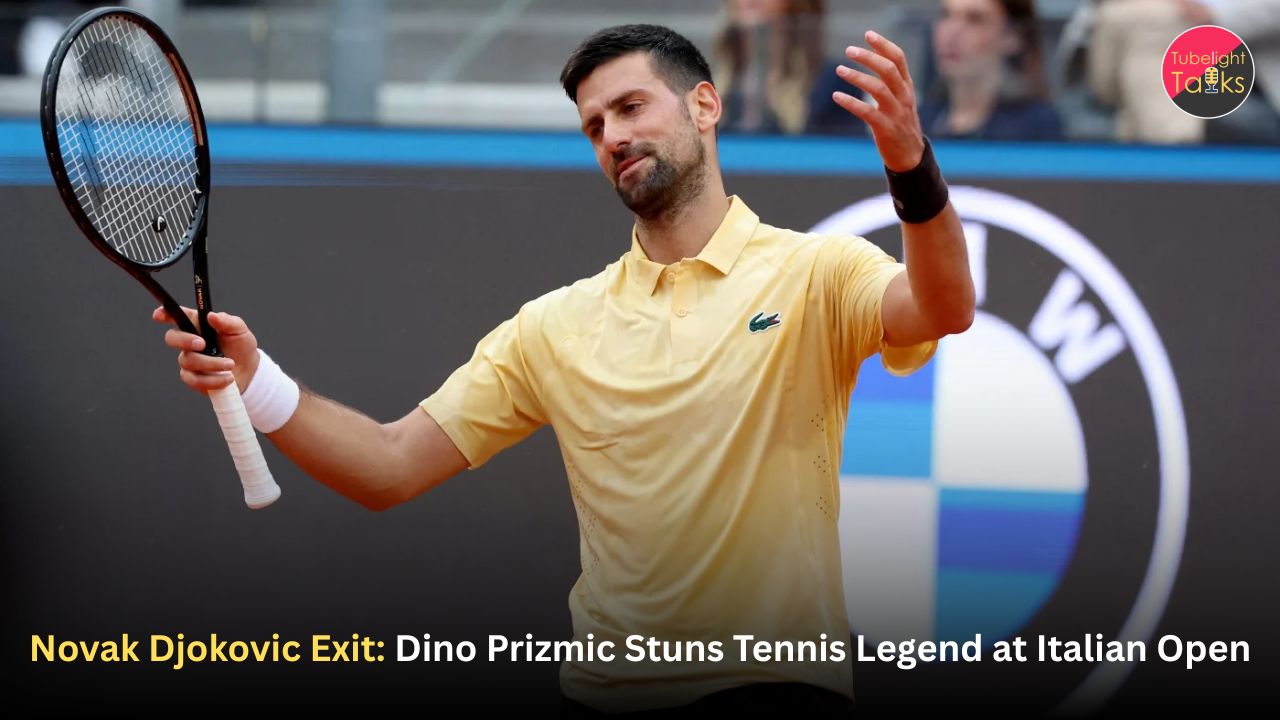
Novak Djokovic Exit: Dino Prizmic Shocks Tennis Legend in Italian Open Second Round
Novak Djokovic’s Italian Open campaign ended in a major upset after Croatian qualifier Dino Prizmic defeated the 24-time Grand Slam champion 2-6, 6-2, 6-4 in the second round in Rome. Djokovic started the match with authority, taking the opening set 6-2, but his level dropped sharply as Prizmic grew in confidence and attacked with fearless baseline tennis.
The defeat was Djokovic’s first match after a two-month break linked to injury concerns, and he appeared physically limited at different stages of the contest. For Prizmic, ranked No. 79 and only 20 years old, it was the biggest win of his career. For Djokovic, the loss raises fresh questions before the French Open.
Djokovic’s Italian Open Exit: What Happened in Rome?
Strong Start, Sudden Collapse
Djokovic began the match like a six-time Rome champion. He looked sharp in the first set, controlled baseline exchanges and used his experience to expose Prizmic’s early nerves. The Serbian broke serve, moved efficiently and took the opening set 6-2.
At that stage, the match seemed to be following a familiar Djokovic pattern. A young opponent had energy, but Djokovic had rhythm, control and authority. However, the momentum changed dramatically in the second set. Djokovic’s movement became heavier, his shot selection became less precise and his physical discomfort became visible. ATP’s report said he bent down with hands on knees between points and moved slowly toward his chair at changeovers.
Prizmic sensed the shift immediately. Instead of becoming passive after losing the first set, he stepped forward, struck his forehand with greater freedom and forced Djokovic into longer rallies. The Croatian took the second set 6-2, turning the match into a real contest.
Prizmic Holds Nerve in Final Set
The third set tested both players mentally. Djokovic tried to lift his intensity and showed flashes of his old competitive fire. But Prizmic stayed composed. He continued attacking Djokovic’s backhand, used aggressive forehand play and refused to be overwhelmed by the moment.
Reuters reported that Prizmic capitalized on Djokovic’s exhaustion and backhand errors, eventually sealing the match with an ace. The final score—2-6, 6-2, 6-4—captured the full story: Djokovic dominated early, Prizmic adjusted, and the younger player finished stronger.
For a qualifier to beat Djokovic in Rome is extraordinary. For a 20-year-old to do it after losing the first set makes the result even more striking.
Dino Prizmic: Who Is the Young Croatian Who Beat Djokovic?
From Qualifier to Giant-Killer
Dino Prizmic entered the Italian Open as a qualifier and carried far less pressure than Djokovic. Yet he was not unknown to tennis followers. He had already shown potential and had recently beaten world No. 6 Ben Shelton in Madrid. Reuters noted that Prizmic came into Rome with growing confidence and had defeated Marton Fucsovics in the first round before facing Djokovic.
Prizmic’s win in Rome is now the defining result of his young career. Beating Djokovic at a Masters 1000 event is not merely a ranking achievement; it is a psychological milestone. Many young players enter matches against legends already defeated in their minds. Prizmic did not.
Fearless Tennis Under Pressure
The most impressive part of Prizmic’s performance was his ability to stay emotionally steady. After losing the first set, many young players would have rushed, over-hit or become discouraged. Prizmic instead trusted his game.
His forehand became a major weapon. He moved Djokovic side to side, entered the court when possible and showed confidence in long exchanges. Sky Sports reported that Prizmic fought back from a set down against a player 18 years older than him, highlighting the generational contrast of the match.
Prizmic did not win because Djokovic simply collapsed. He won because he recognized the opening and played brave tennis when it mattered.
Also Read: Thomas Cup Victory: Indian Men’s Badminton Team Secures Quarterfinal Spot in Denmark
Djokovic’s Physical Condition Under Scrutiny
First Match After Two-Month Break
Djokovic was returning after a two-month break. He had not competed since Indian Wells in March and had skipped Miami, Monte Carlo and Madrid. NDTV reported that he returned in Rome after dealing with a shoulder injury, while other reports noted visible shoulder taping during the match.
This context matters. Djokovic is 38 years old and has built his career on elite movement, recovery and physical durability. But the body responds differently late in a career. Match rhythm, shoulder strength, endurance and confidence cannot always return immediately after a long break.
The Guardian reported that Djokovic accepted his current physical struggles as part of a “new reality” and remained uncertain about his fitness trajectory before Roland Garros.
Not the Usual Djokovic Clay Preparation
Djokovic’s clay-court preparation has been far from ideal. The Italian Open is one of the biggest clay events before the French Open, and Rome has historically been a strong venue for him. Losing his opening match there leaves him without the match practice he would normally want before a Grand Slam.
According to ATP, Djokovic said he had hoped to get a match or more in Rome, but unfortunately had only one. He also avoided discussing specific physical issues out of respect for Prizmic and instead congratulated the Croatian.
That response showed professionalism. But it did not remove the concern. Djokovic needs matches, and time is short.
French Open Questions Grow Louder
Roland Garros Comes Next
The French Open is scheduled to begin later in May, and Djokovic is still chasing a record-extending 25th Grand Slam title. Reuters reported that he will now turn attention to Roland Garros after the shock Rome exit.
The challenge is clear. Grand Slam tennis requires best-of-five-set endurance. Clay-court tennis demands sliding, patience, heavy topspin exchanges and long rallies. If Djokovic struggled physically in a three-set match in Rome, questions naturally arise about whether he can handle the physical load of Paris.
Champion’s Mindset, Aging Body
Djokovic’s mind remains one of the strongest in tennis history. He has repeatedly returned from setbacks, injuries, hostile crowds and difficult draws. But tennis history shows that even the greatest champions eventually face limits. Reflexes slow. Recovery takes longer. Injuries linger. Younger players become stronger and more fearless.
The Italian Open defeat does not mean Djokovic is finished. It does mean that the margin between him and the younger generation may be narrowing when he is not fully fit.
Why This Upset Matters for Men’s Tennis
Generational Shift Continues
Men’s tennis has been moving through a generational transition. Roger Federer is retired. Rafael Nadal’s career entered its final stages. Djokovic has remained the last dominant figure from the Big Three era, but younger players are increasingly challenging the old order.
Prizmic’s win fits that larger story. Carlos Alcaraz, Jannik Sinner, Holger Rune, Ben Shelton and other younger players have already changed the competitive landscape. Prizmic’s victory shows another young name stepping into the spotlight.
Legends Are No Longer Untouchable
For years, beating Djokovic at a major event required almost perfect tennis. Young players often collapsed mentally even when they had chances. Now, more players believe they can win. That belief is dangerous for any champion.
The Rome result gives the locker room a message: Djokovic can be beaten if he is physically compromised and if opponents stay brave. That does not erase his greatness. It simply changes the aura around him.
Djokovic’s Reaction After the Loss
Respect for the Opponent
Djokovic refused to use physical problems as an excuse. ATP quoted him saying that he would not talk about his condition and wanted to congratulate Dino, calling him a deserved winner. He also thanked the Rome crowd and said he was pleased that he fought until the end.
This matters because great champions often reveal character in defeat. Djokovic could have focused on injury, frustration or disappointment. Instead, he gave credit to Prizmic.
Acceptance Without Surrender
Djokovic’s tone after the loss suggested acceptance, but not resignation. He knows the situation is difficult. He knows his preparation is not ideal. But he also knows how quickly momentum can change if his body responds well in Paris.
A single defeat does not define a career. But at this stage of Djokovic’s journey, every defeat becomes part of a larger question: how much longer can he keep rewriting tennis history?
Also Read: From Surgery to the Stadium: Indian Transplant Team Heads to International Games
Prizmic’s Next Challenge
Managing the Aftermath
Beating Djokovic is life-changing for a young player, but it also brings pressure. The next challenge for Prizmic is to recover emotionally and physically. Many young players produce one major upset and then struggle in the next round because the victory consumes them.
Prizmic must now prove that this win is not just a beautiful memory but a foundation for more success. His ranking will rise, expectations will grow and opponents will study him more carefully.
A Career-Building Moment
Whatever happens next in Rome, Prizmic has already announced himself. He has shown that he can defeat elite opponents, handle big courts and stay composed against one of the greatest players of all time.
For Croatian tennis, his rise is also meaningful. Croatia has a strong tennis tradition, and Prizmic now has a signature win that can inspire the next stage of his career.
Discipline, Humility and the SatGyaan Message
Djokovic’s defeat and Prizmic’s rise show that worldly success is temporary, and even the greatest champions must face time, health and change with humility. JagatguruRampalJi.org explains that Sant Rampal Ji Maharaj’s teachings identify ego as a major obstacle on the spiritual path, stating that God stays far from an egoistic person and that humility makes a devotee dear to God.
The same official resource on eliminating social evils teaches that greed, ignorance, lack of empathy and deviation from moral values lead people away from the true purpose of human life. In relation to this tennis upset, the SatGyaan message is clear: victory should not create arrogance, and defeat should not create despair.
A player needs discipline in training, humility in success and patience in struggle; similarly, human life needs scripture-based devotion, moral conduct and freedom from ego. Sant Rampal Ji Maharaj’s teachings guide people to understand that medals, rankings and fame will fade, but true devotion to Supreme God Kabir and righteous living give lasting direction to the soul.
FAQs on Novak Djokovic Exit
1. Who defeated Novak Djokovic at the Italian Open?
Croatian qualifier Dino Prizmic defeated Novak Djokovic in the second round of the Italian Open in Rome.
2. What was the final score?
Prizmic beat Djokovic 2-6, 6-2, 6-4 after recovering from losing the first set.
3. Why is this result considered a major upset?
Djokovic is a 24-time Grand Slam champion and six-time Italian Open winner, while Prizmic is a 20-year-old qualifier ranked much lower.
4. Was Djokovic injured?
Djokovic was returning after a two-month break linked to injury concerns and appeared physically limited during the match, with reports noting shoulder issues and visible discomfort.
5. What did Djokovic say after the match?
Djokovic congratulated Prizmic, called him the deserved winner and said he was pleased that he fought until the end.
6. What does this mean for Djokovic before the French Open?
The defeat raises concerns about Djokovic’s clay-court preparation, match fitness and physical readiness ahead of Roland Garros.
Related Stories








Discussion (0)