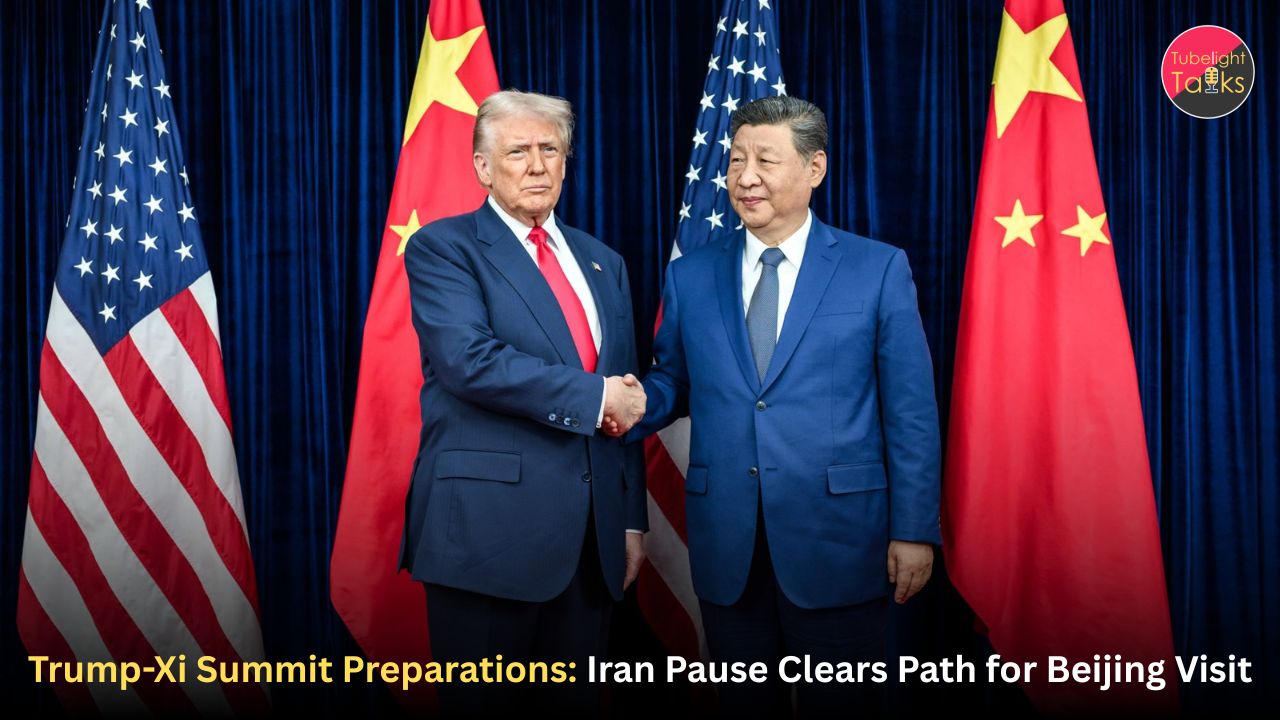
Trump-Xi Summit Preparations: Tactical Iran Pause Clears Path for High-Stakes Beijing Visit
Preparations are intensifying for President Donald Trump’s scheduled May 14–15 visit to Beijing, where he is expected to meet Chinese President Xi Jinping in one of the most consequential diplomatic engagements of the year. The summit had already been rescheduled once because of the Iran war, and the current tactical pause in the conflict is now being viewed by diplomats and analysts as essential to keeping the Beijing visit on track.
Washington wants China to use its influence with Tehran to reopen and stabilize the Strait of Hormuz, while Beijing wants assurances on energy flows, tariffs, technology restrictions and Taiwan. The summit agenda is crowded: Iran, trade, rare earths, fentanyl, artificial intelligence, export controls, commercial deals and strategic stability will all compete for space.
Trump-Xi Summit: Why the Beijing Visit Matters
May 14–15 Meeting Comes at a Critical Moment
Trump is scheduled to meet Xi in Beijing on May 14–15. Reuters reported that the U.S. president plans to bring a smaller CEO delegation than originally expected, reflecting internal divisions in Washington over U.S.-China economic policy and reduced expectations for a major breakthrough. Around a dozen CEOs are expected to travel, compared with the 29 executives who joined Trump during his 2017 China visit.
This smaller business delegation sends a message. The summit is not being framed as a grand commercial celebration. It is being treated as a strategic test. Both leaders need the meeting, but neither wants to look weak. Trump wants a diplomatic win before the Iran conflict worsens. Xi wants stability without appearing to surrender to U.S. pressure.
The meeting may not produce a sweeping reset, but it could determine whether U.S.-China competition remains controlled or moves into another dangerous phase.
Summit Already Delayed by Iran War
Bloomberg reported that the Beijing summit had already been rescheduled once because of the Iran war, which has triggered global energy pressure and restricted supplies to major importers, including China. The leaders are still expected to meet, despite Chinese unease about holding such a high-stakes summit before the Iran conflict is fully resolved.
That background explains why the Iran “pause” matters. It gives Washington and Beijing just enough room to proceed. Without some reduction in Gulf tensions, Trump’s visit could look politically risky and logistically unstable. China also does not want to host a summit while the U.S. is actively escalating a war that directly affects Chinese oil imports.
Also Read: Trump and Xi set for South Korea summit in bid to ease US‑China trade standoff
Iran Conflict Becomes the Shadow Agenda
China’s Influence With Tehran
The Trump administration is pressing China to use its influence with Iran to help reopen the Strait of Hormuz and support a broader ceasefire. China has deep economic ties with Iran and is a major buyer of Middle Eastern energy. Beijing has an interest in preventing a prolonged Gulf war because disruption in Hormuz can damage Chinese industry, shipping and growth.
Al Jazeera reported that Iranian Foreign Minister Abbas Araghchi met Chinese Foreign Minister Wang Yi in Beijing shortly before Trump’s planned visit. Wang called for a comprehensive ceasefire and said China was deeply distressed by the war.
This gives Beijing leverage. China can tell Washington that it is helping to calm Iran, but it will likely expect something in return—possibly tariff relief, fewer tech restrictions, flexibility on energy purchases or a softer U.S. tone on some strategic issues.
Iran Is Not a Side Issue
Analysts say the Iran war may take centre stage at the summit, even though the meeting was originally expected to focus heavily on trade and Taiwan. The crisis affects oil prices, shipping lanes, China’s energy security, U.S. military posture and wider Indo-Pacific strategy.
If the U.S. remains tied down in the Middle East, China may see reduced American capacity in the Indo-Pacific. Former U.S. official Kurt Campbell warned that the summit is “politically awkward” because the Iran conflict has strained U.S. alliances and shifted attention away from Asia.
This is why the tactical pause is so important. It is not merely a Middle East development; it is a diplomatic condition for the U.S.-China meeting.
Trade Truce and Economic Negotiations
Extending the Trade Pause
Reuters reported that one major summit objective is extending the current U.S.-China trade truce, which paused retaliatory export controls. China is reportedly seeking a one-year extension, while the U.S. prefers six months.
This difference matters. China wants predictability. U.S. businesses also want stability, especially firms exposed to Chinese markets, supply chains and rare earth restrictions. But Trump’s trade team may prefer shorter timelines to maintain leverage.
A six-month extension gives Washington more pressure. A one-year extension gives businesses more confidence. The final compromise may reveal which side has more bargaining power.
Managed Trade Versus Market Access
U.S. Trade Representative Jamieson Greer reportedly opposed a large CEO delegation because he wanted the summit focused on “managed trade” rather than open business celebration. This suggests the Trump administration is not simply asking China to buy more American products. It wants specific outcomes: purchases, quotas, export-control rules, supply-chain commitments and possibly enforcement mechanisms.
China may offer major commercial purchases to reduce pressure, including aircraft, energy, agricultural goods or technology-related commitments. But Beijing will resist any arrangement that looks like unilateral concession.
CEO Delegation: Smaller, But Still Strategic
Tech and Finance Leaders Expected
The expected delegation includes leaders from companies such as Nvidia, Apple, Qualcomm, Citigroup and Boeing. Their presence shows what is at stake: semiconductors, consumer electronics, aviation, finance and industrial trade.
These companies are deeply tied to U.S.-China relations. Apple depends on Chinese manufacturing and consumers. Nvidia and Qualcomm are affected by chip export rules. Boeing has long sought large aircraft orders from China. Citigroup represents financial-market access and investment flows.
Even a smaller delegation can carry major economic weight.
Boeing Deal Under Watch
Reuters reported that one possible commercial agreement could involve a Boeing sale to China of up to 500 737 MAX jets. Such a deal would be symbolically powerful because it would support U.S. manufacturing, help Boeing recover market momentum and give Trump a visible export win.
For China, a Boeing order could be used as a diplomatic bargaining chip. It would show goodwill while also meeting aviation demand. But Beijing may use the promise of purchases to seek tariff relief or technology concessions.
Also Read: Marco Rubio’s India Visit: New Delhi Prepares for High-Stakes Bilateral Talks and Quad Diplomacy
Taiwan: The Most Sensitive Strategic Issue
Risk of Abrupt Decisions
Taiwan remains the most sensitive and dangerous issue in U.S.-China relations. Beijing considers Taiwan part of China, while the U.S. maintains unofficial relations with Taipei and supports its self-defence under American law.
Analysts have warned that Trump’s transactional style could create uncertainty around Taiwan. Any language that appears to weaken U.S. support for Taiwan would alarm allies and partners across Asia. At the same time, overly aggressive language could provoke Beijing and destabilize the summit.
China Wants Strategic Calm
Xi’s likely goal is strategic calm on Taiwan, technology and tariffs. China does not want a crisis while its economy faces pressure and while the Iran conflict threatens energy flows. Beijing may try to secure language that discourages Taiwanese independence moves and limits new U.S. restrictions.
Trump, however, may use Taiwan as leverage in broader negotiations. This makes the Taiwan discussion both critical and risky.
Rare Earths, Chips and Technology Controls
Rare Earths as China’s Leverage
China dominates parts of the global rare earth supply chain, including processing. These materials are essential for defence systems, electric vehicles, electronics, wind turbines and advanced manufacturing. If Beijing restricts exports, global industries can suffer.
The summit is expected to include rare earth access and export-control disputes. China may seek relief from U.S. technology controls in exchange for supply-chain assurances.
Chips and AI Competition
Semiconductors and artificial intelligence remain central to the rivalry. The U.S. has restricted some advanced technology exports to China, arguing that such tools could strengthen Chinese military and surveillance capabilities. China sees these controls as containment.
A breakthrough is unlikely, but both sides may seek limited rules to prevent uncontrolled escalation. Even small understandings can matter when two superpowers are competing in technology.
Fentanyl and Security Issues
U.S. Wants Stronger Chinese Action
The summit is also expected to cover fentanyl precursors. Washington has long accused Chinese networks of supplying precursor chemicals used in illicit fentanyl production. China has sometimes cooperated but also uses enforcement as a diplomatic bargaining tool.
Trump may press Xi for stronger commitments, while China may demand tariff or sanctions relief in exchange.
Security Dialogue Needed
Beyond Iran and Taiwan, the U.S. and China need military communication channels to prevent miscalculation in the South China Sea, Taiwan Strait and cyber domain. The summit may restore or strengthen crisis communication if both leaders see value in stability.
Why the Tactical Iran Pause Helps Beijing Talks
Trump Needs Space to Travel
A U.S. president travelling to Beijing during an active Gulf escalation would look risky. A pause allows Trump to present himself as a leader managing multiple crises, not being trapped by one.
Xi Needs Stability Before Hosting
China wants a controlled summit environment. If oil prices are spiking, shipping is frozen and U.S.-Iran missile exchanges continue, Xi’s meeting with Trump becomes politically awkward. A pause allows Beijing to claim that diplomacy is still possible.
Both Sides Need a Win
Trump wants trade and security deliverables. Xi wants reduced pressure and recognition of China’s role. Iran creates both risk and opportunity. If China helps calm Tehran, Beijing can enter the summit with leverage. If the Iran pause collapses, the summit could become dominated by blame and crisis management.
What to Watch Before May 14
Iran’s Response to U.S. Proposal
If Iran accepts or partially accepts a ceasefire framework before Trump travels, the summit atmosphere improves. If Iran rejects the proposal, pressure rises.
China’s Public Statements
Any Chinese statement calling for Hormuz reopening, ceasefire or restraint will signal Beijing’s posture before the summit.
CEO List Finalization
The final business delegation will show which sectors the White House wants emphasized: tech, aircraft, finance, energy or agriculture.
Trade Truce Extension
Whether negotiators agree on six months, one year or another timeline will be a key summit outcome.
Power Diplomacy and the SatGyaan Message
The Trump-Xi summit preparations show that global peace often depends on powerful leaders choosing restraint over ego and dialogue over domination. JagatguruRampalJi.org explains that Sant Rampal Ji Maharaj’s True Spiritual Knowledge teaches that Supreme God Kabir is the Father of all souls, which means humanity is one family beyond borders, power blocs and political rivalry.
The same official teachings describe Sant Rampal Ji Maharaj’s mission as establishing peace, brotherhood and unity while removing social evils such as corruption, intoxication, violence, discrimination and greed. In relation to the Trump-Xi summit, this SatGyaan is deeply relevant: when nations behave only through competition, trade threats and military pressure, the world remains unstable; when leaders act with truth, humility and concern for all human beings, diplomacy can become a path to welfare.
Sant Rampal Ji Maharaj’s teachings guide society to understand that lasting peace cannot come from economic deals alone. It requires inner reform, righteous conduct and devotion to Supreme God Kabir, because real stability begins when ego and greed are removed from human hearts.
FAQs on Trump-Xi Summit Preparations
1. When is Trump scheduled to visit Beijing?
President Donald Trump is scheduled to visit Beijing on May 14–15, 2026, for a summit with Chinese President Xi Jinping.
2. Why is the Iran conflict important for the summit?
The Iran conflict affects global energy flows, the Strait of Hormuz, China’s oil imports and U.S. military focus. The current tactical pause helps keep the summit on track.
3. What topics will Trump and Xi discuss?
The agenda is expected to include Iran, trade, Taiwan, rare earths, technology controls, artificial intelligence, fentanyl, export restrictions and commercial deals.
4. Why is Trump taking a smaller CEO delegation?
The smaller delegation reflects cautious expectations, internal U.S. policy divisions and a desire to focus the summit on strategic trade outcomes rather than a large business showcase.
5. Could there be a major trade deal?
A broad breakthrough is uncertain, but possible outcomes include extension of the trade truce, commercial purchases, rare earth understandings and limited technology discussions.
6. Why is Taiwan a sensitive issue?
Taiwan is the most sensitive security issue between Washington and Beijing. Any change in language or policy could affect regional stability and U.S. alliances in Asia.
Related Stories







Discussion (0)