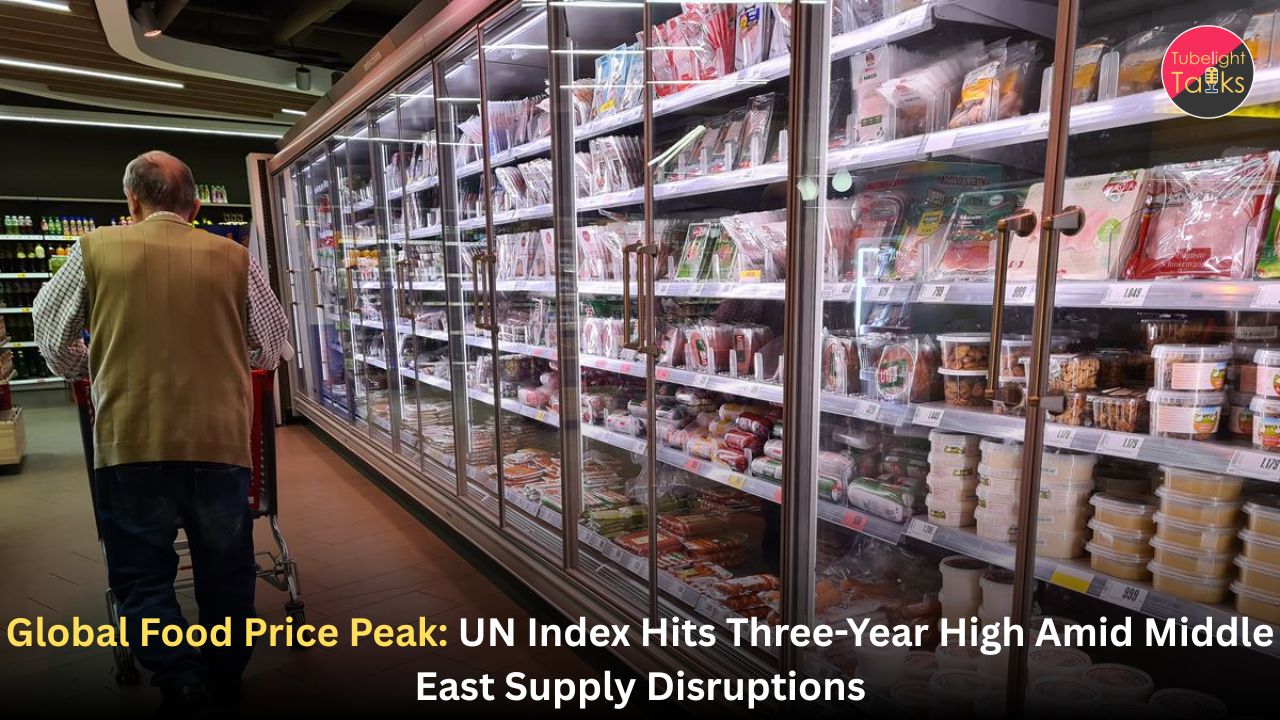
Global Food Price Peak: UN Reports Three-Year High as Middle East Disruptions Push Up Commodity Costs
The United Nations has reported that global food-commodity prices climbed to their highest level in more than three years, raising fresh concern over inflation, hunger and supply-chain vulnerability. The Food and Agriculture Organization’s Food Price Index averaged 130.7 points in April 2026, up 1.6% from March and marking the third straight monthly increase. Vegetable oil prices rose sharply by 5.9%, while meat and cereal prices also increased.
The rise has been linked to elevated energy costs, biofuel demand, fertilizer pressure and disruptions connected to the Middle East crisis, particularly risks around the Strait of Hormuz and wider Gulf supply chains. For ordinary consumers, the warning is simple: global food inflation is again becoming a serious economic and humanitarian threat.
FAO Food Price Index Hits Highest Level Since 2023
Third Consecutive Monthly Increase
The FAO Food Price Index rose for the third consecutive month in April, reaching 130.7 points. The index is a global benchmark that tracks monthly changes in international prices of a basket of food commodities, including cereals, vegetable oils, dairy, meat and sugar. FAO said the April increase was driven mainly by higher vegetable oil, meat and cereal prices, while sugar and dairy prices declined.
The latest level is significant because it marks the highest reading in more than three years. Reuters reported that the index reached its highest level since February 2023, showing that the world is again moving into a period of food-cost pressure after earlier moderation.
For families, this does not always mean an immediate one-to-one rise in grocery bills. International commodity prices pass through retail markets differently depending on currency, subsidies, transport, taxes, domestic production and government policy. But when global food prices rise for several months, household food baskets usually feel pressure sooner or later.
Vegetable Oils Lead the Surge
The biggest driver was vegetable oil. FAO’s April vegetable oil price index rose 5.9% month-on-month, reaching its highest level since July 2022. Prices rose across soy, sunflower, rapeseed and palm oil markets, with support from biofuel demand, energy costs and supply concerns.
Vegetable oil is a basic ingredient across food systems. It is used in cooking oil, packaged foods, bakery products, processed snacks, animal feed and biofuel production. When vegetable oil prices rise sharply, the effect spreads widely across consumer markets.
Palm oil and soybean oil are especially important for Asia and Africa. Sunflower oil is important for Europe, the Middle East and many import-dependent countries. Rapeseed oil is important in European and industrial food systems. A rise across multiple oils shows broad market stress, not just one crop failure.
Also read: Trump Tariff Rollback Offers Relief for Indian Farmers
Middle East Disruptions Add Pressure
Energy Costs Feed Into Food Costs
The Middle East crisis is affecting food prices through energy. Food supply chains depend heavily on fuel for planting, harvesting, irrigation, processing, refrigeration, transport and shipping. When oil prices rise, food production and distribution costs rise.
Reports linked the increase in food prices partly to the Iran war and disruptions around the Strait of Hormuz, which have raised energy-market anxiety and affected shipping routes. Higher energy prices also increase biofuel demand, which pulls vegetable oils and oilseeds into fuel markets instead of food channels.
This creates a chain reaction. If diesel becomes expensive, farmers pay more to run tractors and pumps. If fertilizer becomes expensive, crop production costs rise. If shipping becomes expensive, imported food prices rise. If vegetable oils become attractive for biofuel, food buyers face higher competition.
Fertilizer and Cereal Concerns
Cereal prices rose 0.8% in April, a smaller increase than vegetable oils but still important. FAO noted that cereal prices were supported by modestly higher quotations for wheat and maize, along with weather concerns, rising fertilizer costs and increased biofuel demand.
Cereals matter because they are the backbone of global food security. Wheat, rice and maize feed billions directly or indirectly through bread, rice meals, flour, noodles, livestock feed and processed foods. Even a modest rise in cereal prices can affect poor households because cereals form a large share of their daily diet.
The April rise was not yet a full cereal crisis, but it is a warning. If energy disruption continues and fertilizer costs rise further, future crop decisions may change. Farmers may reduce fertilizer use, shift crop choices or delay investment, which can affect yields later.
Why This Matters for Low-Income Families
Food Inflation Hits the Poor First
Food inflation is not equal for everyone. Wealthier households may reduce discretionary spending, but poor households already spend a large share of income on food. When prices rise, they may cut nutrition, reduce meal size, switch to cheaper staples or borrow money.
Children, pregnant women, elderly people and informal workers are often hit hardest. Higher food prices can quickly become a public-health issue, not only an economic issue. Malnutrition, anemia and school dropout risks increase when families cannot afford stable diets.
Import-Dependent Countries Are Vulnerable
Countries that rely heavily on imported wheat, rice, cooking oil, fuel and fertilizer face special risk. Currency weakness can make imports even more expensive. If governments try to shield consumers through subsidies, fiscal pressure rises. If they do not, public anger can grow.
The Middle East, North Africa, South Asia and parts of Sub-Saharan Africa may be especially sensitive depending on import structures, fuel dependence and social safety nets.
Global Supply Chains Remain Fragile
One Crisis Can Spread Across Markets
The food-price rise shows how interconnected the global economy has become. A military crisis near the Strait of Hormuz can affect fuel prices. Fuel prices can affect fertilizer, transport and biofuel demand. Biofuel demand can affect vegetable oils. Vegetable oils affect grocery prices. Grocery prices affect household budgets and political stability.
This is why food security cannot be treated as only an agricultural issue. It is linked to war, energy, shipping, climate, trade policy, currency markets and social protection.
Climate Risk Adds Another Layer
While the latest price rise is strongly linked to energy and supply-chain disruption, climate risk remains a constant pressure. Droughts, heatwaves, floods and erratic rainfall can affect yields. If climate shocks combine with war-driven energy stress, prices can rise faster.
Governments must therefore prepare not only for one crisis but for overlapping shocks.
Also Read: India’s Inflation Rate Drops Amid Decrease in Food Prices: A Positive Sign for the Economy
What Governments May Need to Do
Protect Vulnerable Households
Governments may need targeted food assistance, cash transfers, school meals, public distribution support and nutrition programmes for vulnerable groups. Broad subsidies can be costly and inefficient, but targeted relief can protect those most at risk.
Avoid Export Panic
During food-price spikes, some countries impose export restrictions. While such measures may protect domestic consumers temporarily, they can worsen global shortages and push prices higher. International cooperation is essential.
Strengthen Food Reserves
Strategic food reserves can help stabilize markets, but they must be managed transparently. Panic buying by governments can itself worsen price spikes.
Invest in Local Resilience
Countries should invest in local production, irrigation, storage, cold chains, diversified crops and climate-resilient agriculture. Reducing waste is also crucial. A large share of food is lost between farm and plate because of poor storage, transport and distribution.
Also Read: Sikkim’s Organic Milestone: Export-Readiness Push Strengthens Farmers and Global Market Access
India and Global Food Price Pressure
India Has Both Risks and Buffers
India has large food production and public food distribution systems, which provide some protection. But India is still exposed to edible oil imports, fertilizer prices, fuel costs and global market sentiment. Vegetable oil price spikes are especially relevant because India is one of the world’s major edible oil importers.
If global edible oil prices rise, Indian households may feel pressure in cooking oil, packaged foods and restaurant costs. Fertilizer and fuel price pressure can also affect farmers.
Opportunity for Self-Reliance
The crisis reinforces the importance of edible oil self-reliance, storage infrastructure, sustainable farming, crop diversification and efficient supply chains. It also shows why food policy must connect agriculture, energy and trade strategy.
Food, Compassion and the SatGyaan Message
The global food-price peak reminds humanity that hunger is not only an economic statistic; it is a direct test of compassion, equality and moral responsibility. JagatguruRampalJi.org explains that under the guidance of Sant Rampal Ji Maharaj, free community meals are organized in Satlok Ashrams, where food is provided without discrimination based on caste, religion, gender or wealth.
The same official source states that meals and ration were distributed during crises such as the pandemic and disasters, reflecting the teaching that feeding the hungry is a noble and essential humanitarian duty. In relation to today’s food-price crisis, this SatGyaan is deeply relevant: when food becomes expensive, society must not allow the poor to suffer silently.
Sant Rampal Ji Maharaj’s teachings guide people away from greed, corruption, intoxication, wasteful habits and selfishness, while inspiring service, equality and compassion. A world guided by true spiritual knowledge would treat food as a shared blessing, not a commodity for hoarding and profit. Real progress means ensuring that no person sleeps hungry while others waste or exploit essential resources.
FAQs on Global Food Price Peak
1. What did the UN report about global food prices?
The UN FAO reported that its Food Price Index rose to 130.7 points in April 2026, the highest level in more than three years.
2. How much did the FAO Food Price Index rise?
The index rose 1.6% from March, marking the third consecutive monthly increase.
3. Which commodity rose the most?
Vegetable oils rose the most, with FAO’s vegetable oil price index increasing 5.9% month-on-month to its highest level since July 2022.
4. Why are food prices rising?
Prices are rising due to higher energy costs, Middle East supply-chain disruptions, biofuel demand, fertilizer pressure and increases in vegetable oil, meat and cereal prices.
5. Did cereal prices also rise?
Yes. Cereal prices rose 0.8% in April, supported by higher wheat and maize quotations, weather concerns, fertilizer costs and biofuel-linked demand.
6. Who is most affected by global food inflation?
Low-income households, import-dependent countries, children, elderly people and families already spending a large share of income on food are most vulnerable.
Related Stories







Discussion (0)