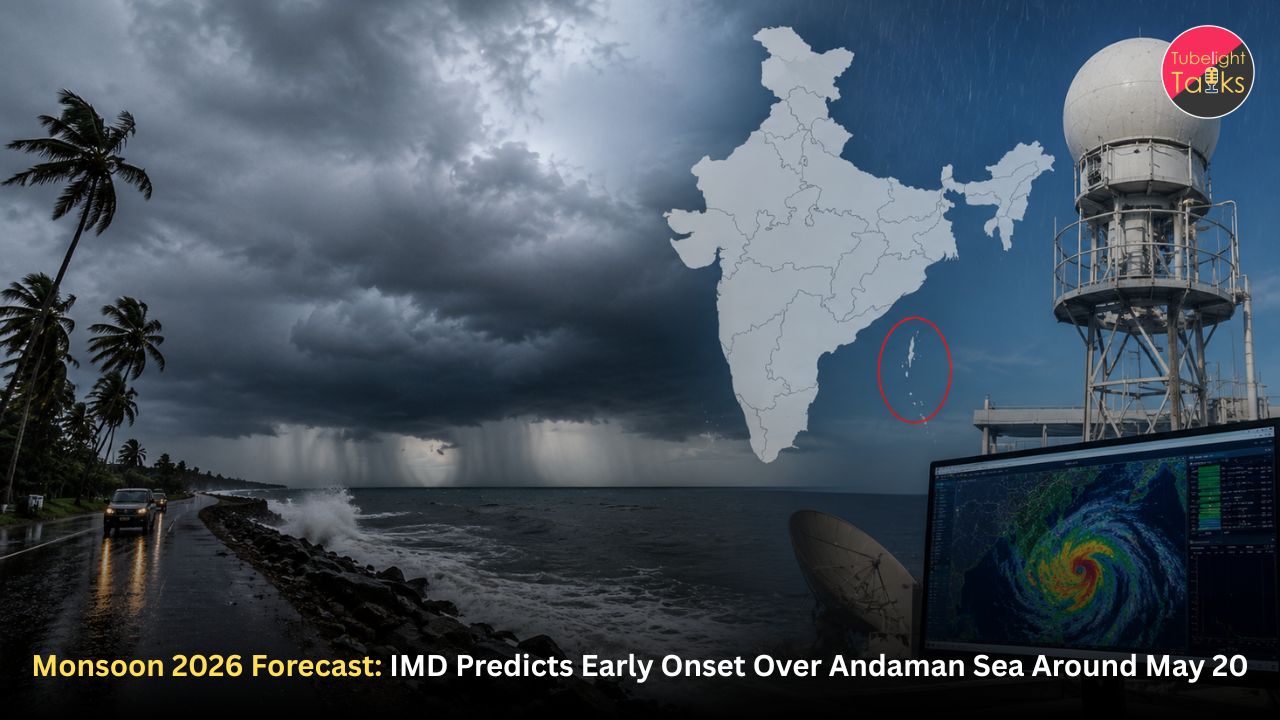
Monsoon 2026 Forecast: IMD Predicts Early Arrival Over Andaman Sea Around May 20
The India Meteorological Department has predicted that the Southwest Monsoon is likely to make its onset over parts of the South Bay of Bengal, Andaman Sea and Andaman & Nicobar Islands during the second forecast week of May 14–20, with wider reporting placing the likely arrival around May 20. This marks the first major signal of India’s 2026 monsoon season.
The monsoon’s timely movement over the Andaman region is closely watched because it sets the early rhythm for rainfall progression toward Kerala and then across the country. IMD’s extended range forecast also indicates that rainfall is likely to be above normal over southern, eastern and northeastern India during the same period, bringing attention from farmers, water managers, disaster agencies and state governments.
IMD Monsoon 2026 Forecast: What Has Been Predicted?
Southwest Monsoon Likely Over Andaman Sea During May 14–20
According to IMD’s extended range forecast dated May 7, the Southwest Monsoon onset is likely over parts of the South Bay of Bengal, Andaman Sea and Andaman & Nicobar Islands during week 2 of the forecast period, covering May 14 to May 20. The Indian Express reported the onset as likely around May 20, describing it as a timely movement over the Andaman Sea.
This is an important early-stage forecast. The monsoon does not arrive across India all at once. Its first movement over the Andaman Sea and adjoining Bay of Bengal is usually treated as an early indicator of seasonal progression. From there, meteorologists track wind patterns, rainfall activity, clouding, pressure systems and cross-equatorial flow before declaring onset over Kerala.
For India, the monsoon is not only a weather event. It shapes agriculture, drinking-water storage, hydropower, food prices, rural income, inflation, heat relief, reservoirs and flood preparedness.
Timely Signal, Not Yet Full-Country Onset
The forecast does not mean the monsoon has already arrived across mainland India. It means the earliest phase of the Southwest Monsoon is likely to begin over the Andaman Sea region. The Kerala onset usually follows later, generally around early June, though exact timing depends on atmospheric conditions. Business Standard reported that IMD expects the Southwest Monsoon to reach Kerala around its usual onset date in early June.
This distinction matters because public excitement around monsoon arrival can sometimes lead to confusion. Pre-monsoon thunderstorms may already occur in many regions, but they are not the same as official monsoon onset. IMD uses specific criteria involving rainfall, wind and outgoing longwave radiation before declaring monsoon arrival.
Why the Andaman Onset Matters
First Step in India’s Rainfall Journey
The Andaman Sea is one of the first zones where the Southwest Monsoon becomes active before advancing toward Kerala and then northward and westward across India. A timely onset there can support confidence that the seasonal system is developing, though it does not guarantee perfect rainfall distribution for the entire country.
Meteorologists will now monitor whether the system strengthens steadily, whether Bay of Bengal circulation supports rainfall, and whether cross-equatorial winds build as expected.
Farmers Watch the Signal Closely
Farmers across India watch monsoon forecasts carefully because sowing decisions depend on rainfall timing and soil moisture. A timely onset can improve planning for kharif crops such as paddy, pulses, maize, cotton, soybean and millets. However, farmers usually wait for local rainfall stability before major sowing decisions.
A premature sowing decision can be risky if early showers are followed by a dry spell. Agricultural advisories therefore matter. Farmers should follow local agromet bulletins, soil-moisture guidance and district-level forecasts rather than relying only on national-level monsoon headlines.
Also Read: Heatwave Warning for North India as IMD Predicts Rising Temperatures
Weather Conditions Supporting Monsoon Activity
Bay of Bengal Activity Likely to Increase
IMD’s forecast notes that southwesterly winds in the lower and middle tropospheric levels from the Bay of Bengal to Northeast India are likely to prevail during the second forecast week. It also says the Madden-Julian Oscillation is likely to support convective activity over the Bay of Bengal throughout the forecast period. These conditions are important for rainfall development and monsoon advancement.
The Bay of Bengal often plays a crucial role in monsoon behaviour. Moisture-laden winds, low-pressure systems and convective activity in this region can influence rainfall over the Andaman & Nicobar Islands, Northeast India, eastern India and later central India.
Above-Normal Rainfall Likely in South, East and Northeast
IMD’s extended forecast says overall rainfall is likely to be above normal over the southern, eastern and northeastern parts of the country during week 2, while rainfall may remain below normal over the Western Himalayan Region and near normal over the rest of the country.
This suggests an active pre-monsoon-to-monsoon transition in several regions. Northeast India, the eastern states and parts of the south may see continued thunderstorm and rainfall activity, while northwest and western India may still face heat and dry spells in some areas.
Pre-Monsoon Thunderstorms Continue
Rainfall and Gusty Winds Before Monsoon Arrival
IMD’s forecast for May 7–13 already included fairly widespread to widespread light to moderate rainfall with thunderstorms, lightning and gusty winds over the Andaman & Nicobar Islands. It also warned of thunderstorm activity across parts of eastern India, northeast India, central India and south peninsular India.
This is typical of the pre-monsoon transition. Thunderstorms, lightning, gusty winds and local heavy rainfall can occur before the formal monsoon onset. While these showers provide relief from heat, they can also damage crops, power lines, trees, temporary structures and vulnerable homes.
Safety During Thunderstorms
People in storm-prone areas should avoid standing under trees during lightning, secure loose objects, keep away from open fields during thunderstorms and follow local weather warnings. Fishermen and coastal communities should pay attention to marine warnings, especially around the Bay of Bengal and Andaman Sea.
Lightning safety becomes especially important during pre-monsoon months. Many deaths during this period occur because people continue outdoor work during thunderstorms.
Impact on Agriculture and Rural Economy
Kharif Planning Begins
The monsoon is central to India’s kharif season. Paddy transplantation, cotton sowing, pulses, coarse cereals, oilseeds and sugarcane planning all depend on rainfall timing. A timely Andaman onset can boost farmer confidence, but actual field activity depends on rainfall reaching local farming zones.
State agriculture departments may now prepare advisories for seed procurement, nursery preparation, water conservation, fertilizer planning and crop choice. Farmers in rainfed areas should be especially cautious and wait for adequate soil moisture.
Food Prices and Rural Demand
A good monsoon supports food supply, rural income and livestock systems. It can help stabilize prices of cereals, pulses, vegetables and edible oils if rainfall distribution remains favourable. Conversely, delayed or uneven rainfall can create pressure on crop yields and food inflation.
This is why traders, policymakers and rural markets track monsoon progress closely. The monsoon affects not only farmers but also consumers in cities.
Water Security and Reservoirs
Recharging Rivers, Tanks and Groundwater
The monsoon replenishes reservoirs, rivers, lakes, ponds and groundwater systems. Timely rainfall is especially important after summer heat has increased water demand. Urban and rural water supply planning depends heavily on seasonal rainfall.
Southern, eastern and northeastern India may see early rainfall benefits if IMD’s above-normal forecast for the second week verifies. However, water managers still need to prepare for both extremes: flood risk in high-rainfall zones and dry spells in regions where rainfall is delayed.
Hydropower and Irrigation
Reservoir levels affect hydropower generation and irrigation releases. A healthy monsoon helps electricity supply, agriculture and drinking water. But intense rainfall in short bursts can also create flood-management challenges. Authorities must monitor dam inflows carefully once seasonal rainfall strengthens.
Disaster Preparedness Before the Monsoon
Flood-Prone Regions Must Prepare Early
The monsoon brings life, but it also brings floods, landslides, waterlogging and river erosion. Northeast India, parts of Bihar, Assam, Bengal, Kerala, Konkan, coastal Karnataka and Himalayan states face different kinds of monsoon risks.
State disaster agencies should use the early forecast window to inspect drains, embankments, culverts, vulnerable slopes, relief shelters and emergency communication systems. A timely onset should not lead to complacency; it should trigger readiness.
Urban Flooding Risk
Cities must prepare for waterlogging before heavy rain begins. Drain cleaning, stormwater management, pothole repair, traffic planning and emergency response systems should be reviewed. Urban flooding increasingly affects daily life, especially in cities where concrete surfaces reduce natural drainage.
Heat Relief, But Not Everywhere Immediately
North and West India May Still Face Heat
Although monsoon signals are emerging in the Andaman region, parts of northwest and western India may continue to face heat in the coming days. IMD’s extended forecast indicates possible heatwave conditions in isolated pockets over Gujarat and West Rajasthan during May 9–13, with low probability of heatwave conditions in some parts during week 2.
This means the country may experience two contrasting realities: monsoon development over the Bay of Bengal and heat stress in the west and northwest. Such transitions are common in May.
Public Health Preparedness
People in heat-prone areas should continue hydration, avoid outdoor exertion during peak hours, protect children and elderly people, and follow local heat advisories. Monsoon arrival in one region does not immediately end heat risk elsewhere.
Also Read: IMD Heavy Rain Warning as Northeast Faces Orange Alert, Delhi Under Watch
Climate Signals: ENSO and IOD
El Niño Conditions May Develop
IMD’s extended range forecast notes that ENSO-neutral conditions are evolving toward El Niño conditions over the equatorial Pacific, while neutral Indian Ocean Dipole conditions currently prevail and positive IOD conditions may develop toward the end of the Southwest Monsoon season.
These large-scale climate signals can influence monsoon behaviour, though their exact effect depends on timing, strength and interaction with other atmospheric conditions. El Niño is often associated with weaker monsoon rainfall, while a positive Indian Ocean Dipole can sometimes support rainfall over India. But no single signal determines the entire monsoon.
Distribution Matters More Than Total
For farmers and water managers, rainfall distribution matters as much as total seasonal rainfall. A season can have normal overall rainfall but still suffer from dry spells, floods, delayed sowing windows or regional deficits. IMD’s weekly and district-level updates will therefore remain important throughout the season.
Rain, Agriculture and the SatGyaan Message
The monsoon forecast reminds India that rain is not merely a weather event; it is the lifeline of farmers, food security, rivers and everyday life. JagatguruRampalJi.org’s World Soil Day resource explains that water is the main resource of agriculture, water is supplied by rain, and true worship according to scriptures pleases God, through whose blessings rain comes on time and the earth becomes fertile.
This SatGyaan is directly relevant to the monsoon because scientific forecasting helps society prepare, while true spiritual knowledge reminds humanity to live with humility, gratitude and righteous conduct. Sant Rampal Ji Maharaj’s teachings guide people away from intoxication, corruption, violence, greed and wasteful habits, creating a disciplined society that respects food, water, land and farmers.
When people understand the value of rain and agriculture, they also understand that human life depends on nature’s balance and God’s grace. The deeper lesson is that monsoon preparedness should be matched with moral preparedness: conserve water, avoid wastage, help farmers, protect the environment and follow the scripture-based path of devotion to Supreme God Kabir.
FAQs on Monsoon 2026 Forecast
1. When is the Southwest Monsoon likely to reach the Andaman Sea?
IMD has forecast that the Southwest Monsoon is likely to reach parts of the South Bay of Bengal, Andaman Sea and Andaman & Nicobar Islands during May 14–20, with wider reporting indicating around May 20.
2. Does this mean monsoon has reached all of India?
No. This forecast refers to the early onset region over the Andaman Sea and nearby areas. Mainland India, including Kerala, will be monitored separately for official onset.
3. When is the monsoon expected over Kerala?
IMD expects the Southwest Monsoon to reach Kerala around its usual onset date in early June, depending on evolving conditions.
4. Which regions may see above-normal rainfall during May 14–20?
IMD says rainfall is likely to be above normal over southern, eastern and northeastern parts of India during week 2 of the forecast period.
5. What should farmers do now?
Farmers should prepare for the kharif season but wait for local rainfall stability and district-level agromet advisories before major sowing decisions.
6. Are thunderstorms expected before monsoon arrival?
Yes. IMD has forecast thunderstorms, lightning and gusty winds over several regions during the pre-monsoon transition, including the Andaman & Nicobar Islands and parts of east, northeast and south India.
Related Stories








Discussion (0)