West Bengal Second Renaissance: Suvendu Adhikari Takes Charge as First BJP Chief Minister
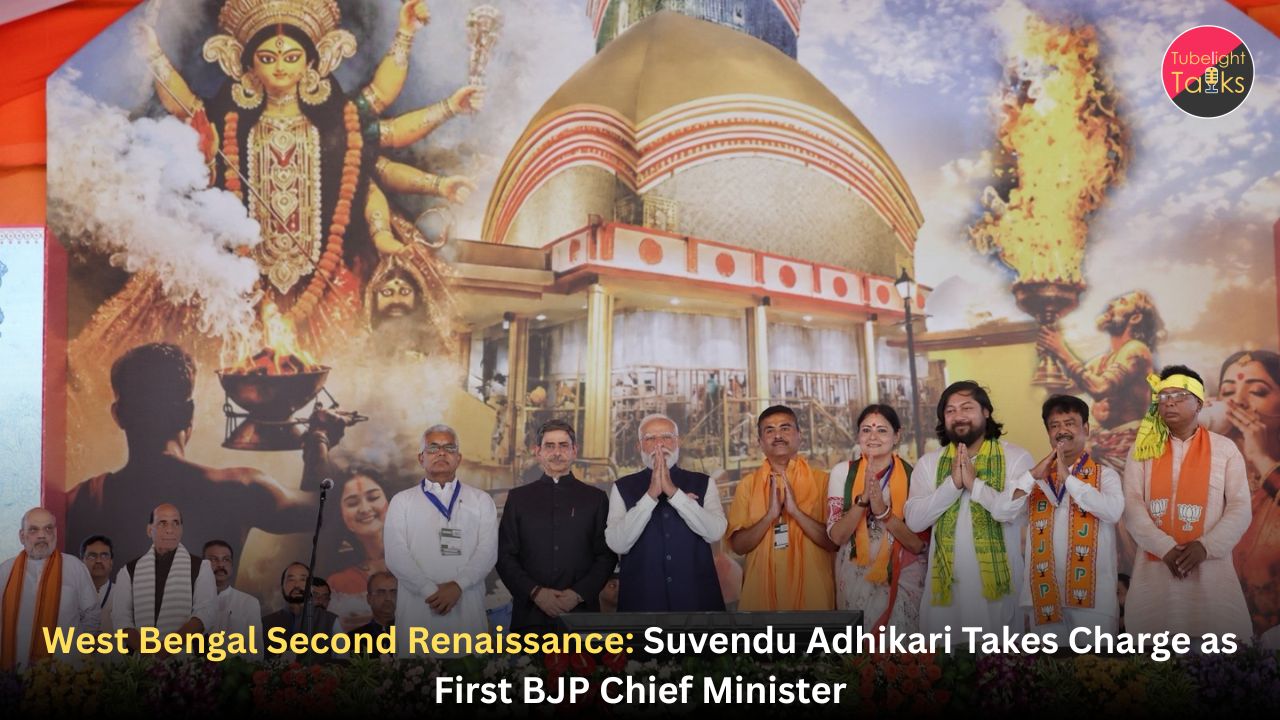
West Bengal has entered a historic new political phase as Suvendu Adhikari officially takes charge as the state’s first Bharatiya Janata Party Chief Minister. Adhikari took oath at Kolkata’s Brigade Parade Ground on May 9, 2026, becoming the ninth Chief Minister of West Bengal and succeeding Mamata Banerjee, who had held the office since 2011. Five ministers were sworn in alongside him, while Prime Minister Narendra Modi, Union Home Minister Amit Shah and several senior NDA leaders attended the ceremony.
BJP leaders have described the moment as Bengal’s “Second Renaissance,” arguing that the new government will focus on development, transparent governance, infrastructure, industrial revival and the removal of political violence and corruption from public life.
West Bengal Gets Its First BJP Chief Minister
Suvendu Adhikari Takes Oath at Brigade Parade Ground
The oath-taking ceremony at Brigade Parade Ground carried strong symbolic weight. It was not only a change of government; it was the BJP’s first entry into the Chief Minister’s office in West Bengal since Independence. Governor R. N. Ravi administered the oath of office and secrecy to Adhikari and five ministers at the grand Kolkata ceremony.
Brigade Parade Ground has long been associated with major political mobilizations in Bengal. Holding the ceremony there turned the transition into a mass political statement. The BJP wanted the event to project not only victory but also arrival: a national party that had long struggled in Bengal had finally captured power in one of India’s most politically charged states.
Adhikari’s swearing-in also ends the uninterrupted 15-year rule of Mamata Banerjee and the Trinamool Congress. Before that, Bengal had seen 34 years of Left Front rule. This means Bengal has moved from Left dominance to TMC dominance and now to its first BJP-led government. That is why supporters are calling the shift a “Second Renaissance.”
Five Ministers Sworn In
Five ministers were sworn in alongside the Chief Minister. Reports identified Dilip Ghosh, Ashok Kirtania, Kshudiram Tudu, Nisith Pramanik and Agnimitra Paul as part of the first ministerial team. The cabinet is expected to expand later because West Bengal can have a much larger council of ministers.
The initial cabinet composition sends political signals. Dilip Ghosh represents the BJP’s older organizational base in Bengal. Agnimitra Paul brings visibility as a woman leader and prominent party face. Nisith Pramanik has influence in North Bengal politics. Kshudiram Tudu adds tribal representation. Ashok Kirtania reflects the party’s need to balance regional and social constituencies.
A full cabinet expansion will be watched closely because Bengal’s politics is shaped by region, caste, community, language, rural-urban differences and religious demography. The BJP will need to show that its government is inclusive and administratively capable.
Why This Is Being Called Bengal’s “Second Renaissance”
A Political Renaissance After Long Dominance
The phrase “Second Renaissance” is being used by BJP supporters to frame the election result as more than a change in party rule. It suggests a rebirth of governance, culture, economic confidence and institutional order. Historically, Bengal’s first renaissance refers to the 19th-century intellectual, social and cultural awakening associated with figures such as Raja Ram Mohan Roy, Ishwar Chandra Vidyasagar, Bankim Chandra Chattopadhyay, Swami Vivekananda and Rabindranath Tagore.
By invoking a “Second Renaissance,” the new political narrative is trying to connect modern governance with Bengal’s historical identity as a centre of learning, reform, culture and national awakening.
However, slogans alone will not create a renaissance. The Adhikari government will have to prove this claim through delivery: jobs, industry, law and order, education, healthcare, rural development, women’s safety, infrastructure and institutional fairness.
BJP’s Ideological Milestone
The ceremony also carried ideological meaning for the BJP. Economic Times reported that Prime Minister Modi paid respect to 97-year-old Makhanlal Sarkar, described as a close associate of Syama Prasad Mukherjee, during the swearing-in event. This gesture connected the BJP’s Bengal victory to the party’s historical roots and Mukherjee’s legacy.
For the BJP, Bengal is not just another state. It is the birthplace of Syama Prasad Mukherjee, founder of the Bharatiya Jana Sangh, the BJP’s predecessor. Winning Bengal therefore carries emotional and ideological value for the party’s national leadership.
Also Read: Bengal Violence: Tensions High After Suvendu Adhikari’s Close Aide Shot Dead in Madhyamgram
From Mamata Era to Adhikari Era
End of 15 Years of TMC Rule
Mamata Banerjee came to power in 2011 by ending 34 years of Left Front rule. Her political rise was itself historic. She built the TMC into Bengal’s dominant force and won three consecutive terms. Now, Adhikari’s rise marks the end of that era. NDTV reported that he succeeds Banerjee after her 15-year tenure as Chief Minister.
This transition is politically dramatic because Adhikari was once one of Mamata Banerjee’s closest and most important leaders. He played a major role in the Nandigram movement and later became one of the strongest BJP faces after leaving the TMC. His victory now carries personal, political and symbolic force.
Mamata Banerjee Absent From Ceremony
Reports indicate that Mamata Banerjee did not attend Adhikari’s oath-taking ceremony, despite being invited. Her absence underlines the bitterness of the political transition. Mint reported that she did not attend the event, which was otherwise attended by several major national leaders.
In a democratic transfer of power, attendance by outgoing leaders can signal institutional grace. But Bengal’s political climate remains highly polarized. The new government will need to reduce tension if it wants to govern effectively.
Adhikari’s Immediate Governance Agenda
“We Will Rebuild Bengal”
Times of India’s live coverage quoted Adhikari as saying, “We will rebuild Bengal,” after taking oath. BJP leaders have framed the new government’s mission around development, transparency, infrastructure, jobs and ending political criminality.
The phrase “rebuild Bengal” will now be tested in practice. Bengal has strong cultural capital, fertile land, a strategic location, ports, educational institutions and industrial history. But the state also faces challenges in investment, employment, migration, political violence, urban infrastructure, rural distress and administrative trust.
If Adhikari wants the “Second Renaissance” message to work, his government must focus quickly on visible governance reforms.
Law and Order as First Test
Law and order will be one of the first major tests. Bengal has seen political clashes, post-poll violence allegations and rising tension after the election result. The killing of Chandranath Rath, a close aide of Adhikari, has already intensified concerns over political violence.
The new government will face pressure from its supporters to act strongly, but it must also avoid political vendetta. Rule of law must be impartial. If the BJP government uses the police to settle scores, it will repeat the same accusations it made against previous governments. If it acts fairly and transparently, it can build trust beyond its voter base.
Administrative Continuity and Bureaucracy
A new government often faces the challenge of working with a bureaucracy shaped by previous administrations. Adhikari will need to build trust with officers while demanding accountability. Transfers may happen, but excessive administrative reshuffling can slow governance.
The government must set priorities clearly: law and order, welfare continuity, industrial policy, agriculture, education, healthcare and infrastructure.
Economic and Development Priorities
Industrial Revival
Bengal once had a powerful industrial base, but over decades it lost ground to western and southern states in manufacturing investment. The new government is expected to push industrial revival as a central promise.
To attract investment, Bengal will need policy stability, land clarity, labour confidence, infrastructure, port development, logistics corridors, power reliability and reduced political interference. Investors will watch whether the new government changes the business climate or only changes political language.
Jobs and Youth Expectations
Young voters will expect jobs. Bengal’s educated youth have long migrated to other states for employment. A “Second Renaissance” must therefore include skill development, startups, technology parks, manufacturing, tourism, creative industries and better higher education opportunities.
If the government cannot deliver employment pathways, the political excitement may fade quickly.
Rural Bengal and Agriculture
Rural Bengal remains crucial. Farmers, small traders, self-help groups, fishermen, artisans and rural workers need stable incomes. The new government must balance industrial ambition with rural welfare.
Schemes related to irrigation, crop diversification, rural roads, market access, cold chains and women’s livelihoods will be important.
Also Read: Eastern India Political Shift: Assam Victory & Bengal Battle
Political Challenges Ahead
Managing Expectations of BJP Cadre
BJP workers who fought a difficult political battle in Bengal will expect recognition, protection and influence. Managing cadre expectations without allowing local-level arrogance or intimidation will be essential.
A party that moves from opposition to power must change behaviour. Protest politics is different from governance. The government must discipline supporters and send a clear message that violence, revenge and extortion will not be tolerated.
Opposition Strategy
Mamata Banerjee and the TMC remain a strong opposition force. Indian Express reported that Banerjee has urged opposition parties, including the Left, to come together and fight the BJP in the state.
This means Adhikari’s government will face a combative opposition from day one. The Assembly may become highly charged. The government will need political patience and strong communication.
Federal Relations
Bengal’s relationship with the Union government may change significantly now that the BJP controls both Centre and state. This could help with infrastructure, central schemes, funding coordination, border management and industrial approvals. But it may also increase expectations for fast delivery.
Inclusive Governance Will Be Crucial
Beyond Party Voters
Adhikari now governs all of West Bengal, not only BJP voters. His government must reassure minorities, opposition supporters, civil society, farmers, workers and cultural groups that governance will not become exclusionary.
Bengal has a complex social fabric. Any perception of targeted governance could deepen polarization. A true “Second Renaissance” would mean development and dignity for all communities.
Cultural Confidence and Political Balance
Bengal’s identity is deeply tied to language, literature, music, festivals, intellectual debate and social reform. The BJP government will need to show respect for Bengali cultural pride while implementing its national political agenda.
Balancing regional identity and national party ideology will be one of Adhikari’s most important tasks.
Governance, Moral Reform and the SatGyaan Message
West Bengal’s political change shows that power can shift dramatically, but true transformation depends on moral conduct, not only party change. JagatguruRampalJi.org explains that Sant Rampal Ji Maharaj’s objectives include establishing peace and brotherhood in society, removing corruption, gambling, cheating, casteism, intoxication, dowry and other social evils, and bringing moral and spiritual awakening among youth. This SatGyaan is directly relevant to Bengal’s new government.
A “Second Renaissance” cannot come only through slogans, cabinet formation or election victory; it must come through corruption-free governance, non-violent politics, honest public service and compassion for every citizen. Sant Rampal Ji Maharaj’s teachings guide people away from hatred, ego, violence and misuse of power, while directing society toward truth, humility and devotion to Supreme God Kabir.
If Bengal’s new leadership truly wants renewal, it must build a system where political workers do not fear violence, citizens do not face corruption, and governance becomes service rather than domination.
FAQs on West Bengal Second Renaissance
1. Who has become the new Chief Minister of West Bengal?
Suvendu Adhikari has taken oath as the new Chief Minister of West Bengal, becoming the first BJP leader to hold the post in the state.
2. Where was the oath ceremony held?
The oath ceremony was held at Brigade Parade Ground in Kolkata.
3. Who administered the oath?
Governor R. N. Ravi administered the oath of office and secrecy to Suvendu Adhikari and the ministers.
4. How many ministers took oath with Adhikari?
Five ministers were sworn in alongside Suvendu Adhikari in the first phase of the new government.
5. Whom did Adhikari succeed as Chief Minister?
He succeeded Mamata Banerjee, who had served as West Bengal Chief Minister since 2011.
6. Why is this called a historic moment?
It is historic because West Bengal has received its first BJP Chief Minister, ending 15 years of TMC rule and marking a major shift in the state’s political direction.
Related Stories






Discussion (0)