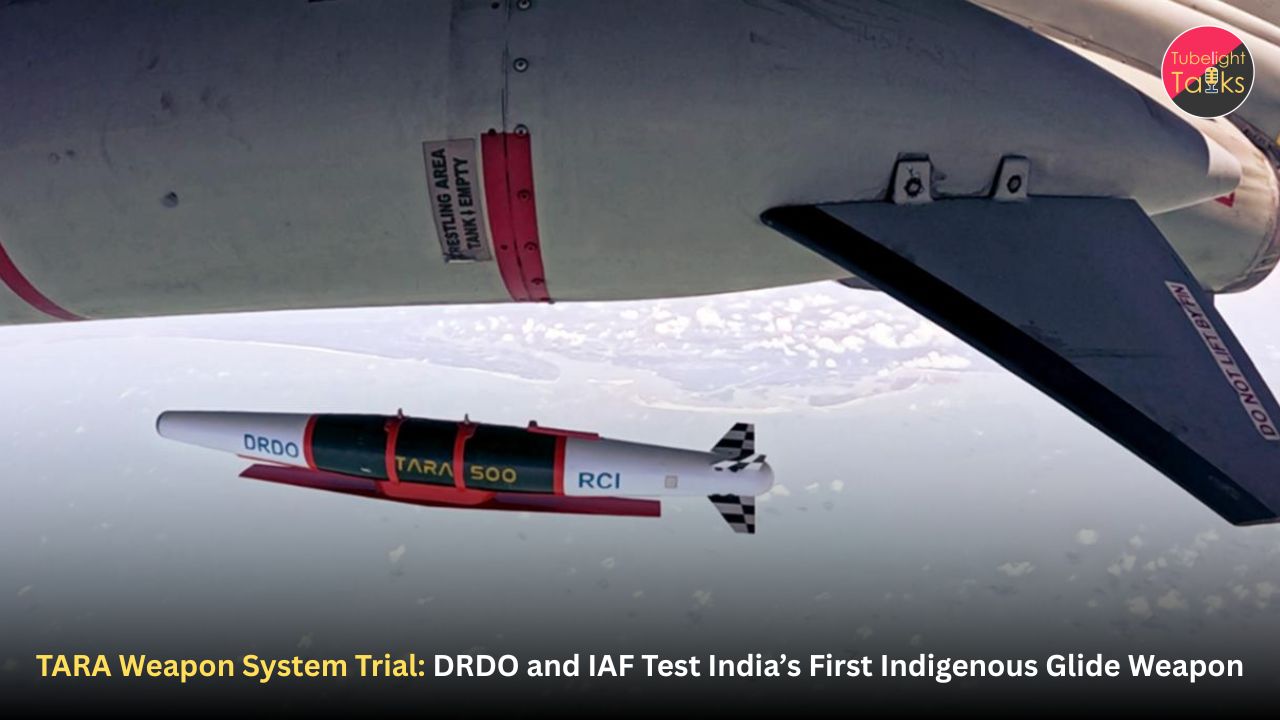
TARA Weapon System Trial: India Successfully Conducts Maiden Flight Trial of Indigenous Glide Weapon
India has successfully conducted the maiden flight trial of the indigenous Tactical Advanced Range Augmentation weapon system, known as TARA, off the coast of Odisha. The test was carried out on May 7, 2026, by the Defence Research and Development Organisation and the Indian Air Force. TARA is India’s first indigenous glide weapon system and has been designed as a modular range-extension kit that can convert unguided warheads into precision-guided weapons.
The Ministry of Defence described the successful trial as a significant step in advancing India’s indigenous defence capabilities. Defence Minister Rajnath Singh congratulated DRDO, IAF, DcPP and industry partners involved in the project, while DRDO Chairman Dr Samir V Kamat also praised the teams associated with the trial.
TARA Weapon System Trial: What India Tested
Maiden Flight Trial off Odisha Coast
The maiden flight trial of TARA was conducted off the coast of Odisha on May 7, 2026. According to the Ministry of Defence, the trial was successfully completed by DRDO and the Indian Air Force, making it a major milestone for India’s precision-strike technology programme.
Odisha’s coast has long been associated with India’s missile and defence testing ecosystem. Testing a new glide weapon system from this region gives DRDO and IAF access to controlled range conditions, tracking systems and established safety protocols. The successful trial indicates that the system has moved from design and development into flight validation.
For India’s defence planners, this is not merely a single test. It is a signal that indigenous design teams are now working on systems that can improve the capability of existing air-delivered weapons without depending entirely on expensive imported platforms.
India’s First Indigenous Glide Weapon System
TARA is described by the Ministry of Defence as India’s first indigenous glide weapon system. It is a modular range-extension kit designed to convert unguided warheads into precision-guided weapons.
This is important because many air forces around the world have large inventories of conventional unguided bombs or warheads. These weapons may be powerful, but they lack the accuracy and stand-off range required in modern combat. A glide kit can help improve utility by adding precision and range, allowing the launching aircraft to release the weapon from a safer distance.
In simple terms, TARA represents a smarter way to use existing weapons. Instead of replacing every conventional warhead with an expensive new weapon, a modular kit can improve accuracy and effectiveness at lower cost.
Why TARA Matters for India’s Defence Preparedness
Precision at Lower Cost
Modern air warfare increasingly depends on precision. The aim is not only to hit a target, but to hit it accurately while reducing unnecessary collateral damage and protecting pilots. Precision-guided weapons help aircraft strike ground-based targets with greater accuracy compared with older unguided systems.
TARA is significant because it is being developed as a cost-effective system. The New Indian Express reported that the system has been designed and developed by Research Centre Imarat, Hyderabad, along with other DRDO laboratories, to enhance the lethality and accuracy of low-cost weapons for neutralising ground-based targets.
This cost factor matters for India. High-end precision weapons can be expensive, and large-scale inventories require affordability. If India can produce indigenous glide kits at scale, the Air Force can improve its precision-strike options without unsustainable costs.
Safer Stand-Off Capability
A glide weapon system can extend the range of a warhead after release. This means aircraft may not need to fly as close to heavily defended targets. In modern warfare, air-defence systems, radar networks and missile batteries can create serious risk for pilots and aircraft. Stand-off weapons reduce that exposure.
TARA therefore strengthens tactical flexibility. It can allow the Indian Air Force to engage selected targets while keeping aircraft farther from hostile air-defence zones. This is one of the key reasons many militaries invest in glide kits and precision-guided munitions.
Indigenous Defence Technology and Aatmanirbhar Bharat
DRDO-IAF Collaboration
The TARA trial reflects the importance of cooperation between developers and users. DRDO builds technology, but the Indian Air Force must validate whether the system meets operational needs. A successful maiden flight trial therefore suggests useful coordination between scientists, engineers, test pilots, range teams and industry partners.
The Ministry of Defence specifically credited DRDO, IAF, DcPP and industry partners, showing that the programme is not limited to a single laboratory.
India’s defence ecosystem increasingly depends on this kind of collaborative structure. Research labs, armed forces, public-sector units, private industry and testing agencies must work together if India wants to reduce import dependence.
Step Toward Self-Reliance
The trial fits India’s broader Aatmanirbhar Bharat defence vision. India has been trying to develop indigenous missiles, drones, radars, electronic warfare systems, naval platforms, fighter subsystems and precision weapons. TARA adds another layer to that effort.
Self-reliance does not mean isolation from the world. It means having domestic design, production and upgrade capacity in critical defence areas. When a country can build its own precision systems, it improves readiness, reduces supply-chain vulnerability and strengthens strategic autonomy.
The importance of domestic capability has become clearer in recent years as global conflicts have disrupted supply chains, exposed ammunition shortages and increased demand for advanced weapons. Indigenous production gives India more control over timelines, customization and long-term maintenance.
What Makes Glide Weapons Important?
Turning Conventional Warheads Into Smarter Weapons
The most practical value of TARA lies in conversion. The system is designed to convert unguided warheads into precision-guided weapons. This can help upgrade existing stockpiles, making older munitions more relevant in modern scenarios.
Unguided bombs depend heavily on aircraft positioning, release conditions and pilot skill. Precision-guided weapons can correct their path and improve target accuracy. A glide kit adds aerodynamic and guidance capability, helping the weapon travel farther and more accurately after release.
Better Use of Existing Resources
Defence budgets are always limited. Armed forces must balance personnel costs, platform procurement, ammunition, infrastructure, training and modernization. A system that increases the effectiveness of existing warheads can be financially attractive.
If TARA performs well in future trials and enters production, it could help India build a larger precision-strike inventory at lower cost than buying entirely new foreign weapon systems.
Alsor Read: AI-Powered Drone ‘Kaal Bhairav’ from India Wins Silver at ARCA Innovation Awards 2025
Strategic Significance for the Indian Air Force
Expanding Strike Options
For the Indian Air Force, TARA can expand the range of available strike options. Different missions require different weapons. Some targets may demand long-range cruise missiles. Others may require air-launched precision bombs. Some may need low-cost strike solutions. TARA could fit into this middle space.
A modular glide system gives planners flexibility. It may be used where precision is required but where using a more expensive missile may not be necessary. Such flexibility is valuable in both conflict and deterrence planning.
Improving Deterrence
Defence technology also has psychological and strategic value. When adversaries know that India has growing precision-strike capability, deterrence improves. Deterrence does not mean seeking war; it means preventing aggression by showing that hostile actions will carry costs.
A country with reliable precision weapons can respond more accurately and proportionately if required. That matters in a region where threats can include terrorism, border tensions, hostile infrastructure and military escalation.
Industry Role and Future Production
Industry Partnership Is Crucial
The Ministry of Defence’s acknowledgement of industry partners shows that private and public industry participation is part of the programme. This is important because prototypes alone do not create capability. Capability comes when systems can be produced, tested, maintained and upgraded at scale.
Indian industry will likely play a role in manufacturing components, integration, quality assurance and future improvements. If the programme matures, it may create opportunities for domestic defence firms working in electronics, guidance systems, aerostructures, software, materials and assembly.
More Trials Likely Ahead
A maiden flight trial is a major milestone, but weapon systems usually require multiple tests before full operational induction. Future trials may validate accuracy, range, reliability, platform compatibility, guidance performance and performance under different release conditions.
The successful first test should therefore be seen as the beginning of a development-to-induction pathway, not the final endpoint.
Responsible Defence and National Security
Strength Must Be Guided by Restraint
Precision weapons are meant to improve military capability, but responsible nations must ensure that defence technology is guided by law, discipline and restraint. India’s stated defence posture has often emphasized deterrence and national security rather than aggression. Systems like TARA should be understood in that framework.
A strong defence capability helps protect sovereignty, but power without ethical control can become dangerous. Modern technology must serve national protection, not reckless escalation.
Precision Can Reduce Unnecessary Harm
One important argument for precision weapons is that they can reduce unintended damage compared with less accurate systems, if used responsibly and lawfully. Better accuracy allows military planners to focus on legitimate targets while reducing risk to civilians and infrastructure.
However, this depends on intelligence, rules of engagement, training and command responsibility. Technology alone cannot guarantee ethical outcomes. Human decision-making remains central.
Defence Technology and the SatGyaan Message
The TARA weapon trial shows India’s growing technological strength, but every advancement in defence must also remind society that power should be used for protection, not arrogance or destruction. JagatguruRampalJi.org explains that Sant Rampal Ji Maharaj’s objectives include establishing peace and brotherhood in society, removing social evils such as corruption, gambling, cheating, casteism, intoxication and dowry, and promoting moral values, honesty, non-violence and devotion.
This SatGyaan is directly relevant to defence development: a nation may need strong systems to protect innocent citizens, but real peace cannot come from weapons alone. It comes when human conduct becomes truthful, disciplined and free from ego. Sant Rampal Ji Maharaj’s teachings guide humanity toward a society where strength is controlled by righteousness and where violence, hatred and greed are removed from the heart.
In that light, indigenous defence capability should inspire responsibility, self-reliance and restraint, while true spiritual knowledge should guide people toward lasting peace through devotion to Supreme God Kabir.
FAQs on TARA Weapon System Trial
1. What is TARA?
TARA stands for Tactical Advanced Range Augmentation. It is India’s first indigenous glide weapon system designed as a modular range-extension kit.
2. Who conducted the TARA flight trial?
The maiden flight trial was conducted by the Defence Research and Development Organisation and the Indian Air Force.
3. When was the TARA trial conducted?
The trial was conducted on May 7, 2026, off the coast of Odisha.
4. What does TARA do?
TARA is designed to convert unguided warheads into precision-guided weapons, improving accuracy and operational usefulness.
5. Why is TARA important for India?
It strengthens India’s indigenous defence capability, supports self-reliance, improves precision-strike options and can potentially upgrade existing warheads at lower cost.
6. Which DRDO lab developed TARA?
Reports say the system was designed and developed by Research Centre Imarat, Hyderabad, along with other DRDO laboratories and industry partners.
Related Stories










Discussion (0)