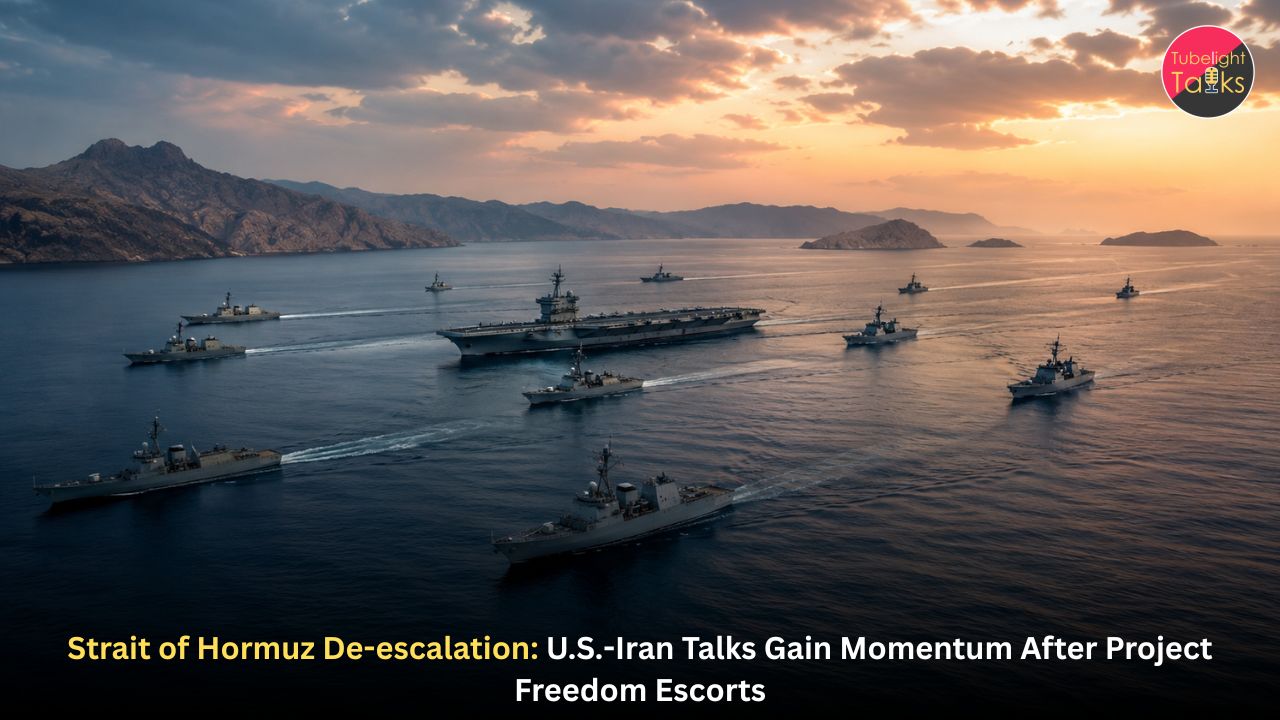
Strait of Hormuz De-escalation: U.S. and Iran Eye Diplomatic Opening After Project Freedom Escorts
The Strait of Hormuz crisis is entering a delicate diplomatic phase as the United States and Iran appear to be testing whether limited maritime progress can be turned into broader de-escalation. U.S. Central Command earlier confirmed that two U.S.-flagged merchant vessels successfully transited the Strait of Hormuz as part of Project Freedom’s opening phase, while Reuters reported that a Qatar-linked LNG tanker approved by Iran was moving toward the strait as a confidence-building gesture involving Qatar and Pakistan.
No formal U.S.-Iran summit date has been publicly confirmed, but diplomatic sources and regional activity suggest high-level talks are being explored to prevent renewed military escalation, restore shipping confidence and protect global energy flows. The situation remains fragile because Iran has not yet formally accepted Washington’s latest proposal.
Strait of Hormuz De-escalation: What Is Happening Now?
Merchant Vessel Transits Create a Small Opening
The first major sign of practical de-escalation came when U.S. Central Command said two U.S.-flagged merchant vessels had successfully transited the Strait of Hormuz and were safely continuing their journeys. This was presented as an early step under Project Freedom, the U.S.-supported mission to restore freedom of navigation for commercial shipping through one of the world’s most important energy corridors.
This matters because the Hormuz crisis has not been only a military standoff. It has trapped shipping, frightened insurers, disrupted energy markets and raised costs for import-dependent economies. Even one successful transit does not normalize the route, but it proves that limited movement is possible under heavy monitoring and escort arrangements.
For shipping companies, repeated safe passage will be more important than speeches. Shipowners and insurers need evidence that vessels can move without attack, seizure, missile threat or sudden escalation. If more vessels pass safely, commercial confidence may slowly return.
Qatari LNG Tanker Becomes a Confidence Test
Reuters reported that a Qatari LNG tanker approved by Iran was heading toward the Strait of Hormuz in what appeared to be a confidence-building gesture involving Qatar and Pakistan. The move came while U.S. Secretary of State Marco Rubio was engaging Qatari officials on Middle East stability and while Washington continued seeking a formal Iranian response to its latest proposal.
This tanker movement is symbolically important. Qatar is a major LNG exporter, and energy shipments through the Gulf are vital for global markets. If Iran permits such movement and the U.S. does not interfere, both sides can quietly test a limited maritime understanding without formally announcing a major deal.
Such gestures are often how de-escalation begins. Before leaders sit at a table, military and maritime actors test whether both sides can avoid incidents.
Is a U.S.-Iran Summit Confirmed?
Talks Are Being Explored, But No Formal Date Yet
The strongest reading of the current situation is that a high-level U.S.-Iran diplomatic track is being explored, but a formal summit next week has not been publicly confirmed by either government. Reuters reported that Washington was still waiting for Iran’s response to the latest U.S. proposal, while tensions remained unresolved despite relative calm near the strait.
This distinction is important. Diplomatic sources may discuss a summit, but until both governments confirm time, place and agenda, it should be treated as a possibility, not a settled event.
The likely purpose of any high-level contact would be limited at first: reopening maritime traffic, reducing direct military clashes, clarifying blockade rules, and preventing attacks on commercial vessels. Broader issues such as sanctions, Iran’s nuclear programme and regional militias would likely be harder and slower to resolve.
Why Both Sides Need a Diplomatic Exit
The Guardian reported that neither Washington nor Tehran can sustain the Hormuz standoff indefinitely. The U.S. faces pressure from oil prices, domestic politics and stretched naval commitments, while Iran faces blockade pressure, economic damage and risk of wider regional isolation.
This creates a strange but real diplomatic opportunity. Both sides may still speak aggressively in public, but both also have reasons to reduce tension. The U.S. wants shipping restored without appearing weak. Iran wants economic breathing space without appearing to surrender. A limited summit or backchannel deal could give both sides a face-saving path.
Project Freedom: From Military Escort to Diplomatic Lever
What Project Freedom Was Designed to Do
Project Freedom was launched to restore commercial shipping through the Strait of Hormuz. CENTCOM said U.S. forces began supporting the mission on May 4 to restore freedom of navigation for commercial vessels.
The mission has had a complicated start. Earlier reports described U.S. pauses and tactical changes after diplomatic pressure and operational concerns. President Trump temporarily paused the escort effort, citing progress toward a deal, while later hinting that a stronger “Project Freedom Plus” could return if Iran did not move toward agreement.
This shows how the operation has become both military and diplomatic. Escorts protect ships, but the threat of renewed escorts also pressures Iran. At the same time, pausing or limiting escorts can encourage Iran to consider talks.
Merchant Escorts Are Not a Final Solution
Military escorts can move some ships, but they cannot create full stability by themselves. The Strait of Hormuz is narrow, heavily watched and vulnerable to drones, missiles, mines, fast boats and miscalculation. Even if U.S. and allied naval forces protect selected vessels, the broader shipping industry will remain cautious until there is a political understanding.
The long-term solution cannot be only warships around tankers. It must include rules of passage, no-attack commitments, regional assurances, communication channels and some mechanism for managing disputes.
Also Read: Project Freedom Paused: Strait of Hormuz Crisis Moves Toward Diplomatic Settlement
Regional Diplomacy: Qatar, Pakistan and Gulf States
Qatar’s Role
Qatar’s involvement is important because it has energy interests, diplomatic channels and credibility with multiple sides. A Qatari tanker movement through the strait can serve as a practical test of whether commercial energy transit can resume under limited understandings.
Qatar also has strong reasons to prevent escalation. LNG exports are central to its economy, and Gulf instability affects shipping, insurance and long-term customer confidence.
Pakistan’s Mediation Track
Pakistan has been mentioned repeatedly as part of the mediation effort. Its role matters because it can communicate with Iran while also engaging Washington and Gulf partners. In crises where direct U.S.-Iran trust is weak, intermediaries can carry messages, clarify red lines and prevent miscalculation.
Pakistan’s involvement may also help frame a deal that allows Iran to say it listened to regional partners rather than yielding directly to U.S. pressure.
Gulf States Want Stability
Gulf states want shipping restored but fear being pulled into a wider war. They rely on maritime trade, energy exports, ports, desalination infrastructure and foreign investment. A conflict in Hormuz could damage all of these.
This is why regional partners are likely pushing both Washington and Tehran toward restraint. Even countries aligned with the U.S. do not want open-ended escalation at their doorstep.
Why Hormuz Matters to the World
Energy Security
The Strait of Hormuz is a global energy lifeline. Oil and LNG flows from the Gulf influence prices worldwide. If the strait becomes unsafe, fuel prices can rise, inflation can worsen and shipping costs can climb.
The current crisis has shown how quickly maritime conflict can affect ordinary consumers. A missile exchange near the Gulf may eventually appear in fuel bills, transport costs, food prices and industrial expenses.
Shipping Insurance and Commercial Confidence
Shipping companies do not respond only to government statements. They respond to risk. If insurers classify the waterway as extremely dangerous, premiums rise sharply or coverage becomes unavailable. That can stop vessels even if military escorts are offered.
This is why safe transit records matter. Each successful passage builds confidence. Each attack destroys it.
The Remaining Risks
Iran Has Not Accepted the Proposal
The biggest uncertainty is Iran’s formal response. Reuters reported that the U.S. and Iran were still not close to ending the conflict as of May 9, even as diplomatic activity continued.
If Iran delays or rejects the proposal, the U.S. may revive stronger escort operations or tighten blockade pressure. If the U.S. expands military action, Iran may respond with drones, missiles or fast-boat harassment. The diplomatic window could close quickly.
Allied Naval Involvement Could Help or Complicate
The UK’s HMS Dragon is reportedly joining a U.S.-led freedom-of-navigation mission, while France has also called for safe passage and an end to blockades. Wider allied participation could reassure shipping companies, but it could also make Iran feel more encircled.
Multinational involvement must therefore be carefully framed. If presented as protection of neutral commercial shipping, it may help de-escalation. If seen as a military coalition against Iran, it may harden Tehran’s position.
One Incident Can Reverse Progress
The most dangerous part of maritime crises is miscalculation. A drone flying too close, a warning shot misunderstood, a tanker hit by fragments, or a fast boat approaching aggressively can restart escalation. The current calm remains tactical, not permanent.
What a Possible Summit Could Address
Safe Passage Rules
The first priority would likely be safe passage for commercial vessels. Both sides may need to agree that merchant ships, especially neutral and humanitarian cargo, will not be targeted or delayed.
Blockade and Port Access
The U.S. blockade of Iranian ports remains a major issue. Iran will likely seek relief or a phased easing in exchange for maritime guarantees. The U.S. may demand verified non-interference with shipping first.
Nuclear and Sanctions Questions
The nuclear issue may be postponed or handled separately because it is more complex. Al Jazeera reported earlier that the U.S. pause suggested a limited framework approach: settle Hormuz first, nuclear later.
This staged approach may be the only realistic path. If negotiators try to solve everything at once, talks may collapse.
Regional Guarantees
Gulf states, Qatar, Pakistan and possibly China may need to support or witness any framework. China’s interest matters because it is a major energy importer and has ties with Iran. Regional buy-in would make a deal more credible.
India’s Stake in Hormuz De-escalation
Energy Imports and Inflation
India has a direct interest in Hormuz stability. Gulf energy flows affect fuel prices, fertilizer costs, shipping routes and inflation. Any sustained disruption can affect Indian households, transporters, farmers and industries.
Maritime Security
India also depends on safe sea lanes. If Hormuz remains unstable, Indian shipping, sailors and energy companies face higher risk. De-escalation therefore supports India’s economic and strategic interests.
A Fragile Moment of Opportunity
The current situation is not peace yet. It is a pause, a test and a narrow diplomatic opening. Merchant vessels have moved. Qatar and Pakistan are active. The U.S. is waiting for Iran’s answer. Allied ships are preparing to support navigation. Energy markets are watching. Regional governments are urging restraint.
If both sides treat this moment responsibly, the Strait of Hormuz could move from crisis toward controlled reopening. If either side uses the pause to prepare escalation, the world may again face a dangerous energy and security shock.
Sea Lanes, Restraint and the Higher Need for Peace
The Strait of Hormuz crisis shows that the world’s prosperity can be shaken when pride, suspicion and military pressure dominate human decisions. A narrow waterway becomes a test of global patience because nations forget that ordinary people—sailors, workers, families and consumers—pay the price of conflict. In this context, the teachings of Sant Rampal Ji Maharaj and SatGyan become deeply relevant.
His message of truth, brotherhood, non-violence, honesty and devotion to Supreme God Kabir reminds society that lasting peace cannot be built only through naval escorts, sanctions or strategic bargaining. Those may manage a crisis, but they cannot remove hatred from human hearts. When leaders act with humility and fairness, dialogue becomes possible; when ego rules, even commercial ships become targets of power politics.
The lesson flowing from this crisis is simple: security must be joined with compassion, and diplomacy must be guided by truth, because real peace begins inside human conduct before it appears in international agreements.
FAQs on Strait of Hormuz De-escalation
1. What is the latest development in the Strait of Hormuz crisis?
The crisis is showing cautious signs of de-escalation after successful merchant vessel movements under Project Freedom escorts and new regional diplomatic activity involving Qatar and Pakistan.
2. Has a U.S.-Iran summit been confirmed?
No formal summit date has been publicly confirmed. However, diplomatic activity suggests that high-level talks are being explored to reduce tensions and restore safe shipping.
3. What is Project Freedom?
Project Freedom is a U.S.-supported mission launched to restore commercial shipping and freedom of navigation through the Strait of Hormuz.
4. Did merchant vessels successfully transit Hormuz?
Yes. U.S. Central Command said two U.S.-flagged merchant vessels successfully transited the Strait of Hormuz and continued safely on their journeys.
5. Why is Qatar involved?
Qatar is a major LNG exporter and has diplomatic channels in the region. A Qatar-linked tanker movement through Hormuz is being viewed as a confidence-building test.
6. Why does the Strait of Hormuz matter globally?
It is one of the world’s most important energy corridors. Disruption there can affect oil prices, LNG supply, shipping insurance, inflation and global economic stability.
Related Stories




Discussion (0)