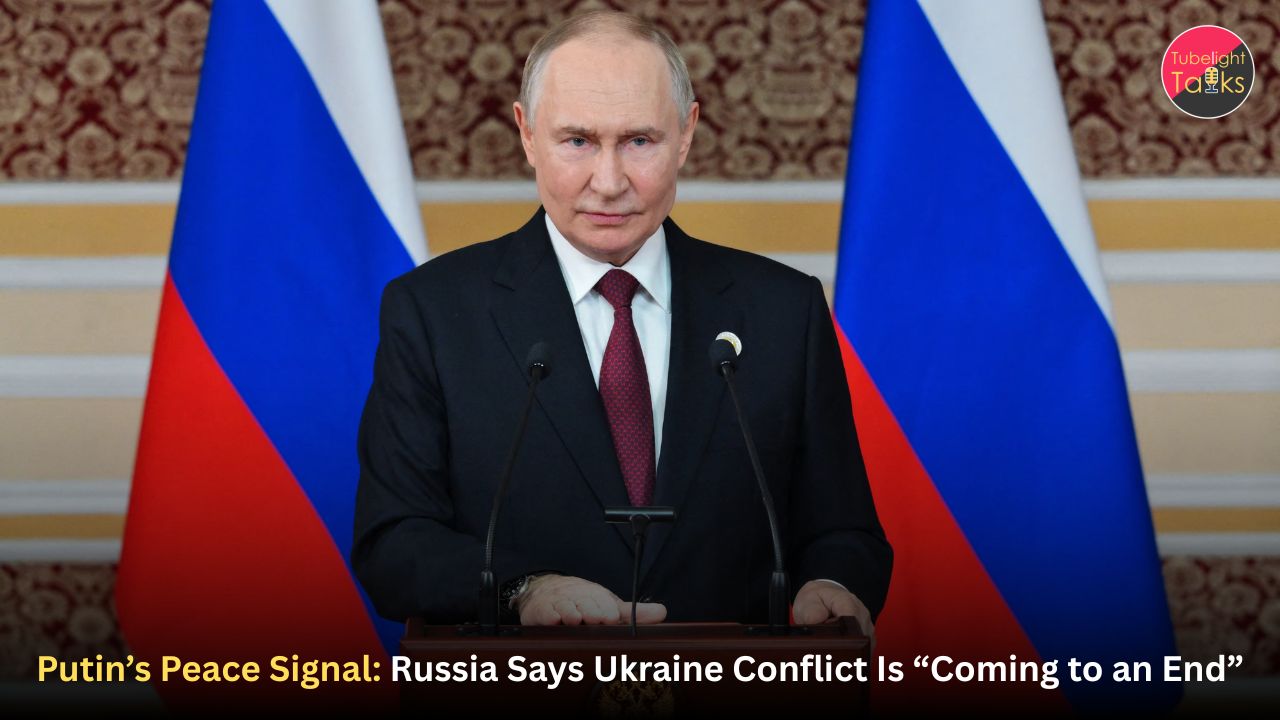
Putin’s Peace Signal: Vladimir Putin Says Ukraine Conflict Is “Coming to an End” Amid Diplomatic Push
Russian President Vladimir Putin has said he believes the Ukraine conflict is “coming to an end,” offering one of Moscow’s strongest public signals yet that the war may be entering a diplomatic phase. Putin made the remarks on Saturday after Russia’s scaled-back Victory Day parade in Moscow, saying he was grateful to the United States for facilitating talks while stressing that the conflict ultimately concerns Russia and Ukraine.
His comments came as a U.S.-brokered three-day ceasefire from May 9 to May 11 took effect, with both sides also confirming a proposed exchange of 1,000 prisoners each. The statement has raised cautious hope, but Kyiv and European leaders remain skeptical because previous ceasefires have collapsed and Russia has not abandoned its core war aims.
Putin’s Peace Signal: What Did He Say?
“The Matter Is Coming to an End”
Putin told reporters in the Kremlin that he believes the Russia-Ukraine war is nearing its conclusion. Reuters quoted him saying, “I think that the matter is coming to an end,” after Russia held its most scaled-back Victory Day parade in years. The statement was notable because Putin has repeatedly insisted that Russia will continue fighting until its objectives are achieved, making this softer language diplomatically significant.
His comments came after he blamed Western policy, NATO expansion and Ukraine’s European alignment for the war. That means the peace signal should not be interpreted as a full concession. Putin is still presenting Russia’s position as justified and still demanding recognition of Moscow’s security concerns. But even within that hard framing, the phrase “coming to an end” marks a shift in tone.
The timing also matters. Putin spoke during Victory Day events, one of Russia’s most symbolic national occasions. The parade was reportedly reduced, with no usual display of intercontinental ballistic missiles, tanks and missile systems across Red Square. Instead, Russia used large screens showing military hardware in action. The scaled-down display reflected the pressure and anxiety around the war, even as Moscow tried to project resilience.
Thanks to the United States
Putin also thanked the United States for facilitating talks. According to Times of India, he said Russia was grateful to the U.S. for helping talks move forward, while stressing that the final issue concerns Russia and Ukraine. This wording is diplomatically important because it recognizes Washington’s role without allowing the U.S. to fully own the process.
For Moscow, accepting U.S. mediation can help open a channel without appearing to negotiate under European pressure. Putin also indicated that if Russia were to discuss wider European security arrangements, his preferred negotiating partner would be former German Chancellor Gerhard Schroeder. That detail suggests Moscow may be looking for familiar or sympathetic intermediaries rather than current European leaders who have strongly backed Ukraine.
Ceasefire and Prisoner Swap: The Humanitarian Opening
Three-Day Pause From May 9 to May 11
The latest peace signal comes during a three-day ceasefire announced by U.S. President Donald Trump. The ceasefire runs from May 9 to May 11 and includes suspension of all “kinetic activity” between Russia and Ukraine. The Guardian reported that both Russia and Ukraine confirmed the truce.
The pause coincides with Russia’s Victory Day, but it also includes one of the most important humanitarian components of the war so far: a proposed prisoner exchange involving 1,000 prisoners from each side. If implemented fully, this would become one of the largest prisoner swaps since the invasion began in 2022.
Ceasefires during this war have often been fragile. Both Moscow and Kyiv have accused each other of violating past pauses. That is why even a three-day truce must be measured carefully. The absence of large reported violations would build confidence, while even one major strike could damage the process.
Also Read: Russia-Ukraine 3-Day Ceasefire: Trump Announces 72-Hour Pause and Major Prisoner Swap Starting Today
1,000-for-1,000 Prisoner Exchange
The prisoner exchange may be the most emotionally important part of the diplomatic opening. Families on both sides have waited months or years for news of missing or captured loved ones. A 1,000-for-1,000 exchange would bring relief to thousands of families and could create limited trust for future negotiations.
Zelenskyy confirmed the U.S.-announced ceasefire and prisoner-swap format, saying Ukraine had received Russia’s agreement to conduct the exchange. He also thanked the U.S. for diplomatic involvement and said Ukraine expects Washington to ensure Russia fulfills the agreements.
Putin and his aides have also discussed the prisoner lists. Times of India reported that Moscow was awaiting Ukraine’s response and that Russian and Ukrainian agencies were working on lists. The practical details matter: prisoner exchanges require identity verification, medical checks, safe transport, coordination points and communication channels.
Why Putin’s Statement Matters
A Rare Public Softening
Putin’s comments do not mean the war is over. They do not mean Russia has withdrawn forces or accepted Ukraine’s demands. But they do represent a rare public softening at a moment when diplomacy is active.
In war, language matters. When leaders say victory is near, they prepare citizens for continued sacrifice. When they say a conflict is nearing an end, they may be preparing citizens for negotiation, compromise or a transition from battlefield escalation to political bargaining.
This does not guarantee sincerity. It may also be tactical. Russia may want to reduce pressure, influence Trump’s diplomacy, divide Western allies or improve its negotiating position. But even tactical language can create diplomatic space if other actors use it carefully.
Moscow Wants Security Talks
Putin said he would be willing to negotiate new security arrangements for Europe. This is a major point because Russia has long argued that the war is connected to the broader European security architecture, NATO expansion and Ukraine’s geopolitical orientation.
Ukraine and its allies reject Moscow’s framing as justification for invasion. They argue that Russia attacked a sovereign state and must not be rewarded for aggression. This disagreement remains one of the biggest obstacles to peace. Russia wants security guarantees that limit Western influence near its borders. Ukraine wants guarantees that Russia cannot invade again.
Any serious peace settlement will therefore need to address both battlefield realities and long-term security arrangements.
Kyiv’s Likely Response
Cautious Hope, Deep Distrust
Ukraine is unlikely to treat Putin’s remarks as a breakthrough by themselves. Kyiv has seen previous Russian statements followed by renewed attacks. Ukrainian leaders will judge Moscow by action: whether the ceasefire holds, whether prisoners are exchanged, whether missile strikes stop, and whether Russia enters serious negotiations.
For Ukraine, the war has caused immense destruction, displacement and loss. Kyiv cannot accept a settlement that simply freezes Russian gains without security guarantees. Zelenskyy has repeatedly emphasized prisoner release, civilian protection and accountability.
Demand for U.S. Guarantees
Zelenskyy’s statement thanking the U.S. while expecting Washington to ensure Russian compliance is significant. Ukraine wants American pressure to remain active. A ceasefire without enforcement could become a pause for regrouping. A ceasefire with monitoring, verification and consequences has a better chance of becoming meaningful.
This puts the Trump administration in a central role. Washington must now move from announcement to enforcement. If the ceasefire and prisoner exchange succeed, U.S. diplomacy gains credibility. If they fail, the process could collapse quickly.
European Skepticism
Leaders Wary of Putin’s Intentions
European leaders remain deeply skeptical of Putin’s intentions. Reuters noted that European leaders have continued to support Ukraine and have cast Putin as an autocratic leader who could threaten NATO members if allowed to win in Ukraine. Russia rejects those claims, but the mistrust remains severe.
Europe’s skepticism is rooted in experience. Since 2022, Russia’s invasion has caused the worst European war since World War II. Cities have been destroyed, civilians killed, infrastructure damaged and millions displaced. Europe will not accept vague peace language without concrete guarantees.
Security Architecture Debate
If Putin wants talks on European security, European governments will eventually need to decide whether to participate, refuse or allow intermediaries. The reference to Gerhard Schroeder is politically sensitive because he has long been seen as close to Moscow. Many European leaders may reject him as an acceptable channel.
Still, some form of security discussion may become unavoidable if a broader ceasefire or settlement emerges. The challenge will be ensuring that Ukraine is not sidelined and that Europe’s security is not negotiated over Kyiv’s head.
Trump’s Diplomatic Role
“Beginning of the End”
Trump described the ceasefire as a possible beginning of the end of the war. The Guardian reported that he announced the May 9–11 ceasefire and said there was progress in talks. He also said the pause would include a suspension of all kinetic activity and a 1,000-for-1,000 prisoner swap.
Trump’s role is politically important. He wants to present himself as the leader who can stop a war that has drained Western resources and caused massive human loss. If the ceasefire works, he can claim a major diplomatic success. But if he pushes too quickly toward settlement, Ukraine and European allies may fear that their interests are being compromised.
Pressure to Extend the Ceasefire
Reuters reported that Trump said he would like to see a major extension of the ceasefire. That will be the next test. A three-day pause is meaningful, but a longer ceasefire would require stronger terms, monitoring and clearer political commitments.
Russia may agree to talks but resist terms that weaken its battlefield position. Ukraine may accept humanitarian pauses but reject any deal that legitimizes occupation. The gap remains large.
Also Read: Victory Day Tensions: Zelensky Warns International Allies Against Attending Russia’s May 9 Parade
What Could Happen Next?
Scenario 1: Prisoner Swap Succeeds
If the 1,000-for-1,000 exchange goes ahead smoothly, it could build momentum for additional humanitarian agreements. Future steps might include return of wounded prisoners, civilian detainee releases, child-return mechanisms, or limited safe zones.
Scenario 2: Ceasefire Extended
If the three-day pause holds, Washington may push both sides toward a longer truce. That would require written terms, monitoring arrangements and consequences for violations.
Scenario 3: Talks Stall Again
The risk remains that both sides use the ceasefire for optics while preparing for renewed fighting. If prisoner lists become disputed or frontline incidents occur, the process could break down.
Scenario 4: Broader Security Talks Begin
If Putin’s statement is part of a real shift, discussions may expand toward European security, sanctions, territorial issues and Ukraine’s future guarantees. This would be the most complex but potentially transformative path.
Why This Moment Is Still Fragile
War Aims Remain Unresolved
Russia still controls significant Ukrainian territory and has not abandoned its stated objectives. Ukraine still demands sovereignty, territorial integrity and security guarantees. These positions remain far apart.
A war does not end simply because leaders say it is ending. It ends when military action stops, prisoners return, agreements are signed, borders or security lines are accepted, and civilians can rebuild their lives.
Human Cost Demands Urgency
Reuters described the war as Europe’s deadliest conflict since World War II, with hundreds of thousands killed and large parts of Ukraine damaged. That human cost gives urgency to every diplomatic opening.
Even if the current signal is imperfect, diplomacy must be tested because the alternative is continued death.
War, Peace and the SatGyaan Message
Putin’s peace signal reminds the world that even the most destructive conflicts must eventually face the truth that violence cannot bring lasting peace. JagatguruRampalJi.org explains that Sant Rampal Ji Maharaj’s True Spiritual Knowledge teaches peace, brotherhood, moral discipline and devotion to Supreme God Kabir, while guiding people away from violence, corruption, intoxication, hatred, greed and ego.
This SatGyaan is directly relevant to the Russia-Ukraine war because wars are not born only on battlefields; they begin in human hearts when pride, domination and distrust overpower compassion. A ceasefire can stop bullets for three days, but true peace needs inner transformation, honesty and righteous conduct. Sant Rampal Ji Maharaj’s teachings remind humanity that all souls belong to one Supreme Father, so killing, hatred and revenge only deepen suffering.
Leaders may negotiate documents, but lasting peace will come only when nations and individuals reject ego and follow the path of truth, humility and devotion.
FAQs on Putin’s Peace Signal
1. What did Vladimir Putin say about the Ukraine war?
Putin said he believes the Ukraine war is “coming to an end,” describing it as a conflict that may now be moving toward a concluding phase.
2. When did Putin make the statement?
He made the remarks on Saturday, May 9, 2026, after Russia’s scaled-back Victory Day parade in Moscow.
3. Did Putin thank the United States?
Yes. Putin thanked the United States for facilitating talks, while stressing that the final issue concerns Russia and Ukraine.
4. What ceasefire is currently in place?
A U.S.-brokered three-day ceasefire from May 9 to May 11 has been confirmed by both Russia and Ukraine.
5. What is the prisoner-swap proposal?
The ceasefire includes a proposed exchange of 1,000 prisoners from each side, making it one of the largest humanitarian steps in the war if implemented fully.
6. Does Putin’s statement mean the war is over?
No. The statement is a significant peace signal, but the war will only truly move toward conclusion if the ceasefire holds, prisoners are exchanged, negotiations continue and core disputes are addressed.
Related Stories





Discussion (0)