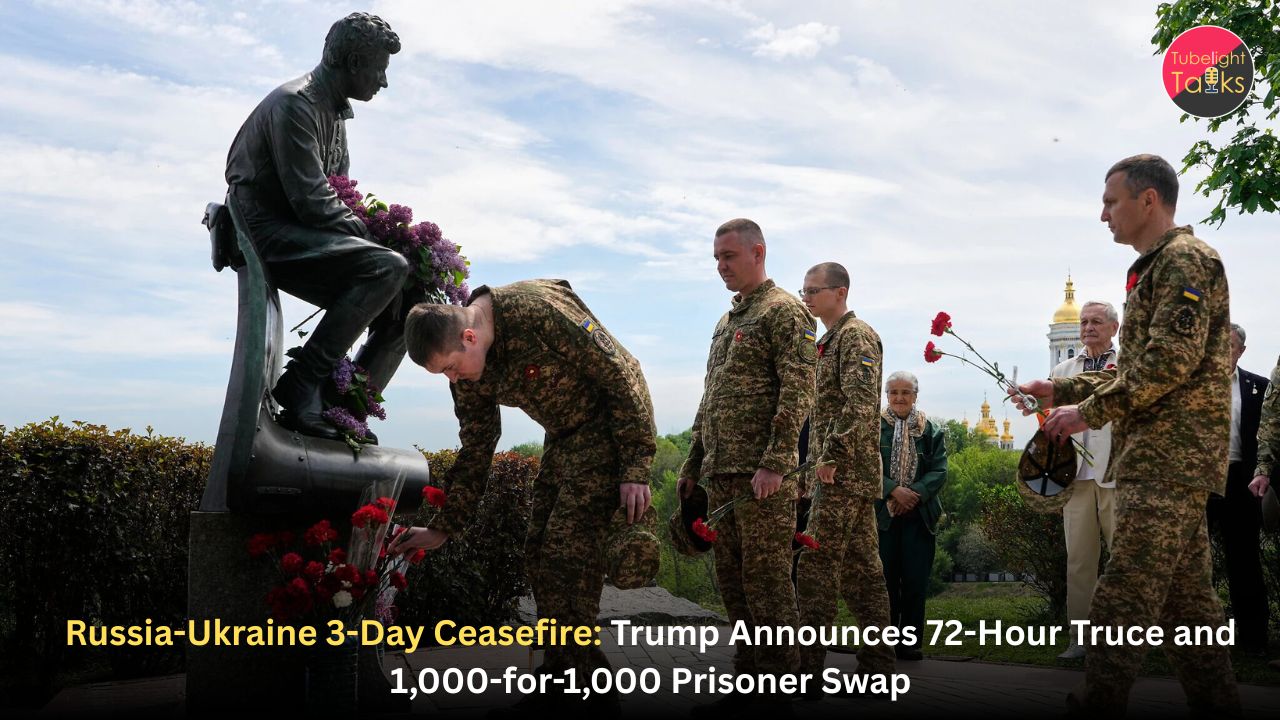
Russia-Ukraine 3-Day Ceasefire: Trump Announces 72-Hour Pause and Major Prisoner Swap Starting Today
President Donald Trump has announced that Russia and Ukraine have agreed to a 72-hour ceasefire beginning May 9 and lasting through May 11, in what could become one of the most important humanitarian pauses of the four-year war. The agreement includes a suspension of kinetic military activity and a mutual prisoner exchange involving 1,000 prisoners from each side. Ukrainian President Volodymyr Zelenskyy confirmed the arrangement and emphasized the humanitarian importance of bringing captives home.
The Kremlin also acknowledged the truce through senior officials. The ceasefire coincides with Russia’s Victory Day commemorations, giving the pause heavy symbolic importance. Yet the agreement remains fragile because both countries have repeatedly accused each other of violating earlier truces.
Trump Announces 72-Hour Russia-Ukraine Ceasefire
A Short Pause With Large Diplomatic Meaning
The ceasefire is scheduled to run from May 9 to May 11. According to major international reports, Trump announced the agreement after U.S.-led diplomatic efforts and described it as a possible beginning of the end of the war. The deal includes a halt to military activity and a large prisoner exchange, with 1,000 prisoners to be released by each side.
Although the pause is only three days long, its importance is larger than its duration. The war has caused immense destruction, displacement, deaths and psychological suffering since Russia’s full-scale invasion of Ukraine in February 2022. Even a temporary reduction in fighting can allow families to reunite, medics to work more safely, damaged infrastructure to be assessed and diplomats to test whether a broader pathway exists.
Trump has framed the deal as proof that negotiation can still work. For Washington, the agreement offers a diplomatic achievement at a time when global conflicts in Europe and the Middle East are creating heavy pressure on U.S. foreign policy.
Ceasefire Linked to Victory Day
The timing of the truce is sensitive. May 9 is Russia’s Victory Day, marking the Soviet victory over Nazi Germany in World War II. The Kremlin had already announced its own short truce around the commemorations, but Ukraine had earlier pushed for a wider and more meaningful ceasefire.
This context makes the 72-hour agreement both hopeful and fragile. Russia wants its most symbolic national day to pass without major disruption. Ukraine wants any pause to deliver real humanitarian results, especially the return of prisoners. The United States appears to have used this overlapping interest to push both sides into accepting a broader temporary halt.
Also Read: Victory Day Tensions: Zelensky Warns International Allies Against Attending Russia’s May 9 Parade
Prisoner Swap: The Most Human Part of the Deal
1,000 Prisoners From Each Side
The prisoner exchange is the most emotionally powerful part of the agreement. A 1,000-for-1,000 swap would be one of the largest exchanges of the war. For families waiting months or years for missing sons, husbands, brothers and daughters, the announcement represents real hope.
Prisoner exchanges matter because they cut through political speeches and battlefield maps. Behind every prisoner is a family living with uncertainty. Some captives may be wounded, sick, traumatized or held in harsh conditions. Their return can provide relief not only to individuals but to entire communities.
Ukraine has repeatedly emphasized prisoner return as a major humanitarian priority. Zelenskyy’s confirmation of the deal focused strongly on this aspect, underlining that Ukraine sees the exchange as more than a diplomatic gesture.
Trust Will Be Tested
Large prisoner swaps require coordination, lists, identification, transport, medical checks, safe routes and third-party involvement. Even small mistakes can create accusations. Both sides will want to verify identities and ensure that the promised number is actually released.
If the prisoner exchange happens smoothly, it could build limited trust. If it fails, each side will likely accuse the other of bad faith, making future talks harder.
Why the Ceasefire Is Fragile
Past Truces Have Broken Quickly
The biggest reason for caution is history. Russia and Ukraine have announced or discussed several ceasefires during the war, but many were either rejected, ignored or broken quickly. Both sides have repeatedly accused each other of violating pauses through drones, artillery, missile strikes or frontline attacks.
This time is no different in terms of risk. The battlefield is broad, with many units, commanders, drones, artillery systems and intelligence operations active across several regions. A single strike could trigger claims that the ceasefire has collapsed.
No Final Peace Framework Yet
A three-day ceasefire is not a peace agreement. The core issues remain unresolved: territorial control, Donetsk, Crimea, security guarantees, NATO-related concerns, sanctions, war crimes accountability, reconstruction and the future of occupied regions.
Reuters reported that negotiations remain difficult, especially over contested territories, with both sides refusing to compromise on core claims.
This means the ceasefire is a bridge, not a destination. It can create space for dialogue, but it cannot by itself end the war.
Also Read: Victory Day Ceasefire Snub: Russia Rejects Ukraine’s May 9 Truce With Fresh Drone Strikes
Zelenskyy’s Position
Humanitarian Priority Over Symbolism
Zelenskyy confirmed the ceasefire and prisoner exchange, thanking the United States for its role. His public emphasis was humanitarian: Ukraine wants its people back. This is politically important because Kyiv does not want Russia to control the symbolism of May 9.
Ukraine has rejected Russia’s attempt to present Victory Day as moral cover for the current war. For Kyiv, the meaningful part of the pause is not Moscow’s parade but the chance to recover prisoners and reduce civilian suffering.
Demand for U.S. Guarantees
Zelenskyy has also urged the United States to help ensure Russian compliance. This reflects Ukraine’s deep distrust of Moscow. Kyiv believes Russia may use ceasefires tactically—to regroup, stage public events or control optics—rather than as genuine steps toward peace.
U.S. involvement therefore matters. If Washington monitors the process and publicly pressures both sides, the ceasefire may have a better chance of holding.
Russia’s Calculations
Protecting Victory Day
For Russia, May 9 is politically central. Moscow wants the parade and commemorations to proceed without Ukrainian disruption. A ceasefire reduces the risk of drone attacks or battlefield developments overshadowing the day.
The Kremlin can also present the truce domestically as a responsible act tied to historic remembrance. But that message will depend on whether fighting truly pauses and whether Russian forces comply across the front.
Avoiding Diplomatic Isolation
Russia may also see the agreement as a way to show that it remains open to diplomacy, especially with Trump involved. Moscow has an interest in preventing further international isolation and may use the ceasefire to argue that Ukraine and the West must negotiate more seriously.
However, Russia’s long-term demands remain hard for Ukraine to accept. That is why this temporary pause does not remove the deeper conflict.
Trump’s Diplomatic Role
A High-Profile Mediation Moment
Trump’s announcement places him at the center of the diplomatic breakthrough. AP reported that both Zelenskyy and Kremlin adviser Yuri Ushakov confirmed the agreement after Trump announced the deal.
For Trump, this is a major foreign-policy moment. He can claim that direct pressure and negotiation brought both sides to a pause. If the prisoner exchange succeeds, it strengthens his argument that U.S. diplomacy can deliver results.
Pressure to Turn Pause Into Process
The challenge for Trump is what comes next. A 72-hour ceasefire can be celebrated, but if fighting resumes immediately afterward, critics may call it symbolic. The real diplomatic test is whether the pause leads to follow-up talks, humanitarian corridors, additional prisoner exchanges or a longer ceasefire.
Humanitarian Impact
Relief for Civilians
If the truce holds, civilians near active areas may experience temporary relief from shelling, drones and missile alerts. Aid workers may be able to assess needs, repair teams may inspect damaged systems, and families may move more safely.
A 72-hour pause is short, but for civilians in frontline zones, even one quiet night can matter.
Families Waiting for Prisoners
The prisoner swap could be the most visible result. Families on both sides may gather near exchange points, hospitals or military facilities waiting for confirmation. Many will hope their loved ones are among the 1,000 names.
War often reduces people to numbers, but prisoner exchanges restore faces, names and personal stories to the center of diplomacy.
Also Read: Russia-Ukraine WWII Anniversary Ceasefires: May 8–9 Brings a Fragile Humanitarian Window
What to Watch Next
Whether Fighting Stops Completely
The first test is whether artillery, drones, missiles and ground assaults actually stop across the front. Partial violations could still occur, but repeated incidents would damage the deal.
Whether the Prisoner Swap Happens
The second test is whether both sides exchange the promised 1,000 prisoners each. Delays, disputes over lists or accusations of withholding prisoners could weaken trust.
Whether Talks Continue After May 11
The third test is what happens after the 72 hours end. If the ceasefire becomes a one-off symbolic pause, its long-term value will be limited. If it leads to new negotiations, it could become a turning point.
Peace, Prisoners and the Higher Lesson of Humanity
The Russia-Ukraine ceasefire reminds the world that even in the middle of war, compassion can open a small door. The release of prisoners is not only a diplomatic act; it is a human act that returns sons, fathers, brothers and daughters to families. The teachings of Sant Rampal Ji Maharaj and Sat Gyaan emphasize truth, humility, compassion, righteous conduct and true worship according to holy scriptures.
Sant Rampal Ji Maharaj’s teachings guide people away from violence, intoxication, corruption, dishonesty, greed, ego and hatred. In the context of this ceasefire, the message is deeply relevant. Wars begin when pride and greed dominate human conduct, but peace begins when truth and compassion are accepted. Sat Gyaan teaches that true peace cannot come from weapons alone; it must arise from righteous living and devotion to the Supreme God.
FAQs on Russia-Ukraine 3-Day Ceasefire
1. What did President Trump announce?
Trump announced that Russia and Ukraine agreed to a 72-hour ceasefire from May 9 to May 11, along with a major prisoner exchange.
2. How many prisoners will be exchanged?
The agreement includes a mutual exchange of 1,000 prisoners from each side.
3. Did Ukraine confirm the ceasefire?
Yes. Ukrainian President Volodymyr Zelenskyy confirmed the ceasefire and prisoner exchange and emphasized the humanitarian importance of prisoner release.
4. Did Russia acknowledge the deal?
Yes. Reports say Kremlin adviser Yuri Ushakov confirmed the arrangement after Trump’s announcement.
5. Why is the timing important?
The ceasefire coincides with Russia’s May 9 Victory Day commemorations, making it symbolically and politically sensitive.
6. Could this lead to lasting peace?
It could create a diplomatic opening, but a lasting peace would require resolution of major territorial, security and political disputes that remain unresolved.
Related Stories






Discussion (0)