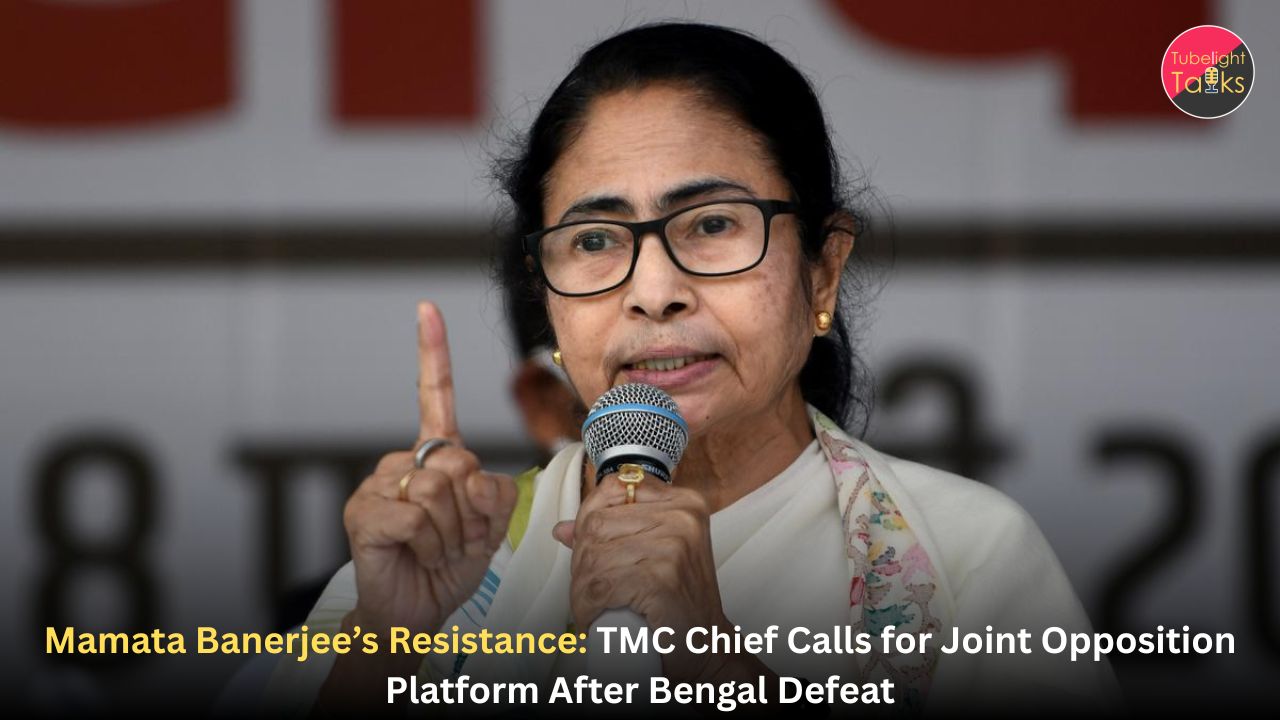
Mamata Banerjee’s Resistance: Former Bengal CM Calls for Joint Opposition Platform After Historic BJP Victory
Mamata Banerjee has shifted into political resistance mode after the Trinamool Congress lost power in West Bengal and Suvendu Adhikari took charge as the state’s first BJP Chief Minister. Banerjee has called for a united opposition platform against the BJP, urging opposition parties, student unions and civil society groups to come together in Bengal.
She continues to reject the election result politically, alleging irregularities and conspiracy, even though the constitutional transition has moved forward with dissolution of the Assembly and formation of the new government. Her latest appeal signals that the TMC’s next phase will be built around street mobilization, legal contestation, opposition coordination and an attempt to retain its political base after 15 years in power.
Mamata Banerjee’s Resistance: What Has She Said?
Call for a Joint Opposition Platform
On the day Suvendu Adhikari took oath as Chief Minister, Mamata Banerjee urged opposition forces in West Bengal to come together on a joint platform against the BJP. Reports said she appealed not only to political parties but also to student groups and other anti-BJP forces, framing the moment as a broader democratic struggle rather than only a party setback.
This appeal is politically significant. Banerjee has long positioned herself as a fighter against the BJP at both state and national levels. After losing power, she is now trying to convert defeat into mobilization. Instead of quietly retreating, she is seeking to build a new opposition front inside Bengal.
The phrase “joint platform” suggests that TMC may not rely only on party organization. It may try to bring together smaller parties, Left groups, student unions, intellectuals, civil-society organizations and local protest networks. This strategy reflects Bengal’s political culture, where street protest, ideological mobilisation and public campaigns have historically played a major role.
Refusal to Accept the Mandate Politically
Banerjee had earlier refused to accept the verdict as a true public mandate, alleging that the result was shaped by conspiracy and irregularities. Times of India reported that after the BJP’s victory, she said the question of resignation did not arise and claimed her party had not truly lost the election. Indian Express reported that she alleged large-scale irregularities in counting and claimed the mandate in nearly 100 seats was “looted.”
These are serious political allegations, but they remain allegations unless proven through legal or institutional processes. The Election Commission’s declared result has led to government formation, and the Assembly has been dissolved under constitutional procedure. NDTV reported that the Assembly was dissolved with effect from May 7, even as Banerjee continued to claim wrongdoing in the election process.
The key distinction is this: Banerjee may reject the mandate politically, but the constitutional transition has proceeded. This creates a new kind of confrontation—one between institutional finality and political refusal.
Also Read: West Bengal Second Renaissance: Suvendu Adhikari Takes Charge as First BJP Chief Minister
From Chief Minister to Opposition Figure
End of a 15-Year Rule
Mamata Banerjee’s shift from Chief Minister to opposition leader marks one of the biggest political changes in Bengal since 2011. She came to power by ending the Left Front’s 34-year rule and then built the TMC into the dominant force in the state. Her loss to the BJP therefore represents not only an electoral defeat but a dramatic reversal in Bengal’s political history.
Economic Times reported that after Adhikari’s swearing-in, Banerjee updated her X bio by removing her designation as the incumbent Chief Minister. That change became a symbolic marker of the end of her tenure, even as her public language remained combative.
This duality captures the moment: institutionally, she is no longer Chief Minister; politically, she is refusing to concede the legitimacy of the BJP’s victory.
A New Role for TMC
The TMC now faces a major transition. For 15 years, it controlled the state government, administration, welfare delivery and district-level political networks. In opposition, it must rebuild a different kind of machinery. It will no longer be able to depend on government visibility or administrative power.
The party will need to protect its cadre, retain its MLAs, rebuild morale, respond to investigations or political pressure, and create a strong Assembly strategy. Banerjee’s joint platform call appears to be the first step in creating a resistance structure beyond electoral defeat.
Why Banerjee Is Calling for Opposition Unity
BJP’s Victory Changes Bengal’s Political Balance
The BJP’s victory has changed the political balance in Bengal. For years, the BJP was the challenger. Now it controls the state government. This means the TMC must adapt to a new reality in which the BJP has access to both central power and state power.
This creates a difficult strategic environment for Banerjee. If she fights alone, the TMC risks isolation. If she builds a broader platform, she can try to frame the BJP government as a common threat to all non-BJP forces.
Reaching Out to the Left
Banerjee’s appeal to opposition unity is especially notable because TMC and Left parties have been bitter rivals for decades. The TMC rose to power by defeating the Left in 2011, and political hostility between the two camps has been intense.
But after BJP’s rise, Banerjee may seek a tactical realignment. Whether the Left responds positively remains uncertain. Many Left workers still see TMC as responsible for years of political violence and organizational decline. Still, the BJP’s dominance may push some anti-BJP groups to reconsider old rivalries.
Student Groups and Civil Society
Banerjee’s inclusion of student groups and civil society voices suggests that she wants agitation beyond Assembly politics. Bengal has a long history of student movements, teachers’ protests, cultural activism and intellectual resistance. A broad platform could help TMC recover public space and challenge the BJP government outside formal institutions.
However, such mobilization must remain peaceful. Bengal has already seen political violence and tension after the elections. Any resistance platform that slips into confrontation could worsen instability.
Legal and Political Options Before Mamata
Possible Legal Challenge
Banerjee’s allegations about counting and irregularities may lead to legal challenges. Parties can approach courts or election tribunals in specific cases where they claim malpractice. NDTV reported that her claims of wrongdoing could escalate into a legal battle.
However, courts require evidence. General political allegations are not enough. The TMC would need booth-level data, counting records, affidavits, procedural violations or other material to challenge results effectively.
Assembly Opposition Strategy
The TMC’s elected MLAs will now become the main opposition bloc. Banerjee will need to decide how aggressive the party should be in the Assembly. It can question the government on law and order, welfare continuity, minority rights, federal issues, political violence, jobs and administrative transfers.
A strong opposition can protect democracy. But obstruction without substance can backfire. The TMC will need issue-based politics if it wants to regain credibility.
Street Mobilization
Banerjee’s greatest political strength has always been mass mobilization. She built her career through agitation, protest marches, hunger strikes and direct connection with voters. She may now return to that style.
Street politics can energize supporters, but it carries risks. If protests turn violent, the new BJP government may respond with police action. Banerjee will need to balance passion with discipline.
BJP’s Challenge: Govern Without Retaliation
Power Must Not Become Revenge
The new BJP government faces its own test. After years of accusing the TMC of political violence, corruption and misuse of administration, it must avoid repeating the same mistakes. If BJP uses state power to target opposition workers unfairly, it will deepen Bengal’s polarization.
The best response to Banerjee’s resistance is not repression but clean governance, transparency and law-based administration. If the BJP delivers development and law and order, it can weaken TMC’s resistance politically. If it acts vindictively, it may strengthen Banerjee’s narrative.
Law and Order Will Be Watched Closely
The killing of Suvendu Adhikari’s aide Chandranath Rath and other post-election tensions have already raised concerns. Bengal’s transition must not become a cycle of revenge. The new government must protect all citizens regardless of party affiliation.
The opposition also has responsibility. Resistance must be democratic, lawful and non-violent.
What This Means for National Opposition Politics
INDIA Bloc Recalibration
Banerjee’s defeat affects national opposition strategy. Economic Times reported that regional parties are reassessing INDIA bloc strategy after setbacks in Bengal and Tamil Nadu. A weakened TMC may still remain important nationally, but its bargaining power could change.
Banerjee had often positioned herself as a national opposition figure. Losing Bengal reduces her institutional power, but it may push her toward a more combative opposition role. Whether other parties rally around her depends on how effectively she rebuilds.
Congress and Left Dilemma
Banerjee’s call for unity puts Congress and Left parties in a dilemma. Should they cooperate with TMC against BJP, or maintain separate identities? In Bengal, Congress and Left have their own histories and grievances against TMC. But BJP’s rise may force new tactical thinking.
The next few weeks will show whether Banerjee’s joint platform is a real political formation or only a rhetorical appeal.
Also Read: Bengal Violence: Tensions High After Suvendu Adhikari’s Close Aide Shot Dead in Madhyamgram
Public Reaction and Voter Fatigue
Bengal Voters Want Stability
After a heated election and dramatic transfer of power, many voters may want stability, jobs, security and governance. Endless confrontation can exhaust the public. Banerjee’s resistance will succeed only if it speaks to real public concerns, not only party survival.
TMC Must Reflect Internally
Resistance alone is not enough. The TMC must also ask why voters moved away. Was it anti-incumbency? Corruption allegations? Local leader arrogance? Welfare fatigue? Law-and-order concerns? BJP’s organizational growth? Without honest introspection, opposition unity may not restore public trust.
Political Resistance and the SatGyaan Message
Mamata Banerjee’s resistance after electoral defeat shows how political life can become a test of ego, truth and public responsibility. JagatguruRampalJi.org explains that Sant Rampal Ji Maharaj’s teachings aim to establish peace and brotherhood, eradicate corruption, remove hypocrisy, end discrimination and create moral awakening in society. This SatGyaan is directly relevant to Bengal’s tense political moment.
Opposition has an important role in democracy, but it must be guided by truth, non-violence and public welfare, not hatred or personal pride. Sant Rampal Ji Maharaj’s teachings guide people away from violence, corruption, cheating, intoxication, ego and misuse of power, while promoting righteous conduct and devotion to Supreme God Kabir. In Bengal, both ruling and opposition forces must remember that citizens need peace, justice and development.
True political strength is not in refusing defeat blindly or crushing opponents, but in accepting truth, serving people and keeping society free from violence and fear.
FAQs on Mamata Banerjee’s Resistance
1. What has Mamata Banerjee called for after TMC’s defeat?
She has called for a joint opposition platform against the BJP, urging opposition parties, student groups and civil society voices to unite in West Bengal.
2. Has Mamata Banerjee accepted the election result?
She has not accepted the verdict politically and has alleged irregularities and conspiracy, although the constitutional process has moved forward with the new government taking charge.
3. What did she allege about the election?
She alleged large-scale irregularities in counting and claimed that the mandate in nearly 100 seats was “looted,” according to reports.
4. Has the West Bengal Assembly been dissolved?
Yes. The Assembly was dissolved with effect from May 7, 2026, as part of the constitutional transition after the election results.
5. Why is her call for opposition unity important?
It signals that TMC will try to rebuild political resistance against the BJP through alliances, street mobilisation, student groups and civil society participation.
6. What is the biggest challenge for Mamata Banerjee now?
Her biggest challenge is moving from government to opposition while retaining party unity, rebuilding public trust, proving her allegations legally if pursued, and preventing political violence.
Related Stories





Discussion (0)