Celestial Spectacle: India Witnesses a Rare “Blood Moon” in Holi Week
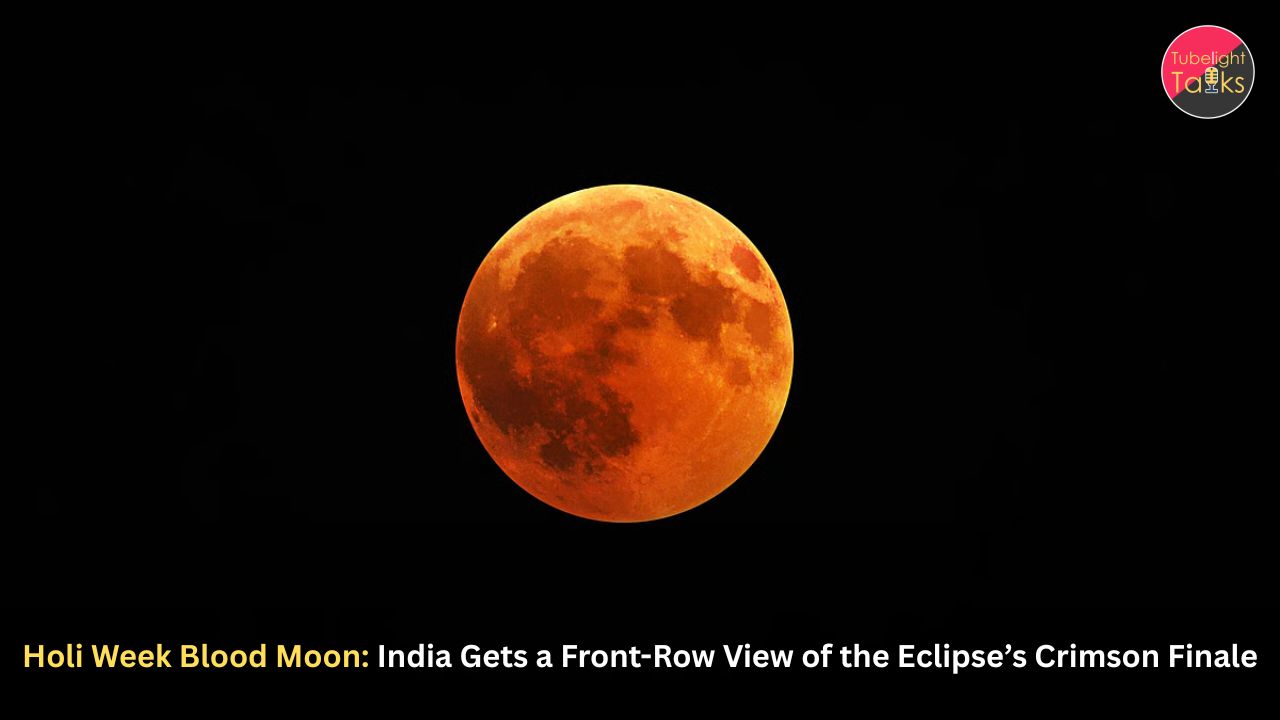
Holi is a festival that celebrates colour on Earth – but this year, colour arrives from space too. A total lunar eclipse on Tuesday, March 3, 2026 (the Holi week that includes Holika Dahan on March 3 and Rangwali Holi on March 4) is set to tint the Moon a dark copper-red – what people call a “Blood Moon.”
The Ministry of Earth Sciences notes a crucial India-specific twist: most of the country will see the eclipse mainly during moonrise, in its ending phases, while parts of the North-East and Andaman & Nicobar may see the end of totality itself. In other words: for millions, the Moon will rise already in shadow – like a cosmic curtain opening mid-scene.
Why This “Blood Moon” Feels Different in India
A total eclipse – yet India’s view is a dramatic final act
A total lunar eclipse means the Moon passes fully into Earth’s darkest shadow (the umbra). But the Ministry of Earth Sciences explains that most places in India will observe the ending of the eclipse at the time of moonrise – not the entire progression. That makes the Indian experience unusually cinematic: the Moon appears while the story is already unfolding, and what people see is the release – the shadow sliding off the lunar surface.
Holi timing adds meaning without changing the science
Holi season already teaches people to pause, gather, and look outward. This eclipse adds an unexpected layer: a national moment where families, students, and communities can share a sky event together – without tickets, without technology, without privilege. The only requirement is a clear horizon and a few minutes of attention.
Official Timings India Should Know
Ministry of Earth Sciences (PIB) timing window
The Ministry of Earth Sciences states, in general:
- Eclipse begins: 15:20 IST
- Eclipse ends: 18:48 IST
- Totality begins: 16:34 IST
- Totality ends: 17:33 IST
These are the core national reference times. The practical viewing experience then depends on your local moonrise and how much of the eclipse is still underway when the Moon clears your eastern horizon.
Holi calendar context
According to Drik Panchang, Holika Dahan falls on Tuesday, March 3, 2026, and Rangwali Holi (colour play) on Wednesday, March 4, 2026. So the eclipse aligns with Holi week and the Holika Dahan evening, amplifying public attention and making it feel like a once-in-a-long-while cultural overlap.
Also Read: Tamil Nadu’s Dark Sky Park Opens in Kolli Hills
Where India Gets the Best View
The “front-row seat” belongs to the North-East and the Islands
The Ministry of Earth Sciences explicitly says: some places in North-East India and the Andaman & Nicobar Islands will be able to see the end of the totality phase, not just the later partial/penumbral stages.
That’s the difference between:
- seeing a reddish, shadowed Moon rise (partial/penumbral), and
- catching the last minutes when the Moon is still fully inside Earth’s umbra (true totality).
A concrete example: Guwahati’s “edge-of-the-horizon” totality
Timeanddate’s local listing for Guwahati shows total eclipse ends at 17:32 with the Moon extremely low, warning that the horizon haze plus eclipse dimming can make it “very hard or impossible to see” unless you have a clean eastward view. It then lists partial eclipse ending at 18:47 and penumbral ending at 19:53.
This is exactly the kind of “front-row but fragile” visibility that makes North-East viewing special: the timing is perfect, but the horizon must be clear.
Most other Indian cities: the Moon rises as the eclipse is ending
The Ministry of Earth Sciences has already set expectations: much of India will see the ending at moonrise. That means in many places you’ll observe a Moon that looks dimmer, darker, and sometimes reddish as it climbs – then slowly returns to normal brightness as Earth’s shadow slips away.
What You’ll Actually See, Step by Step
1) A strangely dim Moon at rise
The eclipsed Moon near the horizon can look even darker because the atmosphere thickens and dims moonlight close to the ground. In cities, haze and pollution can intensify this effect, making the Moon appear “burnt,” “rusted,” or unusually muted.
2) The red colour: not magic – Earth’s atmosphere painting the Moon
The Moon turns red because Earth’s atmosphere bends and filters sunlight into the shadow. Blue wavelengths scatter more, while red/orange wavelengths travel through and refract into the umbra – essentially projecting Earth’s “sunrise/sunset ring” onto the lunar surface. That’s why the colour can vary from copper to deep brick red.
3) The slow return to silver
As the eclipse ends, the shadow recedes. The Moon brightens gradually – often the most educational part for students because it’s a visible demonstration of geometry and orbital motion in real time.
A National “Physics in Motion” Classroom
Why this is a rare public science moment
Lunar eclipses require no special equipment and are safe to watch with the naked eye (unlike solar eclipses). That makes them one of the most inclusive astronomy events possible.
Simple student experiments that make it unforgettable
Learning ideas that turn the eclipse into science, not superstition:
“Brightness journal”
Ask students to rate brightness every 5 minutes from moonrise until the eclipse ends, noting colour changes and the effect of altitude.
“Horizon vs height” comparison
Compare how the Moon looks at 5° above the horizon vs 20°. The Moon should appear clearer and brighter as it rises.
“Shadow geometry sketch”
Students can draw Earth, Moon, and shadow cones (penumbra/umbra) and map what they observed. It builds intuitive understanding of alignment and orbital planes.
“Family science conversation”
This eclipse is a chance for children to ask the most important scientific questions:
- Why doesn’t an eclipse happen every month?
- Why does the Moon turn red?
- What is Earth’s shadow made of?
Those questions are the real gift – not the photograph.
Respecting Tradition Without Losing the Truth
Holi, faith, and the sky: coexistence is possible
Many families observe religious customs connected to eclipses. At the same time, the Ministry of Earth Sciences provides the scientific explanation and official visibility guidance. The healthiest approach is to respect personal beliefs while keeping children anchored in truth: this is not a “bad omen.” It is celestial geometry and atmospheric physics.
When a country can hold tradition in one hand and science in the other, it strengthens society instead of dividing it.
How to Watch It Properly (Practical, Not Fancy)
Find the eastern horizon – this matters more than telescopes
Because much of India sees the eclipse at moonrise, your most valuable tool is a clear view to the East – terrace, open ground, or a spot without tall buildings blocking the horizon.
Expect the Moon to be dim (don’t panic if it’s faint)
Timeanddate explicitly warns for Guwahati that the eclipsed Moon near the horizon may be hard to see. This applies broadly: haze + low altitude + eclipse dimming can make the Moon appear faint. Give it time.
Binoculars are optional; patience is essential
You don’t need any device. But if you have binoculars, you can more clearly see the boundary where shadow meets light – a sharp, unforgettable line that makes the mechanics obvious.
Why This Eclipse Is “Good News” in a Heavy News Cycle
Because it’s a shared wonder with zero entry barrier
No tickets. No VIP zones. No language barrier. Just a sky event accessible to everyone who looks up.
Because it teaches humility
A lunar eclipse quietly tells the truth about human scale: we celebrate, argue, and compete – while above us, the universe runs on precise laws, indifferent to our noise. That perspective is healthy. It softens ego and strengthens awe.
Because it pushes curiosity back into public life
In a time when attention is often trapped in screens, a blood moon pulls attention outward. It makes families step outside together – and that is rare.
Seeing Order in the Cosmos
A lunar eclipse is one of the few moments where the universe looks like a lesson written in light: alignment, timing, cause and effect. In the teachings shared by Sant Rampal Ji Maharaj, there is emphasis on moving from भ्रम (confusion) to understanding – recognizing that creation operates with order, and that knowledge should reduce fear, not increase it.
When children watch Earth’s shadow move across the Moon and then lift, it naturally reinforces the value of clear thinking: observe, understand, and stay steady. True wisdom is not panic; it is clarity – and clarity is what both science education and spiritual discernment ultimately aim to cultivate.
FAQs: Visible Lunar Eclipse in India
1. When is the total lunar eclipse visible in India?
On March 3, 2026, with national timing listed roughly from 15:20 to 18:48 IST.
2. Will all of India see the full “blood moon” totality?
No. The Ministry of Earth Sciences says most places in India will observe mainly the ending at moonrise, while parts of the North-East and Andaman & Nicobar may catch the end of totality.
3. Is it safe to watch a lunar eclipse with naked eyes?
Yes. Lunar eclipses are safe to watch without special glasses.
4. Why does the Moon look red during a total lunar eclipse?
Because sunlight filtered through Earth’s atmosphere bends into the shadow and red/orange light dominates on the Moon’s surface.
5. Does this eclipse coincide with Holi?
It aligns with Holi week – with Holika Dahan on March 3 and Rangwali Holi on March 4.
Related Stories









Discussion (0)