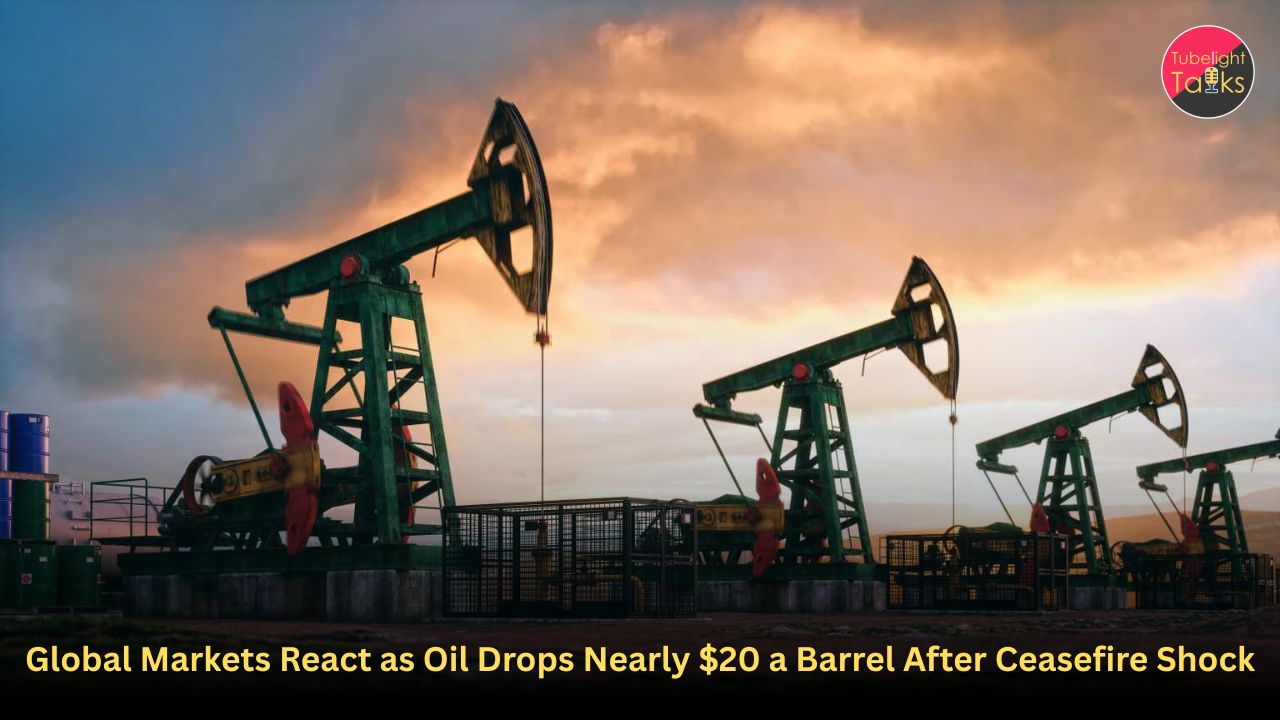
Global Markets: Crude Oil Prices Sink After Ceasefire News and Limited Hormuz Relief
Global oil markets reacted dramatically to ceasefire news involving the United States and Iran, with Brent and WTI crude suffering their steepest one-day percentage declines since 2020 before partially rebounding. Reuters reported that oil dipped below $100 per barrel after the ceasefire announcement, while broader market coverage showed Brent falling by roughly 15% to 16% and U.S. crude sliding by a similar magnitude as traders rushed to price in lower immediate disruption risk.
The move was also linked to expectations of at least limited ship movement through the Strait of Hormuz, even though passage remained restricted and far from normal.
Why oil fell so sharply
Oil had been trading with a massive war premium because the conflict placed one of the world’s most important energy chokepoints under extraordinary stress. Reuters noted that about 20% of global oil and gas supply moves through the Strait of Hormuz. When ceasefire news suggested that a direct U.S.-Iran escalation might pause and that tanker passage could resume in some form, traders immediately cut the probability of a full-scale supply shock. That repricing was violent because prices had already run far ahead on fear.
The market reaction also reflected how oil futures behave during conflict. Prices do not wait for full normalisation; they move as soon as the expected path of risk changes. In this case, the market was not pricing peace. It was pricing a lower chance of catastrophic disruption than the day before. That difference matters. A partial reopening or limited transit is enough to knock out some panic premium, even if real supply conditions remain fragile.
The fall was large, but not a return to normal
Some headlines described crude as collapsing by nearly $20 per barrel, and that is directionally consistent with the sharp fall from previously elevated wartime levels. But the broader picture is more cautious. Reuters later reported Brent and WTI rebounding toward $97 as doubts resurfaced over the ceasefire and the Strait remained under Iranian restrictions. So the selloff was real and dramatic, but it did not restore the market to pre-conflict calm. Prices remained high by normal standards.
That is the key point for businesses and consumers: a one-day plunge in oil prices does not automatically mean fuel stability, lower inflation or a durable easing of energy stress. It means the market briefly believed the worst-case scenario had become less likely. The next headline can reverse that belief.
Also Read: Maritime Update: Iran Announces Alternative Shipping Routes Through the Strait of Hormuz
The Strait of Hormuz remains the central market nerve
Reuters’ “what we know” coverage said the Strait remained blocked in broad terms, with limited ship passages allowed under Tehran’s permission. Other reporting described only partial or modest shipping movement. That means the market did not react to a full reopening. It reacted to the possibility that the strait would not remain completely paralysed and that some cargoes could move again.
This nuance is crucial because financial markets often compress complex logistics into simple price signals. A fall in crude may appear to suggest that the shipping problem is solved. It is not. As Reuters later noted, restrictions, military risk, mines and uncertainty about passage terms continue to keep freight costs and risk premiums elevated. In effect, the market celebrated relief while the physical system stayed under strain.
Equities loved the move because oil affects everything
Oil is not just a commodity; it is a macro variable. When crude falls sharply, stock markets often rally because investors expect less inflation, less pressure on central banks, stronger consumer demand and better corporate margins. AP reported that U.S. stocks surged after the ceasefire news, with the Dow up more than 1,300 points, the S&P 500 up 2.5% and the Nasdaq up 2.8%. The Guardian similarly described broad gains across Asia and Europe.
Travel and transport stocks tend to benefit from cheaper fuel, while oil producers often lag on such days. Countries heavily dependent on imported energy, including India, are especially sensitive to this dynamic because lower crude improves inflation expectations, currency outlook and fiscal comfort simultaneously. That is why one geopolitical headline can travel so quickly from the Gulf to Wall Street, Dalal Street, airline stocks, bond yields and consumer sentiment.
Why volatility is likely to stay high
The same Reuters report that covered the rebound in oil also explained why traders remain cautious: the ceasefire is fragile, the Strait is still under pressure, and Israeli attacks in Lebanon have added a new layer of uncertainty. In other words, the market’s relief trade has collided with the reality that West Asia remains unstable and that ceasefire terms are contested.
Oil markets hate ambiguity more than they hate bad news. Clear bad news can be priced. Confused partial de-escalation, limited transit, unofficial tolls, mine threats, and contradictory diplomatic claims are harder to price because they create scenario volatility. Traders then move more aggressively on every update, which amplifies both selloffs and rebounds.
The economic importance goes far beyond traders
When crude moves this violently, the consequences spread quickly. Importing nations worry about inflation. Exporting nations worry about production continuity and shipping revenue. Central banks watch inflation expectations. Consumers worry about pump prices. Shipping firms worry about war-risk insurance. Airlines, chemical companies, logistics operators and manufacturers all recalculate exposure. That is why oil remains one of the fastest channels through which war affects ordinary households.
The market’s brief optimism after the ceasefire announcement also revealed something deeper: the world economy has become extremely vulnerable to concentrated geographic chokepoints. One narrow waterway, one diplomatic breakdown, or one misread ceasefire clause can move prices globally in a matter of hours. That structural fragility is now impossible to ignore.
Markets, fear and Sat Gyaan
In the light of Sat Gyaan, market panic shows how unstable worldly dependence can be. Wealth, prices and profit all change quickly when fear enters the mind. Sant Rampal Ji Maharaj teaches that attachment to temporary gain creates restlessness, while wisdom brings balance. Effort in material life is necessary, but inner steadiness protects a person from being controlled by every rise and fall.
Call to Action
Follow verified energy and policy updates, avoid sensational price rumours, and understand that one day’s market move does not settle a crisis. Calm analysis is better than emotional reaction.
FAQs: Global Markets React as Oil Drops Nearly $20 a Barrel After Ceasefire Shock
Q1. Did crude oil really fall by about $20 per barrel?
Prices fell extremely sharply, with broad reporting showing about a 15% to 16% one-day drop from elevated levels, which translates to a very large dollar decline.
Q2. Why did oil fall?
Because ceasefire news reduced immediate fears of full supply disruption and raised expectations of at least limited movement through Hormuz.
Q3. Is the Strait of Hormuz fully reopened?
No. Reuters reported that passage remains restricted and subject to Iranian control, with only limited movement.
Q4. Why did stock markets rise?
Lower oil reduces inflation fears and improves expectations for growth, margins and consumer demand.
Q5. Could oil rise again quickly?
Yes. Reuters reported a rebound toward $97 as geopolitical doubts returned.
Related Stories










Discussion (0)