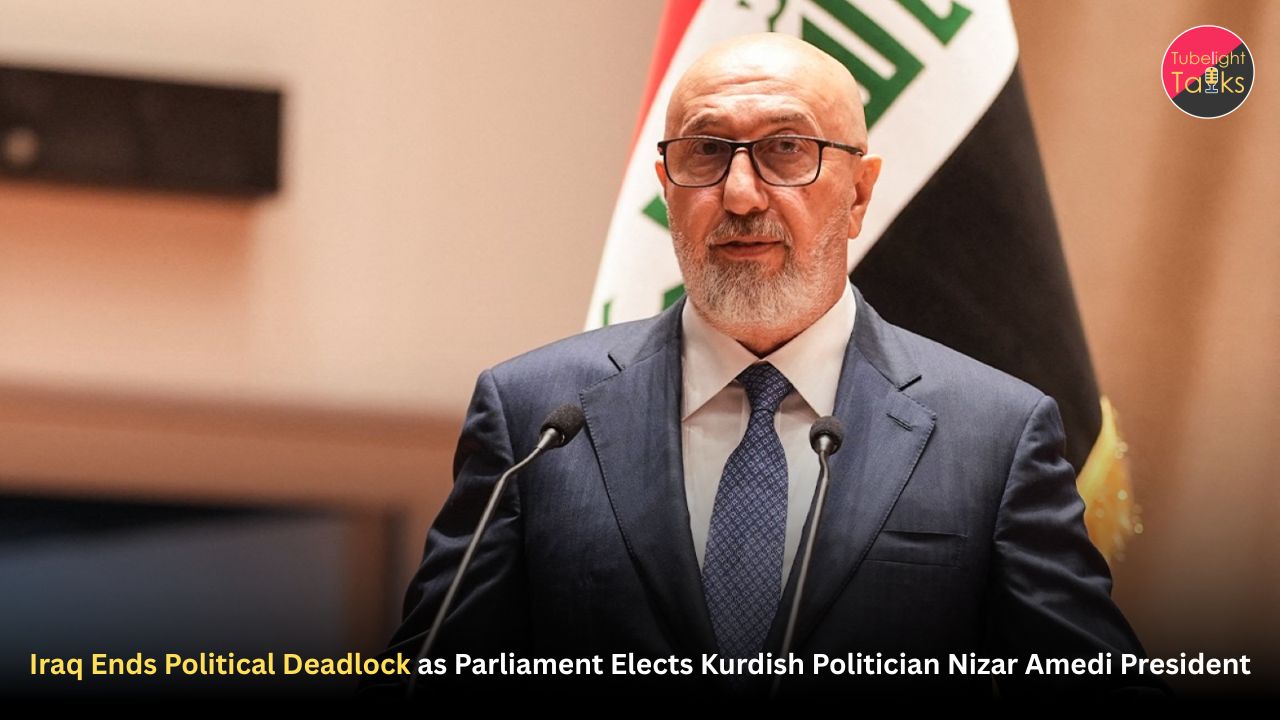
Iraq’s Presidential Deadlock Ends with Nizar Amedi’s Election, but the Hard Politics Begin Now
Iraq’s parliament has elected Kurdish politician Nizar Amedi as the country’s new president, ending five months of political deadlock after inconclusive parliamentary elections. Reuters and AP both reported the development on April 11, describing it as a significant breakthrough in a system that had struggled to convert election results into functioning institutions.
Amedi, associated with the Patriotic Union of Kurdistan, now steps into a presidency that is often described as largely ceremonial—but in Iraq’s coalition-based system, the office plays an important role in government formation and constitutional continuity.
Why the Election Matters
In many parliamentary systems, a presidential election after a stalemate would be notable but not transformative. In Iraq, it matters more because prolonged institutional delay can deepen already existing fractures—sectarian, regional, economic, and geopolitical. AP reported that the deadlock had stretched for five months, leaving the state in a condition of prolonged administrative uncertainty. In such settings, even ceremonial offices acquire outsized significance because they unlock procedures that the rest of the political system needs in order to move.
The Kurdish Dimension
The election also reinforces Iraq’s long-standing political convention under which the presidency is held by a Kurd, while the prime ministership goes to a Shiite and the speakership to a Sunni. Amedi’s rise therefore reflects both democratic procedure and the endurance of Iraq’s post-2003 power-sharing habits.
That convention has often been criticized for entrenching quota-style politics, yet it has also functioned as a mechanism for distributing representation in a fragmented polity. Amedi’s victory shows that even amid regional shocks and domestic fatigue, those structural rules still shape outcomes.
Also Read: Global Markets: Crude Oil Prices Sink After Ceasefire News and Limited Hormuz Relief
Why the Deadlock Lasted So Long
The length of the impasse is itself revealing. Parliamentary elections did not produce a clean governing majority, and Iraq’s coalition politics once again turned government formation into a slow bargaining process rather than a swift democratic transfer of authority. Such deadlocks are rarely caused by one dispute alone.
They emerge from competing elite interests, rival party networks, external pressures, and the need to negotiate posts across multiple centers of power. That makes resolution difficult because every agreement at the top has ripple effects elsewhere.
A Regional Crisis in the Background
AP also linked Amedi’s election to a much wider regional context shaped by war fallout and pressure on Iraq’s economy. That matters because Iraqi domestic politics never unfold in a vacuum. Baghdad’s internal negotiations are constantly influenced by U.S.-Iran tensions, militia activity, oil revenue vulnerability, and the strategic calculations of regional actors. The result is that even a parliamentary vote inside Iraq must be read against a Middle Eastern backdrop that is unusually unstable at present.
The Presidency Is Not the End of the Story
Electing a president does not end Iraq’s political uncertainty; it moves the process into a new phase. Under Iraq’s constitutional framework, the president now has a role in designating a prime minister, and that next appointment may produce the real contest.
AP reported that the Shiite Coordination Framework, the largest parliamentary bloc, had signaled a nominee for premiership, indicating that the next round of power bargaining is already forming. That means Amedi’s election resolves one layer of paralysis but may intensify the next.
What Amedi Must Signal Quickly
For Amedi, the immediate challenge is not ideological grandeur. It is reassurance. He must project institutional steadiness, national balance, and procedural credibility. New presidents in fragile coalition systems are judged first on tone: are they seen as partisan trophies, factional instruments, or constitutional stabilizers? His reported “Iraq First” framing, referenced in current coverage, points toward the third image, which is politically smart in a country tired of deadlock and external overhang.
Why This Could Still Be a Turning Point
If Amedi’s election leads rapidly to a government formation process that feels legitimate and functional, historians may remember April 2026 as the point at which Iraq stepped out of administrative suspension. But if rival blocs simply transfer the deadlock from the presidency to the premiership, then this will look more like an interim breakthrough than a real turning point. The difference will depend on what happens next in Baghdad, not only on what happened in parliament.
Political Stability Requires More Than Numbers
Coalitions may be built by arithmetic, but stable societies are built by justice, trust, and moral intent. Sant Rampal Ji Maharaj’s teachings emphasize peace, brotherhood, and the rejection of social evils that divide human beings. That message carries a wider relevance for any fragmented political system: institutions last only when power is guided by responsibility, not by faction alone. National healing is never merely procedural. It is also ethical.
Call to Action
The presidential vote has ended one deadlock. The more decisive test will be how quickly and credibly Iraq moves toward the next government.
FAQs: Iraq Ends Political Deadlock as Parliament Elects Kurdish Politician Nizar Amedi President
1. Who is Iraq’s new president?
Iraq’s parliament elected Kurdish politician Nizar Amedi as president on April 11, 2026.
2. Why is this election important?
It ends a five-month political stalemate after inconclusive parliamentary elections.
3. Which party is Amedi associated with?
Reports identify him with the Patriotic Union of Kurdistan.
4. Is the Iraqi presidency powerful?
It is often described as a largely ceremonial office, but it remains constitutionally important for government formation.
5. What happens next?
Attention now turns to the appointment of a prime minister and the formation of a functioning government.
Related Stories




Discussion (0)