Nitish Kumar’s Exit from the CM Residence Signals a Defining Bihar Transition
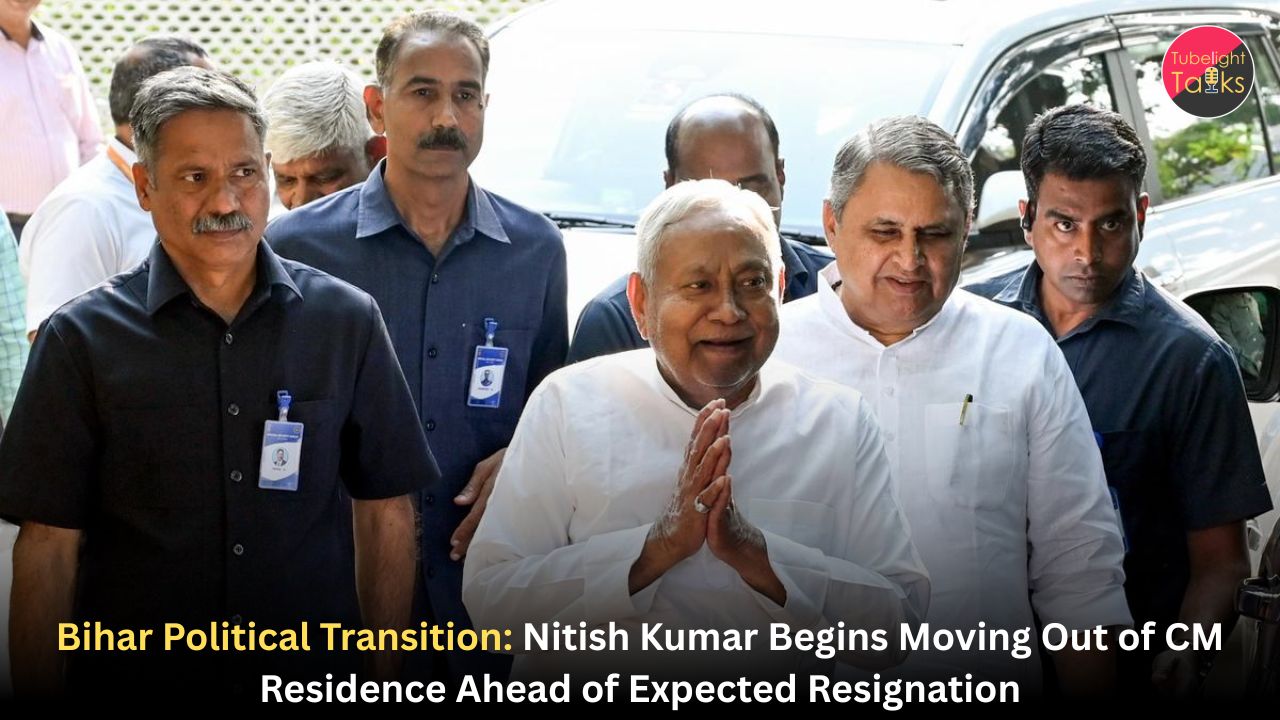
Bihar politics is entering a visibly transitional phase after Chief Minister Nitish Kumar took oath as a member of the Rajya Sabha and then began shifting belongings from the official chief minister’s residence in Patna. What had earlier appeared to be speculation is now being read as an unmistakable sign that a formal leadership change is close.
The symbolism matters because Nitish Kumar is not just any outgoing chief minister. He is one of the central architects of contemporary Bihar politics, and even a logistical move from 1 Anne Marg carries major political weight.
The Oath That Changed the Conversation
The turning point in this sequence was Nitish Kumar’s oath as a Rajya Sabha member. PIB confirmed that Rajya Sabha Chairman C.P. Radhakrishnan administered the oath to Nitish Kumar on April 10. News On AIR and other reporting then connected that move directly to the reshaping of Bihar’s political equation. A chief minister entering the Upper House at this stage is not a routine technical adjustment. It usually signals preparation for a different role, especially when accompanied by active movement from the chief ministerial residence.
Why the Residence Move Matters So Much
In politics, physical movement often speaks before formal announcements do. Reports say Nitish Kumar has begun moving belongings from 1 Anne Marg to another Patna residence, and that the NDA is expected to decide on a new chief minister soon. Shifting out of the official CM residence is not merely personal housekeeping. It is public choreography.
It prepares allies, bureaucrats, the party cadre, and the media for a transition while avoiding the appearance of abrupt rupture. In Indian state politics, such signals are closely watched because they often precede the formal script by a few days.
Also Read: Rohini Acharya Quits Politics: Bihar Poll Debacle Sparks Family Rift Inside RJD
The End of a Long Administrative Era
Nitish Kumar’s expected move away from the chief minister’s office is significant because it may close one of the longest and most influential leadership chapters in Bihar’s post-liberalization politics. For years, Bihar’s governance, coalition arithmetic, and administrative style have been shaped by Nitish’s presence.
Even critics who oppose him politically usually acknowledge that the state’s political vocabulary has been built around him—development, caste equations, coalition flexibility, and calibrated governance. So the current shift is not just about who occupies an office next. It is about whether Bihar is entering a post-Nitish political grammar.
What the NDA Must Manage Now
The National Democratic Alliance now faces a delicate balancing task. It must manage succession without appearing uncertain, preserve administrative continuity, and reassure its voter base that the transition is planned rather than forced. Economic Times reported that Nitish Kumar may resign around April 14 and that cabinet-level discussions had gathered pace.
That indicates the process is active, coordinated, and politically timed. Leadership transitions are most stable when narrative control remains with the ruling coalition. Any sign of internal confusion can quickly embolden the opposition.
What This Means for Delhi and Patna
Nitish Kumar’s entry into the Rajya Sabha also matters nationally. It potentially returns him to a more direct role in parliamentary politics after years of leading Bihar from Patna. News coverage has noted the significance of his re-entry into Delhi’s legislative arena after a long gap.
This could mean that while he may step away from day-to-day state administration, he is not stepping out of relevance. Instead, his influence may be repositioned—from executive state control to strategic federal and coalition space.
The Opposition’s Line of Attack
Opposition parties are already trying to frame the transition as evidence of drift and instability. Reports show Tejashwi Yadav attacking the NDA over governance conditions in the state. That response is predictable. Leadership changes always create a temporary opening for the opposition to question continuity, claim policy paralysis, and project itself as the sharper alternative. The NDA’s challenge is therefore dual: handle the succession internally and close the window for an external narrative of disorder.
What Comes Next for Bihar
The near-term questions are straightforward. Who becomes the next chief minister? How smoothly is cabinet and administrative continuity maintained? What role will Nitish Kumar play from the Rajya Sabha and within alliance politics? The answers will shape not just Bihar’s government but also the balance between regional authority and national coalition management. Transitions are remembered less for the ceremony of exit than for the quality of what follows.
Leadership Is Temporary, Duty Is Larger
Political transitions remind society that positions are temporary, while duty is larger than office. Sant Rampal Ji Maharaj’s teachings emphasize humility, right action, and detachment from ego-driven identity. In public life, that principle matters deeply: leadership has real value only when it serves people more than power. Whether one rises, stays, or steps aside, the moral test remains the same—did the role become a means of service or merely a seat of status?
Call to Action
The symbolic move has already happened. Now citizens should watch the institutional follow-through: succession, cabinet continuity, policy direction, and administrative stability.
FAQs: Nitish Kumar Begins Moving Out of CM Residence Ahead of Expected Resignation
1. Did Nitish Kumar really take oath as a Rajya Sabha MP?
Yes. PIB and News On AIR both reported that he took oath as a Rajya Sabha member on April 10, 2026.
2. Why is moving belongings from the CM residence important?
Because it strongly signals preparation for a formal exit from the chief minister’s post.
3. Has Nitish Kumar resigned yet?
Current reports describe resignation as expected or likely, but the strongest wording available remains that a formal transition is imminent rather than already completed.
4. Who will be the next Bihar CM?
As of the latest reporting cited here, the NDA was still expected to decide on the successor.
5. Does this mean Nitish Kumar is retiring from politics?
No. His Rajya Sabha entry suggests a shift in role, not a withdrawal from political relevance.
Related Stories






Discussion (0)