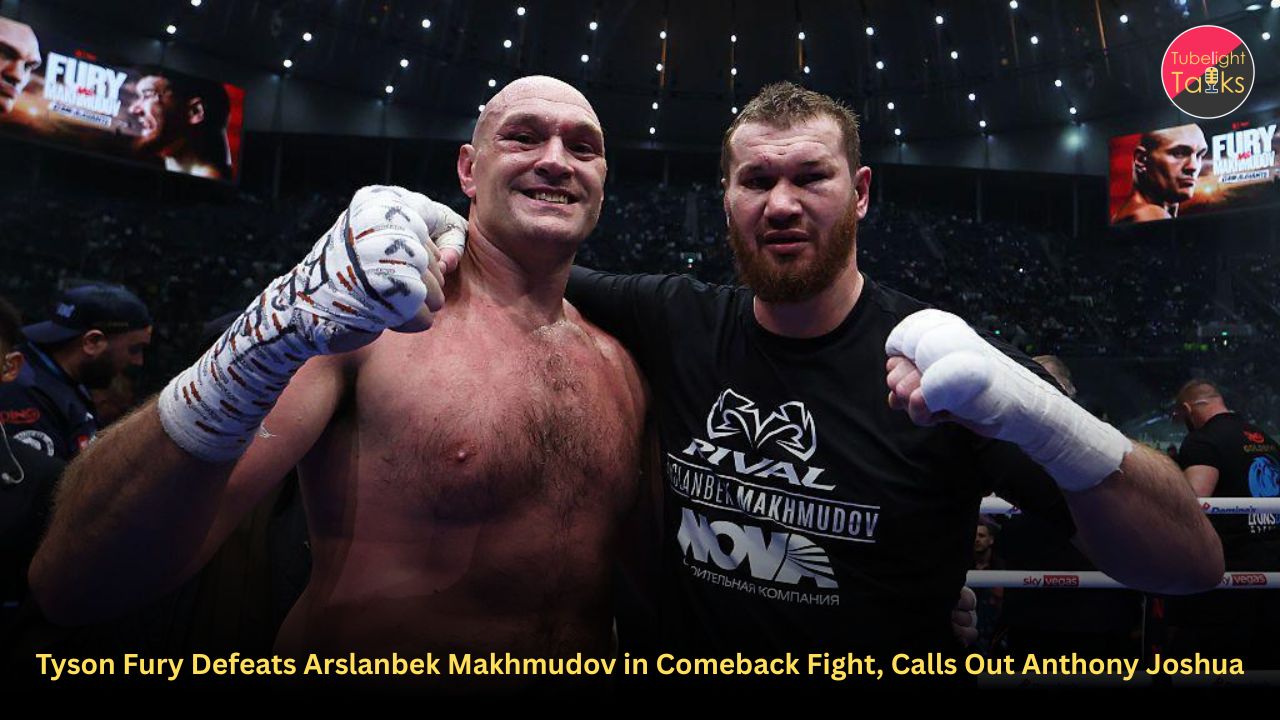
Tyson Fury Returns with a Clear Win Over Makhmudov and Reopens the Anthony Joshua Question
Tyson Fury’s comeback fight delivered the outcome many expected, but the manner of victory—and what followed it—made the night significant. Fury defeated Arslanbek Makhmudov by unanimous decision at Tottenham Hotspur Stadium, with judges scoring the fight 120-108, 120-108, and 119-109.
Reuters described the performance as a dominant return in which Fury used technique, movement, jabs, and uppercuts to steadily outclass his opponent after surviving some early pressure. Then, almost immediately after victory, Fury shifted the conversation from comeback to possibility by calling out Anthony Joshua.
A Controlled Comeback, Not a Reckless One
Comeback fights are often judged on spectacle, but smart ones are judged on control. Fury did not rush the night into chaos. He allowed Makhmudov to show his aggression, read the danger early, and then began to impose his own shape on the contest. Reuters noted that Makhmudov had moments in the opening phase, especially when he pressured Fury to the ropes, but those moments gradually disappeared as Fury’s superior ring craft took over.
This matters because a successful return after time away is not only about winning; it is about showing that your timing, composure, and decision-making remain intact.
Why the Decision Was So One-Sided
The scorecards reflected what most observers saw: Fury in control for the vast majority of the bout. His jab repeatedly interrupted Makhmudov’s rhythm, his stance switches complicated the Russian’s attack lines, and his inside work reduced the danger of raw pressure. By the second half of the fight, the bout had become less about whether Fury would win and more about whether he would pursue a stoppage or settle for a comfortable decision.
He chose the second route, which in comeback logic can often be the wiser one. Twelve rounds of ring time sometimes matter more than a highlight-reel finish.
What the Fight Said About Fury’s Current Level
The performance suggested that Fury remains tactically elite, even if he did not need to produce his most explosive version. After time away, fighters often show rust through overcommitment, poor balance, or emotional pacing. Fury largely avoided those traps.
He looked like a heavyweight who still understands distance better than most of the division and who can make a dangerous puncher spend energy at the wrong time. That does not answer every question about how he would fare against the very top names, but it does answer the most immediate one: he is still a serious heavyweight force.
Makhmudov’s Role in the Story
Makhmudov deserves mention as more than a losing opponent. He came in as a physical test—big, aggressive, and capable of creating uncomfortable early moments. For Fury, that made him a useful comeback opponent.
He was dangerous enough to require respect but limited enough to allow Fury to settle into a rhythm once the opening storm passed. In comeback matchmaking, that is often the calculation. The opponent must create enough risk to make the result meaningful, but not so much that the returning star has no room to re-establish himself.
Then Came the Anthony Joshua Callout
The moment that instantly expanded the night’s importance came after the final bell. Fury publicly called out Anthony Joshua, reviving the “Battle of Britain” narrative that has hovered over the heavyweight division for years without becoming reality. Reuters reported that Joshua, who was ringside, indicated willingness but did not directly step into Fury’s script on Fury’s terms.
That exchange matters because heavyweight boxing often runs as much on public challenge and momentum as on formal negotiation. A comeback win gives Fury leverage; a live callout gives the narrative oxygen.
Why Fury vs Joshua Still Matters
Even after years of delays, changing form, shifting belts, and missed windows, Fury versus Joshua remains perhaps the single biggest unresolved matchup in British boxing. Not every super-fight retains its aura after postponement, but this one still does because of name value, contrasting personalities, and the scale of public interest.
Fury’s win over Makhmudov did not prove he would beat Joshua. What it did was restore the practical basis for making the fight without it feeling entirely nostalgic or speculative. The bout once again feels commercially and competitively alive.
What Fury’s Team Will Want Next
From Fury’s side, the ideal next step is obvious: convert the momentum of a successful comeback into a mega-fight before the story cools. A return win alone is valuable, but its real commercial power lies in what it launches. If negotiations with Joshua accelerate, then the Makhmudov fight will be remembered as the careful bridge back to the one event that really mattered. If negotiations stall again, the comeback still helps Fury—but not nearly as much as a confirmed next date would.
The Bigger Lesson from a Return
Comebacks fascinate audiences because they are never only about sport. They are about doubt, time, reinvention, and the ability to return to disciplined effort after distance or defeat. Sant Rampal Ji Maharaj’s teachings place strong emphasis on self-control, steadiness, and freedom from ego-driven distraction. In competitive sport, those values matter greatly.
A return succeeds not because noise gets louder, but because focus becomes cleaner. Fury’s performance, at its best, reflected that principle.
Call to Action
The performance answered one question. The negotiations with Anthony Joshua may answer the one fans care about most.
FAQs: Tyson Fury Defeats Arslanbek Makhmudov in Comeback Fight, Calls Out Anthony Joshua
1. Who won the Fury vs Makhmudov fight?
Tyson Fury won by unanimous decision.
2. What were the judges’ scores?
The scorecards were 120-108, 120-108, and 119-109 for Fury.
3. Where was the fight held?
It took place at Tottenham Hotspur Stadium in London.
4. Did Fury call out Anthony Joshua?
Yes. After the fight, Fury publicly challenged Joshua.
5. Why is that callout so important?
Because Fury vs Joshua remains one of the biggest possible fights in British boxing.
Related Stories




Discussion (0)