Andhra Pradesh Tragedy: Tanker Overturns on BMW, Killing Senior High Court Lawyer
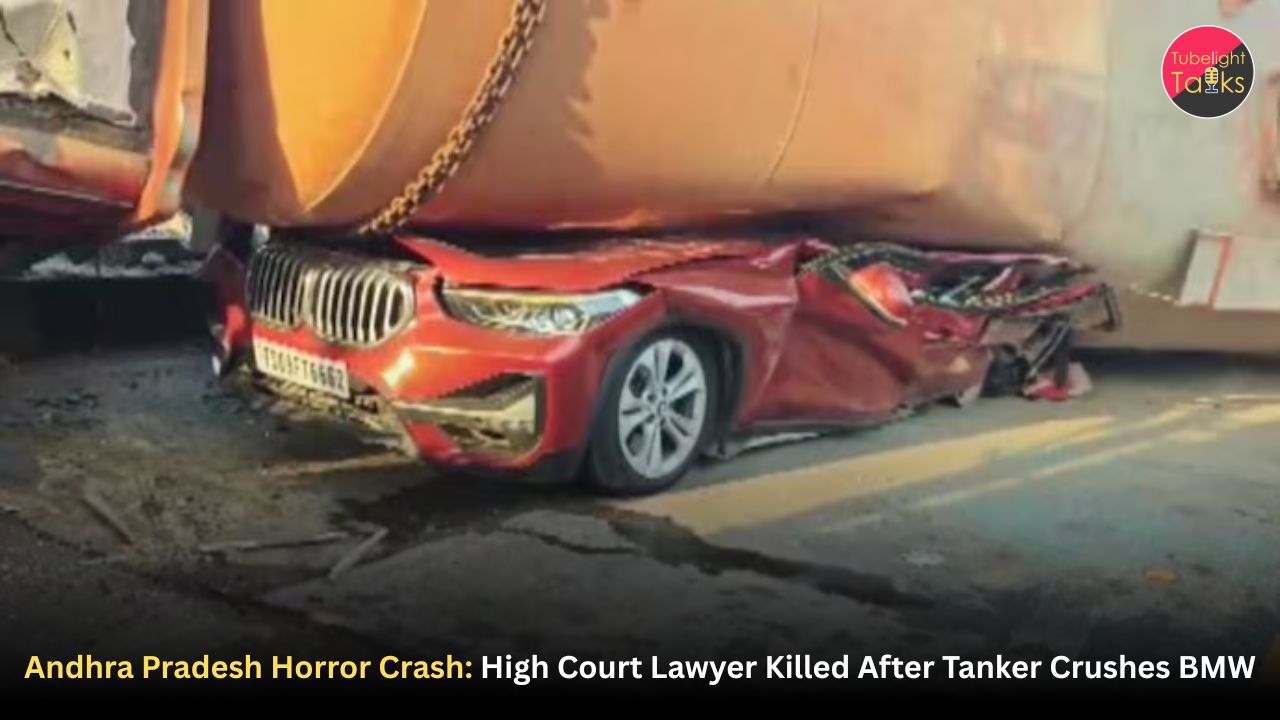
A devastating highway accident in Andhra Pradesh has left the legal community in shock after senior advocate B. Srinivasa Rao of Hyderabad was killed when a heavy tanker reportedly lost control and overturned onto his BMW near the Keesara toll plaza in Kanchikacherla mandal of NTR district.
According to current reporting, the vehicle was completely crushed under the tanker’s weight, and Rao, who was reportedly alone in the car, died at the spot. Rescue teams later used cranes and earth-moving equipment to retrieve the body from the wreckage.
A Crash So Severe That Rescue Became a Recovery
The facts that have emerged point to an impact of extraordinary force. The heavy tanker, described in reporting as a 16-wheeled fly ash or mixer tanker, reportedly suffered brake failure or loss of control before overturning directly onto the car. In many highway crashes, occupants have at least a narrow survival window.
In this case, the crushing weight of the overturned tanker appears to have removed that possibility. The scale of the damage is what turned the emergency response into a highly difficult extraction operation rather than a conventional rescue.
Why This Accident Has Struck a Nerve
Some road accidents become headline items for a day and then disappear. This one has wider emotional force because it involved a prominent legal professional, a brutal accident mechanism, and a familiar public fear: the vulnerability of passenger vehicles when heavy transport vehicles lose control.
Even high-end engineering and safety features in luxury cars can be rendered meaningless when a multi-axle commercial vehicle topples directly on top of them. That brutal imbalance is part of why the incident has resonated so widely.
Also Read: Aftermath of Mumbai Billboard Collapse Couple Found Dead in Car Under The Hoarding
The Highway Safety Questions It Raises
The most obvious question is about commercial vehicle safety standards and enforcement. If brake failure or control loss was indeed involved, investigators will likely look at vehicle fitness, maintenance discipline, loading conditions, driver fatigue, speed, and road geometry.
India’s highways have improved significantly in many areas, but crashes involving heavy freight vehicles continue to expose dangerous gaps between infrastructure expansion and enforcement culture. Fatalities are often not caused by one mistake alone; they emerge from a chain of preventable risk failures.
The Limits of Private Safety in Public Risk
This tragedy also shows a hard truth about modern road travel: individual caution is not always enough when public systems around you fail. A driver may wear a seat belt, use a well-built car, follow lane discipline, and still become the victim of another vehicle’s catastrophic failure.
That is why road safety cannot be treated solely as a matter of personal responsibility. It is also about regulation, inspection, fleet compliance, toll-corridor monitoring, emergency response, and freight discipline. Public safety on highways is collective or it is fragile.
Impact on the Legal Community
The reported death of a respected advocate naturally carries institutional grief beyond the immediate family. Lawyers often become deeply woven into public causes, civic disputes, constitutional litigation, and local legal culture.
Reporting described Rao as a respected lawyer known for dedication and legal activism, which means his death will be felt not just as a private loss but as the sudden disappearance of a public professional voice. Communities that rely on strong advocates feel these losses differently because the person gone is also part of the public process of justice.
Investigation Must Go Beyond Blame
Police have reportedly registered a case and begun investigation. That investigation matters not only for accountability in this case but for the lessons it may offer more broadly. The real value of crash investigation is not limited to naming fault after death.
Its deeper value lies in whether future deaths can be prevented through tighter maintenance enforcement, improved freight checks, better corridor surveillance, and faster heavy-vehicle intervention systems near toll zones and descent stretches. If the system learns nothing, then every such tragedy becomes twice as painful.
The Cruelty of Sudden Loss
Road deaths are uniquely cruel because they convert ordinary routine into irreversible absence within seconds. A journey that began like any other becomes, without warning, the last. Families do not get time to prepare. Colleagues do not get a final conversation. Institutions do not get a graceful farewell. That is why fatal crashes leave behind not just grief, but shock—shock at how abruptly a life with purpose, work, relationships, and plans can be extinguished by a mechanical and physical disaster on a public road.
The Value of Life Above Speed and Negligence
When society becomes careless with transport discipline, it is ultimately becoming careless with life itself. Sant Rampal Ji Maharaj’s teachings repeatedly emphasize non-harm, moral responsibility, and disciplined living. That spiritual view deepens the road-safety conversation: negligence is not merely a legal lapse; it is a moral failure when it endangers innocent lives. Public systems, drivers, fleet owners, and regulators all carry a duty to protect life above convenience, delay, or profit.
Call to Action
Every fatal heavy-vehicle crash should trigger public demand for stricter inspections, real-time enforcement, and more transparent crash investigation outcomes.
FAQs: Andhra Pradesh Horror Crash: High Court Lawyer Killed After Tanker Crushes BMW
1. Who died in the crash?
Reports identify the victim as senior advocate B. Srinivasa Rao from Hyderabad.
2. Where did the accident happen?
It took place near the Keesara toll plaza in Kanchikacherla mandal, NTR district, Andhra Pradesh.
3. What caused the crash?
Current reporting says the tanker reportedly lost control, with brake failure cited as a likely cause.
4. Was anyone else in the car?
Police were quoted as saying that Rao was travelling alone.
5. What happens next?
A police case has been registered and an investigation is underway.
Related Stories




Discussion (0)