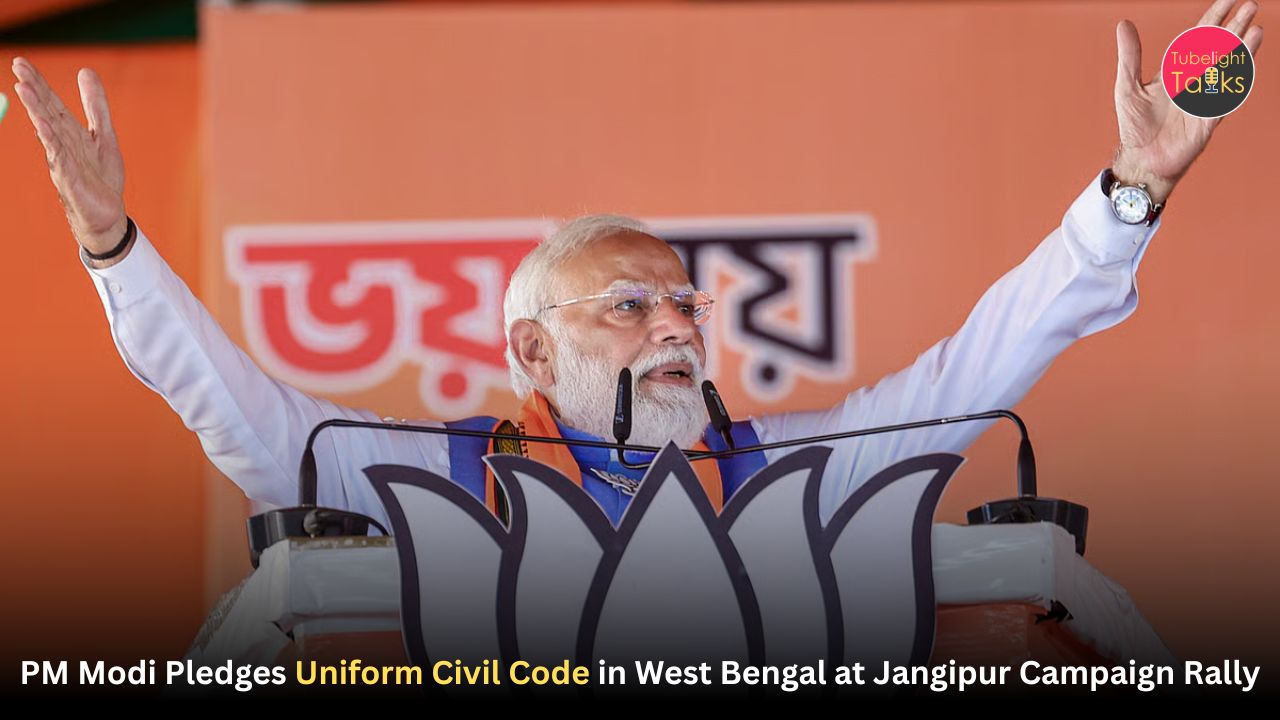
UCC Enters Bengal’s Frontline Campaign as PM Modi Makes High-Stakes Jangipur Promise
Prime Minister Narendra Modi’s campaign stop in Jangipur, Murshidabad, has pushed the Uniform Civil Code from national policy debate into the center of West Bengal’s 2026 election contest. According to multiple reports, Modi told supporters that the BJP would implement UCC in West Bengal if elected, presenting the pledge as part of a wider promise to end appeasement politics and deliver what the party calls legal equality.
The response was immediate, with opposition voices—especially the Trinamool Congress—framing the move as an attack on diversity and rights.
Why Jangipur Was Politically Significant
Jangipur is not just another campaign venue. Murshidabad carries layered political symbolism in Bengal because of its demographic mix, historical weight, and electoral sensitivity. By making the UCC promise there, Modi signaled that the BJP wants to place the civil-code issue squarely inside contested social and political terrain, not keep it as an abstract national talking point.
In campaign strategy terms, location matters almost as much as language. The message was designed to travel beyond the rally ground and dominate the state-wide narrative.
What Modi Is Trying to Frame
Current reporting shows the BJP presenting UCC as a matter of equal rights, national coherence, and legal uniformity. Economic Times also reported that Modi coupled the UCC push with promises related to women’s representation in jobs, police recruitment, and safety, which suggests the party is packaging the civil code not as a standalone legal reform but as part of a governance-and-rights agenda aimed at broadening appeal. In other words, the BJP is trying to argue that UCC is not merely ideological; it is administrative and social reform.
Also Read: Nitish Kumar’s Exit from the CM Residence Signals a Defining Bihar Transition
Why the Opposition Hit Back So Fast
The opposition response has been strong because the issue cuts across identity, constitutional interpretation, minority rights, and federal politics. Reports indicate that Mamata Banerjee attacked the BJP’s UCC position and warned that such a move would harm Bengal’s plural social fabric.
For the TMC, the political objective is clear: convert BJP’s central promise into a state-level fear about cultural erasure, legal overreach, and majoritarian agenda-setting. That means UCC is unlikely to remain a policy discussion alone. It will be fought as emotion, identity, and trust.
A Manifesto Promise Becoming a Core Poll Weapon
The BJP had already inserted UCC prominently into its Bengal manifesto, with Amit Shah previously promising implementation within six months if the party forms the government. Modi’s Jangipur remarks therefore were not isolated. They strengthened an existing campaign line and elevated it with prime ministerial emphasis.
That matters electorally because manifesto points often stay on paper until a top leader repeats them in high-visibility rallies. Once that happens, the promise stops being a document item and becomes a referendum issue.
Beyond Policy: The Deeper Electoral Calculus
This pledge is also part of a broader BJP effort to expand in a state where it has long tried to convert national momentum into a governing breakthrough. AP’s broader election reporting notes that West Bengal remains a major opposition stronghold and a serious test of the BJP’s reach.
In that context, the Jangipur promise is strategic: it sharpens ideological contrast, energizes committed supporters, and attempts to frame the election as a values contest rather than merely a local governance contest.
Risks for Both Sides
There are risks here for all players. For the BJP, UCC can energize support but also consolidate opposition among those who see it as socially disruptive or politically selective. For the TMC, attacking UCC too aggressively may please its base but risks allowing BJP to claim the language of equality and reform. Election campaigns become most intense when both sides believe the same issue can mobilize different voter blocs in opposite directions. That is exactly what seems to be happening in Bengal now.
Why This Issue Will Likely Stay in the Headlines
Because UCC is not a one-day slogan. It connects to law, religion, gender, federalism, and identity politics all at once. It is headline-friendly, debate-ready, and emotionally charged. Campaigns naturally return to such issues because they compress big political stories into a single phrase. Jangipur may have been the stage, but the argument will likely continue across television debates, manifesto releases, public meetings, and legal commentary as Bengal moves closer to the polls.
A Law Gains Meaning Only with Justice
Public life is strongest when reform is guided by fairness, restraint, and moral clarity rather than by division. Sant Rampal Ji Maharaj’s teachings repeatedly emphasize righteous conduct, compassion, and truth-centered living as the basis of a harmonious society. That offers an important reminder in a heated political season: any legal reform earns public respect only when people believe it will protect justice, not merely reward power. Real order begins with ethical intent.
Call to Action
UCC is too important an issue to be reduced to emotional sound bites. Citizens should examine the actual legal implications, constitutional debates, and state-level political consequences before taking a position.
FAQs: PM Modi Pledges Uniform Civil Code in West Bengal at Jangipur Campaign Rally
1. What did PM Modi say in Jangipur?
Reports say he promised that BJP would implement the Uniform Civil Code in West Bengal if the party comes to power.
2. Why is Jangipur important politically?
Jangipur in Murshidabad is a politically sensitive and symbolically important campaign location in Bengal.
3. Has BJP mentioned UCC before in Bengal?
Yes. The party had already included UCC in its Bengal manifesto and senior leaders such as Amit Shah had promoted it.
4. How has TMC responded?
TMC leaders, including Mamata Banerjee, have strongly opposed the promise and argued it threatens rights and diversity.
5. Why is UCC becoming a major poll issue?
Because it sharply separates BJP and TMC on law, identity, and governance, making it a high-mobilisation campaign theme.
Related Stories




Discussion (0)