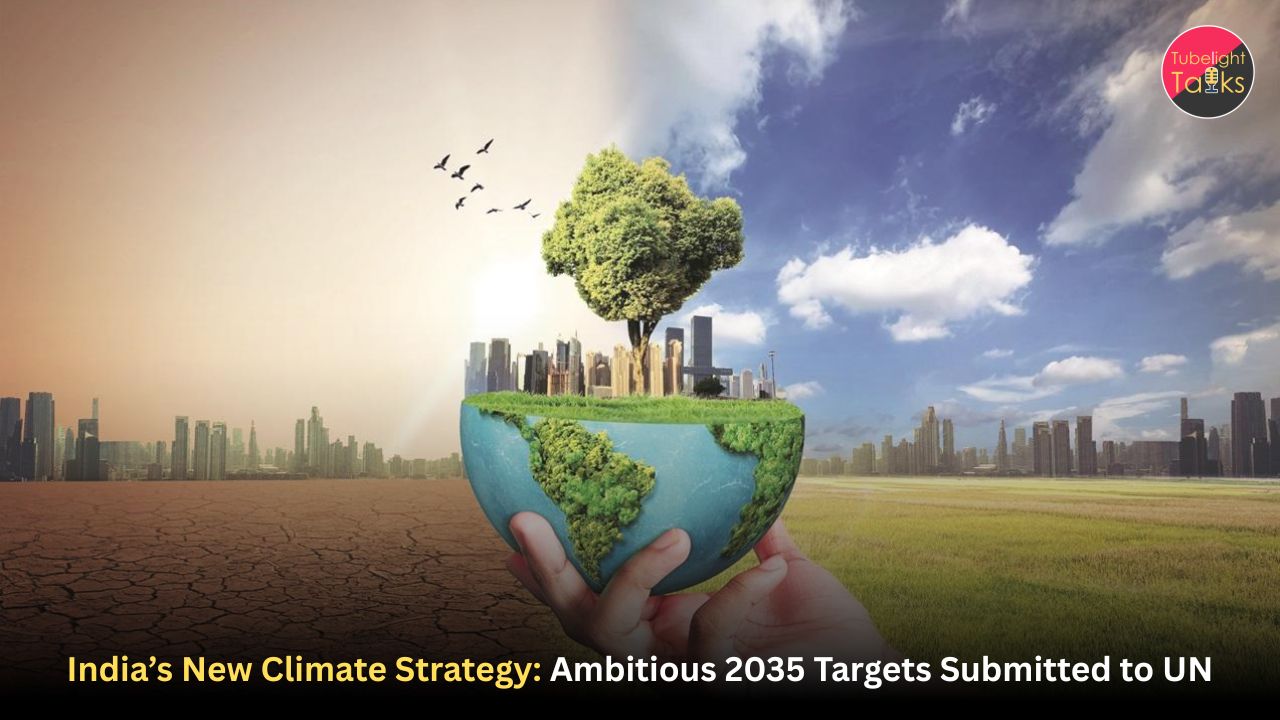
Leading the Green Charge: India’s Strategic Climate Targets for 2035
As the global community intensifies its fight against environmental degradation, India has taken a decisive lead by submitting its revised climate targets for the 2031-2035 period to the United Nations Framework Convention on Climate Change. This submission is a cornerstone of India’s diplomatic and environmental policy, carefully balancing the urgent need for rapid economic development with the ethical responsibility of protecting the planet.
By highlighting its minimal historical contribution to global greenhouse gas emissions, India is calling for “climate justice” while simultaneously outperforming many developed nations in renewable energy adoption.
The Pillars of India’s 2035 Climate Vision
India’s strategy for 2035 is built upon three primary pillars: decarbonizing the energy sector, revolutionizing urban transport, and enhancing natural carbon sinks. The submission outlines an ambitious roadmap to ensure that at least 60% of India’s total installed electricity capacity comes from non-fossil fuel sources by 2035.
This transition is not merely about installing solar panels; it involves a fundamental restructuring of the national grid to handle intermittent renewable sources through advanced battery storage and pumped-hydro projects.
Historical Responsibility and the Call for Equity
A significant portion of India’s UN submission is dedicated to the principle of “Common But Differentiated Responsibilities” (CBDR). India points out that while it is now a major economy, its per capita emissions remain far below the global average. The document emphasizes that developed nations, which built their wealth on two centuries of carbon-heavy industrialization, must provide the promised $100 billion in annual climate finance. India’s stance is clear: it will do more than its fair share, but the global North must fulfill its financial and technological obligations.
Also Read: India Climate Innovation 2026: A Rapid Ascent of the Nation’s Climate-Tech Ecosystem
The Solar Revolution and the ISA
The International Solar Alliance, an initiative co-founded by India, plays a central role in the 2035 targets. India plans to leverage its leadership in the ISA to create a global “One Sun, One World, One Grid.” Domestically, the target for solar capacity has been revised upward, with a focus on PM-KUSUM for solarizing agriculture and Rooftop Solar schemes for urban households. By 2035, India aims to become a net exporter of solar hardware, turning a domestic environmental necessity into a global economic opportunity.
National Green Hydrogen Mission
Perhaps the most futuristic element of the 2035 targets is the heavy emphasis on Green Hydrogen. Recognizing that “hard-to-abate” sectors like steel, cement, and long-haul shipping cannot easily run on electricity, India is betting big on hydrogen produced via renewable energy. The goal is to reach a production capacity of 10 million metric tonnes per annum by 2035. This would not only slash domestic emissions but also position India as a primary energy hub for the hydrogen-hungry markets of Europe and East Asia.
E-Mobility and the Transportation Shift
The transport sector is a major contributor to urban air pollution. India’s 2035 strategy mandates a transition where 40% of all new private vehicle sales and 80% of two-wheelers and three-wheelers are electric. To support this, the government is facilitating the installation of millions of charging stations and offering incentives for domestic battery manufacturing under the PLI scheme. This shift is expected to reduce India’s oil import bill by billions while significantly improving the air quality index in major metropolitan areas.
Afforestation and Carbon Sinks
India remains committed to creating an additional carbon sink of 2.5 to 3 billion tonnes of CO2 equivalent through additional forest and tree cover. The Nagar Van Urban Forest scheme and the Green Credit Program are designed to involve local communities and corporations in mass plantation drives. These efforts are not just about carbon; they are about restoring local ecosystems, protecting biodiversity, and ensuring water security for a population that is increasingly vulnerable to climate-induced heatwaves and droughts.
Also Read: India Climate Action 2026: Low-Cost Reforms Transform Methane Reduction in Rice Farming
Climate Resilient Infrastructure
Recognizing that some level of climate change is already locked in, India is investing heavily in adaptation. The 2035 targets include building climate-resilient infrastructure, from cyclone-proof power grids in coastal Odisha to drought-resistant agriculture in the Deccan plateau. The Coalition for Disaster Resilient Infrastructure, another Indian-led global initiative, will serve as the platform for sharing these innovations with other vulnerable nations in the Global South.
Corporate India and the Green Transition
The 2035 targets are not just a government mandate; they represent a shift in the Indian corporate psyche. Major Indian conglomerates have already pledged to reach Net-Zero well ahead of the national 2070 target. By aligning national UN submissions with corporate ESG Environmental, Social, and Governance goals, India is creating a unified front. This synergy between public policy and private capital is what makes India’s 2035 targets both ambitious and achievable.
The Eternal Environment
While the world focuses on preserving the physical environment, Sant Rampal Ji Maharaj provides a deeper perspective on our true “environment.” He teaches that the current material world is Kaal Brahm’s domain, characterized by decay and destruction. He explains that while we must act responsibly as temporary residents of this planet, our ultimate goal should be to reach Satlok, the eternal world where nature is in perfect, unchanging harmony and there is no suffering.
Sant Rampal Ji Maharaj emphasizes that true “green living” starts with a clean soul, free from the pollutants of lust, anger, and greed. By following the path of Sat-Bhakti, one can move toward a realm that is truly sustainable and eternal. To understand the science of the soul and the eternal world, visit jagatgururampalji.org.
FAQs: India’s New Climate Strategy
1. What is India’s main goal for 2035?
India aims to have 60% of its electricity capacity from non-fossil sources and significantly reduce carbon intensity.
2. Does India contribute most to global warming?
No. India’s per capita emissions and historical contribution are among the lowest in the G20.
3. What is Green Hydrogen’s role?
It is used to decarbonize heavy industries like steel and cement where electricity alone isn’t enough.
4. How does this affect the common man?
It drives the shift toward electric vehicles, cleaner air, and more rooftop solar options for homes.
5. What is “Climate Justice”?
It is India’s demand that wealthy nations provide funding and technology to developing nations to fight climate change.
Related Stories









Discussion (0)